"Pass the parcel. That's sometimes all you can do. Take it, feel it, and pass it on. Not for me, not for you, but for someone, somewhere, one day. That's the game I want you to learn. Pass it on."
Year 11 are working on the Original Writing task for GCSE Paper 1 at the moment, and we spent today’s lesson looking at how to explore an image. There are dozens of ways you can approach this task, and I’m sure people have their favourite methods, but I thought I’d write about this lesson because it’s a lovely way of getting students to generate ideas.
A couple of days ago, I read codexterous’s blog post on creative writing icebergs, and thought that this was a brilliant way of getting students to think about an image that I’ve used for years as a creative writing prompt, Edward Hopper’s 1927 painting Automat. So the Do Now task for today’s lesson was the following slide:
The students very quickly came up with the idea of isolation, and the idea that both images conveyed a sense of cold, whether physical or metaphorical. I prompted them to think of what they knew about icebergs, and from then it was an easy jump to the idea of surfaces and what lies beneath: the fact that you can look at Hopper’s image and have no idea what’s going on in the woman’s mind, or in her life, to bring her to this lonely café.
We then started to look at the painting in more depth. I asked the students to spend a couple of minutes simply writing down what they could see. It was fascinating to see how closely they read the image. They began with obvious points: a woman wearing a green coat and a yellow hat, sitting alone at a table in a café, with a window behind her in which two rows of lights are reflected in the darkness. Then they started to focus on particular details. One of them pointed out that the warmth of the colours: the reds, oranges and yellows. Another picked up on the empty chair opposite the woman. There was a lot of discussion of her clothes. Her coat looks expensive, with a fur collar and cuffs. Her dress is short and low-cut: she looks as if she’s dressed for a night out. She doesn’t have a bag with her. She’s wearing only one glove. She’s looking into her cup of coffee with a downcast expression on her face, emphasised by downward curve of the brim of her hat. I get students to think even further, about the things they can’t see: how much coffee is left in her cup, what time it might be, whether the table is clean or a little bit sticky.
Edward Hopper, ‘Automat’, 1927
From this point, questions abound. Why is she there? Is she on her way to somewhere, or is she going home? If she’s on her way somewhere, does she know where she’s going? How long has she been there? Was there someone sitting opposite her earlier? Has there ever been someone sitting opposite her? Is she running away from something? Why is she so dressed up? Has the person behind the counter noticed she’s there? Are they keeping an eye on her, concerned, wondering whether they should ask if everything’s okay?
We’re going to spend more time developing this piece of writing next week, but today we finished by focusing on that cup of coffee. I asked the students to imagine that they were looking at it, from the woman’s point of view, and to describe it. We shared our ideas, and one student came up with the brilliant idea that it had originally had a heart drawn in the foam on top, but that now the heart had disintegrated, leaving the woman with nothing but the dregs. We talked about what kinds of sentence structures might help us to create a sense of bleakness and despair, and decided that some single-words sentences, and short simple sentences, might be useful. Then we had five minutes to write a description, and I wrote alongside the students. Here’s what I came up with:
There wasn’t time for us to share our work, but that will be the starting point for next lesson. We’ll then think about how to structure a longer piece of writing, using drop-zoom-flash-end as a scaffold. Lots of thinking, lots of rich discussion and hard imaginative work, but the kind of lesson that passed by very quickly.
We’re now three weeks into term, and my Year Twelves are up to Act 1 Scene 4 of King Lear. We haven’t met the Fool yet – he’s waiting until next lesson – but we’re thoroughly immersed, and I’m remembering what a fantastic play this is to teach.
Over the years I’ve witnessed lots of discussions about the teaching of Shakespeare: whether you approach a play through a cold read or a warm read, when to introduce contextual and critical reading, whether to watch a production of the whole play first and so on. My approach varies a little depending on the nature of the group I have in front of me, but I begin by scaffolding students’ reading very heavily. In a typical lesson, I’ll give them a brief overview of whichever scene we’re focusing on – not a plot summary, but a sense of its significance within the play and any major characters we meet. We’ll then read the scene out loud, sometimes splitting it into sections. At the start of the course I ask for volunteers to read, as the start of an A level course can be intimidating not just academically but also interpersonally, especially if you’ve come from a different school or if you’ve spent much of your school career in middle sets and have suddenly found yourself in a group with people who are much more able and confident than you. I don’t want to expose anyone. Once the students are more comfortable with each other, and once I’ve got to know them, I’ll start to allocate parts.
I know some people are sceptical about getting students to read Shakespeare out loud, with memories of stumbling over words and taking ages to get through the play. I think the stumbling is an important part of the learning process and use it as a way of exploring unfamiliar vocabulary. Lots of reassurance also helps to build a sense of your classroom as a safe space where struggling is accepted. I will intervene at points when we’re reading aloud to question and check understanding, drawing in especially those students who aren’t reading and anyone who I suspect might be struggling but not want to admit it. Yes, I could show a professional production of the play, but the exploratory talk is really valuable and part of helping the group to coalesce and learn to trust each other (and me) at this early stage.
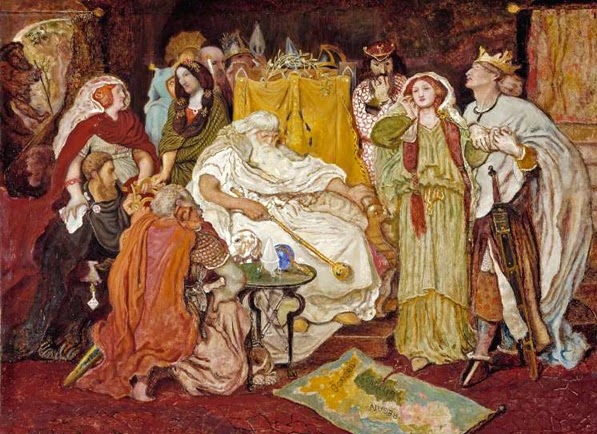
That didn’t go to plan. Cordelia’s Portion, by Ford Madox Brown
Once we’ve finished a particular part of the scene, I’ll display a set of questions designed to make sure students’ understanding is secure and get them to make some observations about aspects of language, character and theme. At this stage, these are fairly simple: I emphasise that our study of the play will be an iterative process and that we’ll add layers of detail and complexity as we go along. Students discuss these questions in pairs or small groups and make notes. We then discuss as a whole class, and I’ll build in further layers of questioning to probe, secure, extend – whatever’s needed at this stage.
We encourage students to use the Cornell method of notemaking, but for our read-through of the play I’ve introduced a slightly modified version in which students split the main part of their page into two equal columns rather than having a narrower left-hand column. Their initial responses to questions go on the left, and then they use the right-hand column to add detail during our discussion. The section at the bottom of the page is used to summarise key points when they revisit their notes.
What about introducing productions? I do this in a number of ways: showing clips of different versions to highlight different interpretations, showing the play act by act so students can consolidate their understanding, and showing the whole play so they get a sense of the overall arc of the tragedy. We’ll go and see a production if one is accessible, but there are a number of fantastic films of stage productions available and these are really useful for focusing on particular scenes. I introduce these once we’ve read the love trial in Act 1 Scene 1. I want students to be able to grasp a number of things about this scene. One is its ceremonial nature. The lack of stage directions in Shakespeare’s plays means that students often skim over the stage directions that are there, but I think it’s really important that they look at the transition from the conversation between Kent, Gloucester and Edmond and the formal, orchestrated quality of the love trial. So we pick up on the sennet that heralds Lear’s entrance, the procession onto the stage of Lear, his daughters, Albany and Cornwall, and the attendants. Those attendants are another thing: we don’t know how many, or what they do, but I want students to think about how they could be used to draw attention to the formality of the scene. Another is the difference between Goneril and Regan: it’s easy to lump them in together, but I want students to be able to pick up on the subtle differences between them. And then there’s the way everything starts to disintegrate, once Cordelia refuses to play the part that Lear has given her. (Because we do Macbeth at GCSE, we draw parallels with the banquet, another scene that starts with a formal entrance and disintegrates into chaos.)
In order to explore these ideas further, I show them clips of two different productions. The first is the 2014 National Theatre production, directed by Sam Mendes, starring Simon Russell Beale as a pugnacious, dictatorial Lear. In this, Lear’s daughters sit at a long table, with Albany and Cornwall, in sombre business suits, beside their wives. Lear sits at a distance on a plain wooden throne, and gets up to pace around as his daughters deliver their speeches. Kate Fleetwood as Goneril is hesitant and careful with her words: Anna Maxwell Martin as Regan is a flirtatious daddy’s girl who gets up to sit on her father’s knee. The tension is heightened by Lear’s close scrutiny of his daughters, and his air of teetering already on the edge of irrationality: Michael Billington, in the Guardian, commented that ‘he has all the aspects of a Stalinesque tyrant and struts around with his massive head thrust forward as if about to devour anyone who crosses him’. There’s also the presence of those attendants, several rows of them in dark military uniforms, who encircle the group on stage. When Cordelia (Olivia Vinall) refuses to play along with her father’s wishes, the enraged Lear upturns the tables and sends his daughters shrinking in fear.
The second clip we watch is from Greg Doran’s 2016 RSC production with Anthony Sher as a very different Lear, dressed in furs and borne onstage by his attendants on a throne enclosed in a transparent case. Again, there’s a sense of distance, created this time by the fact that Lear sits on high, a huge gold disc in the background reflecting the play’s astrological theme. The performative nature of the love trial is emphasised by the fact that Nia Gwynne and Kelly Williams, as Goneril and Regan, speak to the assembled company, their backs to Lear, when delivering their speeches. Sher’s Lear is more godlike than Russell Beale’s, and raises his hand as if channelling some higher power when he banishes Mimi Ndiweni’s Cordelia. Those on stage bow or cower, terrified of what he might unleash.
What’s clear from both these productions is that the trial, of course, isn’t a trial at all. Lear has already decided how he will divide his kingdom, and who will get which portion. Students can see the tension on stage, the power imbalances at play, and recognise the coercive nature of this situation. It’s the perfect example of hubris, and from this point, they’re ready to see Lear’s tenuous grasp on sanity weaken further.
Busy times at work at the moment, but my next King Lear post will focus on the character of Edmond. The clip of Simon Russell Beale’s Lear is here; further clips and interviews are available here. An extract from Anthony Sher’s performance is here; the whole production is available on DVD and Blu-ray from the RSC and can also be streamed from Digital Theatre if you’ve got a subscription.
So. It’s the start of term, I’m back in my own classroom after a year of carting my stuff around six different teaching zones, and I have an A level English Literature group after two years of focusing on English Language. Teaching A level English Literature is – as you might expect – one of my favourite things about my job, and I’ll be starting the year with King Lear, which is just about my favourite text to teach. Wahey! So, as a new-school-year resolution, I’m going to try to blog my way through teaching King Lear, partly as a record of the whole unfolding teaching process, and partly to help anyone who’s teaching it for the first time and could do with a hand.
A word first about the start of the A level course. I know A level English Literature isn’t simply a list of set texts, and that the course should involve a wider exploration of what the study of literature actually involves. In the past, I’ve begun the course by getting students to think about what literature is, why we read the kinds of books we do, how our interpretations are shaped by our own particular contexts, and so on. But I was never convinced that the students were ready for that kind of philosophical reflection at that point in their A level experience. Students are often too nervous to open up in front of peers who they might have only just met, and they can get hung up on not wanting to say the wrong thing. A few years ago, I decided to go straight into the first set text, and start to feed in wider critical concepts once students had found their feet and relaxed a bit. It worked much more effectively, and I’ve never been tempted to go back.
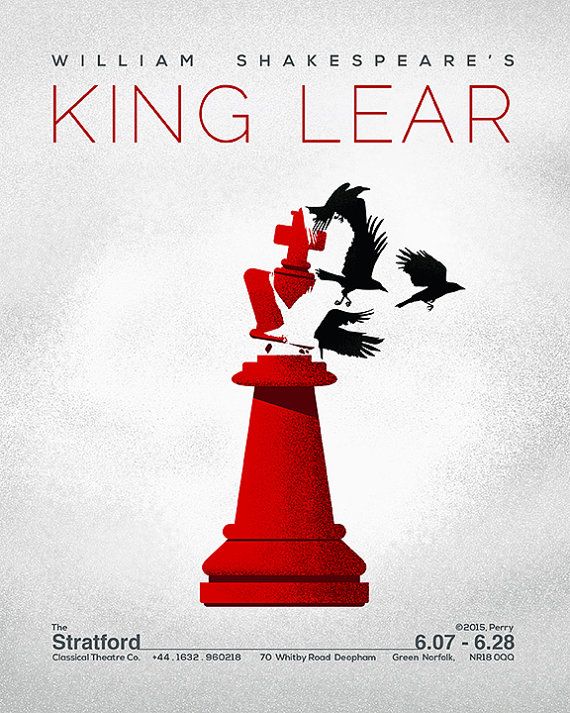
Michael Perry’s King Lear poster design. Source: Pinterest
We do the AQA B specification, and study Aspects of Tragedy and Elements of Political and Social Protest Writing, two big chunky genres that students enjoy. Most of our students have done Macbeth at GCSE, so should know something about tragedy already, and in many ways Macbeth is the perfect preparation for King Lear, raising similar questions about tragic protagonists and the errors that set their downfalls in motion, as well as the nature of kingship. But before we even start to think about tragedy, I put the students into groups, and give them a series of images to explore. I also give them a number of prompts:
What clues do these images give you as to the play’s central characters and themes?
What kinds of locations are featured?
What kinds of emotions are conveyed?
What do you notice about eyes?
What do you notice about crowns?
What do you notice about the number three?
The images I chose are all examples of art inspired by King Lear: theatrical posters, cover designs and illustrations. Pinterest is a great source of suitable images, and students can then, as a follow-up, be asked to find their own images and save them to a shared class Pinterest board. My King Lear Pinterest board is here, and you’ll also find some examples on Michele Walfred’s ‘King Lear Theatrical Posters’ website, which provides a fascinating commentary on some of these images. I chose these images to highlight particular aspects of the play and give students a context for their reading, but it’s important to note that the discussion generated also helps the students to get to know each other and establishes a culture in which they are allowed to be tentative and exploratory, sharing ideas and building on each other’s contributions.
Students then summarise the outcomes of their discussion. It’s interesting to see how much of the play’s plot and themes they can piece together. There are obvious points about tensions and rivalries within families, about the precariousness of the crown and the idea of division. Stefano Imbert’s poster for the Boomerang Theatre Company’s 2006 production depicts a man literally split into three, alone on a hilltop in a bleak landscape. Wieslaw Walkulski’s poster for the 1992 production of Król Lear at the Teatr Nowy in Poznan shows the king’s crown disintegrating and obscuring his vision. Istvan Orosz’s striking poster for the 1999 production of Lear Király at the Petrofi Theatre in Hungary, meanwhile, shows the crown entangled in the bare branches of the king’s mind. Other images – including Clare Van Vliet’s woodcut illustration for The Tragedie of King Lear and the stark poster produced for the Wharton Center’s 2011 production of the play – focus on the threat posed by the elements, while chess pieces and grasping hands also feature.
I then introduce some quotations from the play:
Meantime we shall express our darker purpose.
Come not between the dragon and his wrath!
He hath ever but slenderly known himself.
Now gods, stand up for bastards!
The king falls from bias of nature, there’s father against child.
Who is it that can tell me who I am?
How sharper than a serpent’s tooth it is to have a thankless child!
Thou would’st make a good fool.
I pray you, father, being weak, seem so.
I prithee, daughter, do not make me mad.
You heavens, give me patience, patience I need!
I will do such things – what they are, yet I know not, but they shall be the terrors of the earth.
I am a man more sinned against than sinning.
The younger rises as the old doth fall.
Then let them anatomise Regan; see what breeds about her heart.
The worst is not, so long as we can say ‘This is the worst’.
As flies to wanton boys are we to th’gods; they kill us for their sport.
‘Tis the time’s plague when madmen lead the blind.
Through tattered clothes great vices do appear: robes and furred gowns hide all.
You ever gentle gods, take my breath from me.
I fear I am not in my perfect mind.
O fool! I shall go mad.
I am a very foolish, fond old man.
The gods are just.
The wheel has come full circle.
Why should a dog, a horse, a rat have life, and thou no breath at all?
Students are asked to look for further examples of the themes they’ve identified, and to make connections between quotations. Again, it’s surprising how far students can get in these initial explorations. This week, for instance, my new Year Twelves observed that a number of the quotations make requests of the gods – from Edmond’s ‘Now, gods, stand up for bastards!’ to Gloucester’s ‘You ever gentle gods, take my breath from me’. However, they also spotted that the gods do not necessarily assent to these requests: ‘As flies to wanton boys, are we to th’gods; They kill us for their sport’. They linked this quotation to the recurring images of chess pieces, and the idea that while characters might think they can command the gods, they learn eventually that they are little more than pawns in an indifferent universe.
That was a long way to go in just our first two lessons, accompanied by incredibly rich discussions. Students drew on their knowledge of other plays, and working in groups meant that they were able to build relationships with their new classmates, as well as giving me the chance to observe how they interacted and gauge how confident they were in handling Shakespeare’s language. Their homework for the next lesson was to research the features of tragedy, which is the kind of flipped learning we’ve been doing in English for years without making a fuss about it 🙂
There’s been a lot of discussion on EduTwitter this last fortnight about performative attention. Should students receive a sanction if they look out of the window, fail to smile or sit up straight, or reply to a teacher in a manner that is less than upbeat? I was an extremely diligent student, but there were probably many lessons that I spent daydreaming or doodling in my planner. It didn’t mean that I wasn’t thinking. Beyond the obvious signs of engagement – putting your hand up to answer questions, completing everything that’s asked of you, making progress according to whatever system is being used to assess your work – there’s a whole lot we don’t know about what students are thinking about the things they do in class. Someone who seems to be completely switched off might suddenly reveal themselves to have been thinking very deeply about particular topics. There’s a whole hinterland in our students’ minds that we don’t necessarily have access to.
Admit it: we’ve all been there. (Source: Creative Commons)
Mr Smart, in U. A. Fanthorpe’s poem ‘Dear Mr Lee’, is one teacher who doesn’t recognise this. His student – the anonymous narrator of the poem – has been studying Laurie Lee’s Cider with Rosie and it has fired off things in her brain that Mr Smart has absolutely no idea about. She doesn’t want to write character studies or explore issues about ‘social welfare in the rural community’; she just wants to lose herself in Lee’s wonderfully rich stories of his childhood. She pours all of this out to Lee in her poem, wanting to address him by his first name, even though Mr Smart says this is rude. She wishes she could ‘see everything bright and strange, the way you do’. She’s taken As I Walked Out One Midsummer Morning out of the library, but Mr Smart is scornful about it, and says Spain isn’t like that any more. At the end of the poem, we learn that the narrator has failed her exam, but doesn’t blame Laurie Lee for it. His book isn’t a mere set text, but a book that has lived with her, ‘stained with Coke and Kitkat and when I had a cold.’
I used ‘Dear Mr Lee’ in a conference presentation I gave some years ago, to illustrate some of the tensions that exist in English teaching. What is the study of English Literature all about? Should we prioritise student enjoyment, or disciplinary knowledge? This is what my PhD focused on, and one thing I looked at was the fact that debates that were circulating at the time English literature became an academic discipline in the universities, back in the late nineteenth century, were still apparent in discussions about Curriculum 2000. They’re still going on today. There’s been a lot of discussion on Twitter this weekend about whether English should aim to promote a love of reading, and if so, how it should do this. I admit that I’m on the fence about this. Over the years I’ve heard advocates of the full gamut of approaches, from letting students read whatever they want, even if it’s Charlie and the Chocolate Factory in Year Nine, to listening to canonical texts being read out loud in tutor time. I am deeply sceptical about both of these particular approaches, but I’m not convinced I’ve found the answer, either.
Geek that I am, I’d like my students to be able to enjoy their engagement with the discipline of English, to recognise that there is something deeply pleasurable about analysing texts and writing about them. I’d also love it if my students read outside the curriculum, and as an English teacher it’s part of my job to recommend books and give students the space to share their enthusiasm for reading. There’s a problem, though, when we make English teachers responsible for something that spills over into students’ lives outside school and doesn’t necessarily correlate with their success in curricular English. Some students will love reading, but some won’t. Some will achieve stellar grades regardless of whether they read outside of lessons. Some will be avid readers but struggle to get a Grade 4. We can encourage independent reading and even give space for it in the curriculum, but reading occupies a complex area, a bit of the Venn diagram where ‘something you’re made to do in school’ overlaps with ‘something you do at home if you really want to’.
And while we should strive to create a culture where reading will flourish, we also need to recognise that some of our students might not want to share their feelings about books with us. I remember what it was like to be fourteen or fifteen and immersed in books that I wouldn’t have wanted to discuss with my English teacher in a million years. The thoughts and feelings I had about them were often so complicated and half-formed that I’d have hated to write them up as a book review or record them in a reading journal. Leave me alone, I’d have thought. It’s none of your business what I’m reading. Let’s give students the right to think their own thoughts. And let’s recognise that the daydreamers and doodlers might have a deeper relationship with the texts they read than we will ever know.
The lack of diversity in student reading has been an issue for decades. It has, however, received increased focus over the past year, and has been the subject of a major report, Lit in Colour, produced by Penguin Books UK and the think tank The Runnymede Trust. The report, published last week, found that in 2019, fewer than 1% of GCSE English Literature candidates answered a question on a novel written by a writer of colour, and fewer than 7% answered on a novel or play written by a woman. 82% of the students surveyed did not remember ever studying a text by a Black, Asian or minority ethnic writer.
I’m ashamed to say that at my school, our students’ GCSE diet is overwhelmingly white and male. Shakespeare is compulsory, and while there are three women writers on the 19th-century novel list, I have to say the idea of teaching JaneEyre, Pride and Prejudice or Frankenstein at GCSE didn’t appeal to any of us. Studying a nineteenth-century novel at GCSE is daunting; being assessed on it through a high-stakes end-of-course assessment is even more so, and we wanted something that was both short and accessible (we’ve done Dr Jekyll and Mr Hyde for the last few years, although we’re switching to A Christmas Carol this year). Our modern text is An Inspector Calls. So we haven’t opted for any of the texts that would allow us to offer a more diverse range at GCSE. This is partly an issue of resourcing, but also of expertise. We’re teaching texts that we know, for which we have units of work that include extensive PowerPoints, worksheets, contextual information and sample responses, and for which students are able to find study guides and websites to support their learning. And I’d imagine that many schools, quizzed on their text choices for GCSE, would give a similar answer.
Lower down the school, though, it’s different. We have tried really hard over the past few years to increase the levels of challenge in student reading, and to diversify the texts we use. All our Key Stage 3 students have a reading lesson once a fortnight. This isn’t ideal – I’d rather have a little bit of reading every lesson, rather than one chunk once per cycle – but it’s a product of the way our timetable works and I can’t see it changing. These reading lessons used to take place in our lovely school library, and three years ago we put together reading lists for each year group to shadow and support the units we were working on in class. Our Year Seven reading list, for instance, included texts like I Am Malala, Wonder, The Reason I Jump and Ruby Holler; our Year Nine list contained Persepolis, Oranges Are Not the Only Fruit, Safe Area: Goražde and The Way We Live Now. But there were problems. We had copies of all of the texts, and multiple copies of some texts, but not enough. We didn’t have the funds to buy more. We started a Sponsor-a-Book scheme, to allow parents and local businesses to support us. Some came forward, but not many. And then COVID happened; and bubbles happened; and we couldn’t use the library any more.
Patchwork quilt, USA, c. 1885, displayed in the Metropolitan Museum of Art, New York. (Source: Wikimedia Commons)
This gave us the chance to go right back to basics and look at Key Stage 3 reading again. We decided pretty quickly that we wanted to replace independent reading with a series of class readers. Our stock cupboards gave us some possibilities, but we knew we’d need more books. We secured enough emergency funding to buy two new sets of class readers for each year group, and set about deciding which books we wanted to introduce.
One decision we made very early on was that we didn’t want to buy any books by white men, no matter how good they were. There are lots of excellent books for this age group written by white men, but frankly there are enough white men on the curriculum anyway and we wanted to do something different. So, all of our new books had to be by women. We’re a boys’ school, and it’s vital that our students explore and experience female perspectives. We also wanted greater cultural diversity. However, we wanted to avoid stereotypes. One of my former students commented that ‘books for boys about ethnic minorities always seem to be about gangs, as though that’s the only thing we’re interested in.’ We also felt very strongly that in thinking about diversity, we also needed to consider those of our students who come from Eastern European backgrounds. The Lit in Colour report recognises that ‘the term BIPOC does not notably include White Ethnic Minorities who are the target of racism, such as Gypsy Roma Travellers or Eastern European migrants, although it is sometimes argued to include these groups.’ A growing number of our students are of Polish and Lithuanian heritage, with others coming from Latvia, Romania, Russia and Moldova. In a constituency that registered the second highest proportion of Leave votes in the 2016 EU referendum, and bordering another constituency with the highest proportion, we are acutely aware of the hostility that many of our students and their families experience.
Some choices were easy. The Other Side of Hope by Beverley Naidoo is a cracking read with lots of pace and tension, and opens students’ eyes to the reality of lives that are torn apart by conflict. Coram Boy by Jamila Gavin has long been a favourite, with its story of the sinister Coram Man and exploration of the lives of orphans in eighteenth-century England. And Geraldine McCaughrean’s Where the World Ends, set on the remote Scottish archipelago of St Kilda, is a brilliant example of historical fiction that offered an intriguing counterpoint to life in lockdown.
Other choices required more research. We struggled to find any novels for this age group by writers of Eastern European origin that focused on the experiences of recent migrants. We did, however, choose Between Shades of Gray by the Lithuanian-American writer Ruta Sepetys. Its story of 15-year-old Lina, who is deported from Lithuania with her mother and brother in 1941 and sent to a labour camp in Siberia, asks readers to consider what keeps us alive when we are faced with the most extreme of circumstances. We also chose Sarah Crossan’s verse novel The Weight of Water, narrated by Kasienka, a Polish girl who arrives in Coventry with her mother in search of a better life. It’s a book about not fitting in and finding your own way, making tough decisions and relying on yourself, and appealed to our Year Eights even though they complained that the cover was ‘a bit girly.’
Our final choice was Hell and High Water, by the Carnegie Award-winning novelist Tanya Landman. It’s the story of Caleb, a young man whose father is transported to the Colonies for a crime he did not commit. As Caleb struggles to clear his father’s name, he becomes entangled in a web of secrets, finding out about the exploitation and injustice that exist in the world around him – and discovering more about himself in the process. It’s a pacy, intriguing novel full of courage and adversity, and a great read for our Year Nines.
We’re not there yet. All of our Key Stage 3 students have read at least one novel by a woman this year (in many cases, two or three). Most, although not all, have read a novel by a writer of colour. We’re about to introduce Iridescent Adolescent, the English and Media Centre’s fantastic anthology of short stories, and we’ve got more writers of colour and more working-class writers. We wanted to get beyond the stereotype that novels addressing themes of ethnic diversity that are suitable for teenage boys are all about gang culture and urban violence, and I think we’ve managed to do that. We’d like more sensitive male protagonists. What we’d really like would be a novel by a young writer from an Eastern European background exploring the experience of recent migrants, so agents and publishers, get cracking.
The other thing I’d say about diversifying your reading in schools: finding suitable novels, following up recommendations and discussing which texts would be most suitable for your students, takes time. Reading is an essential part of CPD for English teachers. Just because reading is something we enjoy and spend part of our spare time doing, it shouldn’t be assumed that we’re willing to do this particular CPD in our own time. Schools need to give students time to read, but they also need to invest in time for their English teachers to read as well.
Year Eight are doing The Tempest at the moment, and have done some fantastic work exploring the character of Caliban. I’m writing about it here because it illustrates a number of important things: how the study of literature contributes to critical thinking; how Shakespeare can be used to illuminate contemporary issues; and how sophisticated and thoughtful students can be, if they’re given the opportunity.
The Tempest can be a difficult play to teach. Its links to colonialism and slavery can seem tricky to negotiate: the play is complex enough in itself, with its long scenes and those really boring bits with Miranda and Ferdinand. (I mean, come on.) I’d argue, though, that the play’s historical context, and its stage history, make it ripe for exploring issues of representation and the idea of the Other, and raising students’ awareness of how decisions about how to present particular characters can convey complex messages about ethnicity and power.
With Year Eight, I keep historical context relatively simple. We look at the storm in Act 1 Scene 1, and discuss how a storm at sea might have been created on stage when the play was first performed. Then we examine the backstory outlined by Prospero in Act 1 Scene 2. He and his daughter Miranda have been exiled from Milan, put on board a ship, and left to the mercy of the seas. Eventually, they find themselves on an island. The island has been given by a witch, Sycorax, to her son, Caliban. We note that Caliban’s name is a near-anagram of ‘cannibal’. I remind them of when Shakespeare was writing, and ask them what they know about overseas exploration and exploitation at this time. We note that travellers were setting out from Europe and laying claim to other parts of the world, and share what students know about colonialism. And then we turn our attention to Caliban.
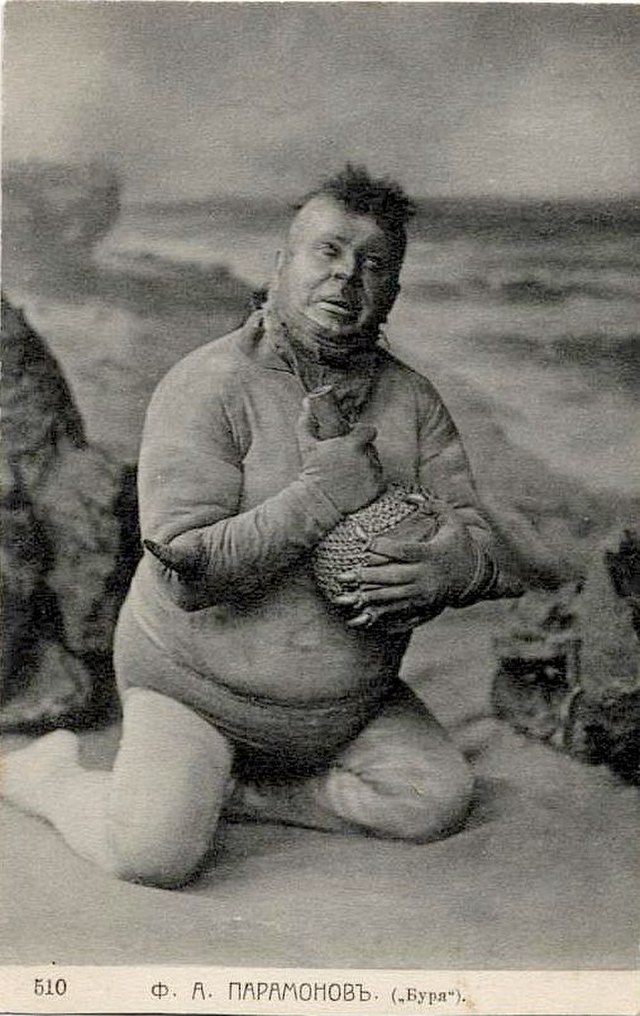
Before our first encounter with Caliban, I ask students to search for images of him in different stage and film productions. Wikipedia proclaims confidently that Caliban is ‘half man, half monster’, and Prospero describes him as a ‘mooncalf’ – a monstrous birth – and as ‘a freckled whelp hag-born, / Not honoured with a human shape.’ Many productions have taken their cue from this, and presented Caliban as a strange being who is only partly human. The students test Google Images to its limits, and find pictures of hairy wild men and strange scaly beasts. In one image he’s a weird lizard-man with green reticulated skin: in another, he’s encrusted with barnacles and seaweed. An early Caliban – Fyodor Paramonov in 1905 – seems almost human, but has enormous claws and spikes on his elbows. Hugh Griffith’s 1946 Caliban is warty and amphibious. A puppet version of Caliban, pictured on the RSC website, looks more like a giant toad.
Fyodor Paramonov as Caliban in 1905, complete with claws and spikes. (Source: Wikimedia Commons)
Many of these beast-like Calibans make the students laugh, but the more human Calibans get them thinking. We look at John Kani’s Caliban for the RSC in 2009, a dignified man who is almost a mirror image of Prospero, and Djimon Hounsou’s Caliban in Julie Taymor’s 2010 film version of the play. We examine Calibans who have scars, who look aggrieved and exhausted. Why might Caliban feel this way? What might have happened in his past?
We place these images alongside the words that Prospero and Miranda use to describe Caliban. He’s ‘a thing most brutish’, a ‘savage’, ‘filth’. He is ‘got by the Devil himself.’ He is, shockingly, addressed as ‘slave’, ‘poisonous slave’, ‘abhorred slave’, ‘most lying slave.’ Prospero calls him a ‘tortoise’, and while the students initially think this is funny, I ask them to think of it alongside the references to slavery: Prospero is insulting him for not doing his bidding quickly enough. The students discuss these descriptions of Caliban, and think about how much more appalling they are if they’re directed at a human being, rather than a giant warty mutant. Is it more effective, I ask, to present Caliban as a monster, or as a human? The penny drops. One student says, ‘If you present Caliban as a monster, you’re kind of justifying why Prospero treats him in the way he does, because Prospero wants to bring him under control. But if you present him as human, it makes Prospero seem worse. Prospero’s more of a monster than he is.’
There are a number of moments in the play that students find particularly intriguing. One is Caliban’s description of how Prospero treated him when he first came to the island:
When thou cam’st first, Thou strok’st me and made much of me, wouldst give me Water with berries in’t, and teach me how To name the bigger light and how the less, That burn by day and night. And then I loved thee, And showed thee all the qualities o’th’isle, The fresh springs, brine pits, barren place and fertile. Cursed be I that did so!
The students are outraged on Caliban’s behalf. ‘It’s not fair!’ one of them exclaims. ‘He treats Caliban as if he’s really special, and then takes advantage of him. Caliban just wants to show off his island, and he ends up having it taken away from him.’ Another is Caliban’s description of the way Prospero’s demons torment him:
For every trifle are they set upon me; Sometime like apes that mow and chatter at me And after bite me, then like hedgehogs which Lie tumbling in my barefoot way and mount Their pricks at my footfall; sometime am I All wound with adders who with cloven tongues Do hiss me into madness.
We look at how the use of a soliloquy here enables Shakespeare to build sympathy for Caliban, allowing a direct communication with the audience. And then there’s the way Caliban reacts to Stephano, and the prospect of a new master. What does Caliban’s behaviour show us about him?
The students are full of ideas. He’s so used to being insulted that he almost throws himself at the first person who’s kind to him. He’s desperate to not be under Prospero’s power. One student points out that Caliban has been treated like rubbish for so long that he can only see himself as someone else’s servant: he doesn’t see himself as worthy of being free. I ask them to link these observations to the images we looked at, and they decide that the humanoid Calibans would just seem ridiculous at this point. One even says that the humanoid Calibans ‘seem funny, but when you think about it they’re actually really offensive.’ Their favourite Calibans, the ones they think are most powerful, are the human Calibans, those who are scarred and dignified. ‘It makes you think’, one boy says, ‘that Shakespeare was saying that colonialism was wrong, because this is what it did to people. It wasn’t just a physical thing, it was a mental thing as well. You never think of Shakespeare as being about things like that.’
The students will be writing their own Caliban monologues next week, exploring Caliban’s feelings about the island and the way Prospero has treated him. We haven’t read the whole play – we’ve missed out the Miranda and Ferdinand bits – and there hasn’t been a GCSE-style extract-based question in sight, but there has been a lot of rich discussion and close reading, and a real awareness of why representations matter.
There’s an opposition that students frequently draw between English and Maths. In Maths, you’re either right or wrong. In English, it’s less clear-cut. Maths is straightforward, unambiguous. English is all airy-fairy. For many students, this means two things. The first is that if you get a disappointing mark in English, it’s because your teacher either doesn’t agree with you or doesn’t like you. This seems to persist no matter how much work you do with mark schemes and peer assessment, no matter how many worked examples you show them or how much time you put in scaffolding their responses and helping them to improve. If they don’t do as well as they thought they should, it’s not because they didn’t refer to the text or forgot to comment on the effects of the writer’s use of language, it’s because you once told them off for talking too much during a cover lesson in Year Seven and three years on, you still hold a grudge.
The second thing that students take from this opposition is that in English, there’s no such thing as a wrong answer. Of course you can get spellings wrong, and make factual errors like mixing up Duncan and Donalbain and claiming that Jane Austen was a great example of a Victorian novelist, but apart from that you can say anything you like in English. Poems can mean whatever you want them to mean, as long as you can argue your case. Simple, yes?
Well, no. The truth is, you can make mistakes. I’d be the last person to say that a poem has only one single meaning: ambiguity is one of the things that makes studying literature so intriguing, and reducing poetry to a simple act of decoding – trying to prise out a single, ‘correct’ meaning from between the lines, as if you’re trying to second-guess what the poet wanted to say – is one way of killing it stone dead. But there are ways of getting it wrong, or at least, of getting it not quite right.
There are hundreds of examples I could give of readings that are in some way flawed or mistaken. I recently came across an interpretation of Vernon Scannell’s poem ‘Nettles’ that saw the relationship between the narrator and his son as distant and hostile, claiming that the military language in the poem hinted that the two were constantly at war with each other. Absolutely not: Scannell applies this language to the nettles (a ‘fierce parade’, ‘tall recruits’) that have hurt the narrator’s son, not to the relationship between them. But the example I’m going to look at in detail is a bit more complex. It concerns Carol Ann Duffy’s poem ‘War Photographer’, originally published in 1985, and one of the big hitters in the AQA Power and Conflict anthology. It’s a fantastic poem, addressing themes of trauma and the importance of bearing witness, and many of my students say it’s one of their favourites. In the first stanza, the war photographer is at home, developing his photographs:
In his dark room he is finally alone with spools of suffering set out in ordered rows. The only light is red and softly glows, as though this were a church and he a priest preparing to intone a Mass. Belfast. Beirut. Phnom Penh. All flesh is grass.
Because students nowadays are so accustomed to digital photography, I introduce the poem by showing images of a darkroom, including an enlarger, trays of developer and fixer, a series of prints hanging up to dry, and reels of film. We talk about the dark, and the sense of relief in being ‘finally alone’. The students want to know about the list of place names, and the conflicts that happened there. We find the cities on a map. We note that the names might be different if the poem had been written more recently, but that the point Duffy is making would remain the same: that conflicts happen everywhere. I show a picture of a Catholic priest consecrating the Host during Mass, and we think about the idea of transubstantiation, of capturing light and turning it into an image. Sometimes, somebody will make an observation – a bit hesitantly, just trying it out – about the photographer’s duty being just as sacred and important as the priest’s. They might even add something about the idea of ritual, drawing out the analogy by referring to a set of steps carried out in a precise order. If they do, I will nod enthusiastically, because it’ll be one of those moments that warms my English-teacher heart and makes me remember that I do actually love my job. We need those moments, every now and then.
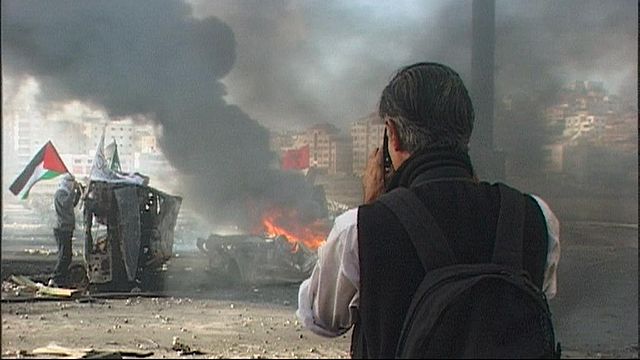
From the 2001 Swiss documentary ‘War Photographer’, by Christian Frei and James Nachtwey. (Source: Wikimedia Commons)
So far, so good. But there’s a problem, and it’s there in the second line. It’s those pesky spools. In class, we talk about the fact that it is comforting, after experiencing something difficult, to organise and tidy, and that the ‘spools of suffering set out in ordered rows’ reflect the photographer’s need to process his experiences and impose an order on them, just as he’s processing his rolls of film. But then the students go home, and because they are mostly diligent students, they go on the Internet and see what else they can find out about the poem. And what they find, almost invariably, is one of several websites assuring them that the ‘spools of suffering set out in ordered rows’ are not reels of film in the darkroom waiting to be processed, but a reference to the white rows of war graves in military cemeteries.
Well. Rows of graves are certainly ordered, and they definitely represent suffering. But they’re not ‘spools’, and they’re not there in the darkroom with the photographer. And actually, there’s no reference in the poem to the idea of the war photographer visiting any military cemeteries. Instead, it’s quite the opposite: the people he has photographed are civilians caught up in conflict, ‘running children in a nightmare heat’ – a reference, perhaps, to Nick Ut’s famous image of nine-year old Kim Phuc – and a dying man and his wife.
These troublesome war graves represent, for me, something that students often do when faced with poetry. They think that poems must be difficult, and that meanings must be hidden. Everything a poet says must refer to something outside the poem entirely. So the ‘spools of suffering’ can’t possibly be rolls of film, because that’s too obvious, too logical and un-poetic. They have to be something else – and because the poem is about war, they must be gravestones.
Why can’t they be gravestones? This is where it gets tricky, because this is where students have to learn how to cope with tentativeness and hesitancy, qualities that aren’t necessarily prized elsewhere in the curriculum. If a student wants the spools of suffering to be gravestones, because someone on the internet has said that they are, I’ll get them to read the first few lines again, and remind themselves of what’s actually going on: the photographer is in his darkroom, preparing to develop the photographs he’s taken at scenes of conflict. I’ll then ask them why his spools of film need to be set out in ordered rows, and how that might help him. We’ll look at the neat and tidy structure of the poem, with its six-line stanzas and regular rhyming pattern. And yes, the line might well carry echoes of war graves, but they are just echoes rather than a direct reference, and the more important and subtle point to make is the one about organisation and order. I might go on to model some sentence starters for them, so they can see how it’s possible to show that you’re playing around with potential interpretations, making your thought processes explicit.
All of this requires a lot of care. Students need to read closely, and understanding this particular line takes a certain amount of empathy and imaginative projection. They need to be able to evaluate these two potential interpretations and decide which one is more convincing. With some poems, they might also need to know something about context: with others, this might not actually help. They can’t apply a formula or work through an algorithm; they need to develop a feel for poetry and how it works. What they also need to realise is that just because something is on a revision website, it’s not necessarily right. There are so many resources available these days, so many knowledge organisers and YouTube videos, that set texts can easily become reduced to a package of easily-digested ‘facts’, learned and parroted without needing to think about them.
The critic Valentine Cunningham has written about the quality of tact in reading. Cunningham has his detractors (John Kerrigan described him in the London Review of Books as ‘one of the least tactful persons on the planet’) but I think this is a really helpful concept. It conveys the need for sensitivity, for the application of judgement. Significantly, tact is also a quality that takes time to develop. Because of this, it can be allied with what Maryanne Wolf describes in her 2018 book Reader, Come Home as ‘cognitive patience’, something that is eminently neither rapid nor whizzy, but that is nevertheless hugely important. We perhaps don’t build enough time into the curriculum for this kind of skill, and this is something we need to put right.
Several years ago, one of my GCSE students stayed behind to talk to me at the end of our final lesson. He was a bright lad, and could have done English at A level if he’d wanted to, but his heart had always been set on a career in science. He still wanted to thank me, though. ‘I’ve really enjoyed doing English,’ he told me. ‘I know I won’t be doing it next year, but it’s taught me how to look at things really carefully.’ It’s one of the best things any of my students has ever said about studying English. If we can teach young people to look at things carefully, to be tactful and patient and to read with a critical eye, that’s an enormous contribution to society.
Poetry is scary. Lots of students find poetry hard, because it seems to demand a different kind of reading to other types of text. The very fact of being arranged differently on the page – with shorter lines, sometimes in groups, sometimes with rhyming words at the end – means that it clamours for a certain kind of attention. Consequently, poetry in the classroom is often surrounded by a haze of mysteriousness, a sense that it needs to be decoded using a certain set of operations performed in a certain order, the English equivalent of quadratic equations. Some people even advocate using acronyms to teach students how to analyse poetry, like SMILE (structure, meaning, imagery, language, effect) or FLIRT (form, language, imagery, rhyme, themes). But poetry is not mathematics, and you don’t have to apply some kind of literary BIDMAS in order to find something to say about a poem.
There are hundreds of ways of approaching poetry in the classroom, and these will vary from class to class, from teacher to teacher, and from poem to poem. English-teacher geek that I am, I enjoy the process of working out how to introduce a particular poem. Sometimes, I might use a word cloud to get students to explore patterns of vocabulary. Sometimes, I use an image or series of images (my first lesson on Carol Ann Duffy’s poem ‘War Photographer’, for instance, begins with images of photographs being developed in a darkroom, a process that students in our digital age often know very little about). Sometimes, I read the poem out loud, and then ask the students to read it out loud too, so they can focus on the sounds and their effects before they start to think about meaning. (Try this with William Blake’s ‘The Tyger’, and – if you’re feeling brave – get them to stamp out the rhythm.) And sometimes, I choose just one line, and focus on that. It’s an approach that I once heard described as ‘teaching from the microcosm’, and that seems as good a name as any.
Here’s an example. It’s the opening line of Wilfred Owen’s poem ‘Exposure’:
I put it on the board, and ask students to spend a few minutes jotting down their thoughts. Which words and phrases seem to be particularly important, and why? Do they notice anything about how the words sound? (I read the line aloud several times while they’re thinking.) Who might be speaking, and why? I’ll then ask students to share their ideas with a partner: this helps them to test out their initial thoughts and gives them some reassurance that they’re not going to say something completely off-track. Then I open the discussion to the whole class.
It’s often the kind of discussion that takes far longer than you’d expect, because there are lots of things that you can say about this line. The first thing that students often pick up on is the alliteration, all those ‘s’ sounds: two of them in ‘merciless,’ one in ‘iced’, one in ‘east’, one in ‘winds’ and one in ‘us’. Say the line out loud and it’s a bit of a tongue-twister. But it’s easy to pick out alliteration, I tell the students: you have to be able to explore the effect it creates. The clue is in the sharpness of the sibilant sounds, which mimic the relentlessness of the wind. (Some students think sibilants are always soft and gentle, but try that interpretation with this line and you’ll come unstuck.) Then there’s the personification of those winds. They’re ‘merciless’, they ‘knive us’. What kind of action does ‘knive’ suggest? The students talk about stealth and malevolence, a sense of intent. Who are they kniving? Is it one person, or a collective? It’s a collective: the pronouns are first-person plurals, ‘our’ and ‘us’. Everyone’s in the same situation. And it’s a miserable one. Look at those long vowel sounds in ‘brains’ and ‘ache’, drawn-out and weary. ‘A brain ache sounds worse than a headache’, a student commented once. ‘It’s deeper. It’s right in your core.’ And then there’s that ellipsis at the end, those three dots that trail off and leave us hanging. All that, from just twelve words.
Once you’ve discussed all this, the rest of the poem presents few challenges. It’s about the feelings of a group of men in a trench in the First World War, freezing cold, waiting for something to happen. It’s a miserable existence. It’s night-time, and the men struggle to stay awake. Bullets, when they come, are ‘less deadly than the air.’ There’s Owen’s characteristic use of half-rhyme, creating a feeling of unrest, and the lines all seem a little bit too long. Except, that is, for the refrain at the end of each stanza, and the repeated line: ‘But nothing happens.’
There are things you can say about the title, too. I get the students to find out what ‘exposure’ could potentials mean. There’s being exposed to the elements, of course, and the medical condition that can result from this. But there’s also ‘exposure’ as in revealing the truth, bringing to light something that might otherwise go unnoticed, and students might be able to make a link between this meaning of the word and Owen’s desire to challenge the view of war as noble and heroic.
See? Lots of thoughtful, close reading; lots of scope for engagement. And not an acronym in sight.
Top reads on the teaching of poetry: Barbara Bleiman’s chapter on poetry in her brilliant book What Matters in English Teaching (English and Media Centre, 2019), Sue Dymoke’s chapter on poetry in Teaching English Texts 11-18 (Continuum, 2009) and Andrew McCallum’s Creativity and Learning in Secondary English (Routledge, 2012). If you want to get creative, Kate Clanchy’s How To Grow Your Own Poem (Picador, 2020) and, of course, England: Poems from a School (Picador, 2018) are fantastic. Sharon Creech’s Love That Dog (Bloomsbury, 2002) offers a different perspective on what poetry can do for students, and I really need to write a Teacher Feature on Miss Stretchberry at some point. You also need to read anything at all by Julie Blake, especially on the importance of reading poetry out loud and learning by heart.





 Passing It On