Adoption stories

Here’s a story I’ve told before, elsewhere. When the Dude was about eight, I took him round to a friend’s house to play. The friend’s little brother was there too. ‘Put your hand up if you’re adopted!’ demanded the little brother, and the Dude dutifully did. ‘You’re going to go to prison!’ the little brother announced. ‘All adopted people go to prison.’

I have no idea where exactly the little brother got that idea from. I don’t think it was his parents – at least, I hope not – but, let’s face it, it wouldn’t need to be, because there are enough stereotypes of adopted and care-experienced people around to sink any number of proverbial battleships. I’ve read so many books featuring adopted characters over the years, and watched so many films and television programmes, that I could list them in great detail, from the saintly adopted child who brightens everyone’s life to the monstrous cuckoo in the nest who destroys his or her adoptive parents with a cold, glittering joy. That character slinking around on the sidelines, unable to form relationships: my spidey senses will start to tingle, and when it’s revealed that they’re adopted, I’ll add them to my mental list, cursing the fact that the Dude and his adopted and care-experienced peers have yet another stereotype to battle against.

Not your actual adopted child. (Source: Wikimedia Commons)

A few months ago, I read the latest novel from one of my favourite novelists. It featured not one but two adopted characters, and it was disappointing, to say the least. The fact that these characters were adopted served no other purpose other than to underline the fact that they were both a bit odd. They weren’t outright villains – they weren’t criminals, and they weren’t even seething with resentment – but the reader clearly wasn’t meant to like them. They were depicted as being a little bit ridiculous, and a little bit mercenary. Their adoption wasn’t central to the plot in any way. There was no big reveal about their biological parents, and the fact that they were adopted was only mentioned a couple of times in the whole novel. It only seemed to be there to mark them out as other, and to underscore the fact that their relationship with their parents was less than perfect. Not dysfunctional, not unhappy; just a little bit distant, and unaffectionate.

It’s a pity. This particular writer is skilful enough to create a slightly odd family without needing to make it an adoptive family. It seemed to be used in this particular novel as a complacent form of shorthand, resting on a shared understanding between writer and reader. Look! This is why they’re a bit weird! And it’s an example of how such stereotypes slip through the writing and editing process unquestioned, as if adoption and care experience are somehow up for narrative grabs.

In the Epilogue to her extraordinary memoir Ootlin, Jenni Fagan writes of the stories we are told about who we are. Fagan, who grew up in the care system, points out that ‘for many of us those stories are complex and sometimes wholly against our own well-being.’ Other people were afraid of her, or refused to accept her, or didn’t bother to find out who she really was, ‘because they often could not get beyond what I represented as a child in care.’ Having an identity projected onto you, being ascribed certain characteristics purely because of the circumstances of your early life: this is something we shouldn’t accept for any of our children, and we shouldn’t allow our publishing and entertainment industries to perpetuate these stories, either.

It was excellent, then, to read the BBC’s article on stereotypes of adopted characters in films, because I have felt that for far too long, the entertainment industry has made vast amounts of money out of peddling the kinds of images that would be unthinkable if they related to any other minority group. Money that could, incidentally, be diverted towards providing support, because the other big adoption-related story in the news over the last few weeks has been the story about adopted children being returned to care because of a desperate lack of help. Young people suffering the effects of developmental trauma, and families unable to cope with the violence and aggression that can result from this: it’s an appalling read. As a society, we need to do better.

My son’s reply to his friend’s little brother was brilliant. ‘I think you’ll find’, he stated, ‘that actually, most superheroes were adopted.’ And indeed they were, but that’s another stereotype. There is danger in a single story, as Chimamanda Ngozi Adichie points out, but there is danger, too, in a bifurcated story, a binary division. It would be really good to see some adopted characters in fiction who are just going through life like their non-adopted peers, neither misfits nor superheroes, but people treated with nuance, understanding, and dignity. And it would be even better to see an increased understanding of the reality of life as an adoptive family, so that the desperate struggle for support can be alleviated.
Seamus and Year Eight and me

In Reading Lessons, I write about the shadow colleagues who share my classroom and help with my lessons: the novelists and poets and playwrights without whom I couldn’t do my job. This week, with Year Eight, it’s been Seamus Heaney. Lovely Seamus: I think he’d have been a good person to work with, slightly irreverent but also deeply wise, with a well-honed sense of the difference between the things worth cherishing and the merely faddish. He’d have a secret biscuit stash, too.

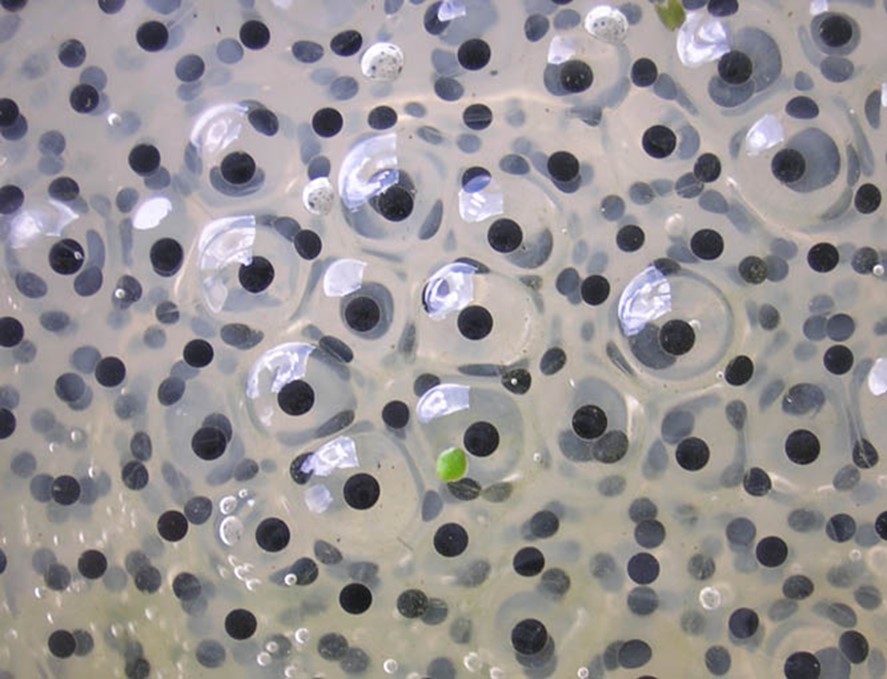
Frogspawn!

We’ve been teaching Year Eight about close reading, Seamus and me. Our Year Eight poetry unit – now in about its tenth iteration – is called ‘Mysterious Beasts’, and focuses on poems about different creatures. We explore William Blake’s ‘The Tyger’, Ted Hughes’s ‘Pike’, and U.A. Fanthorpe’s ‘Not My Best Side’, alongside a number of poems from Robert Macfarlane and Jackie Morris’s beautiful book The Lost Words. And we write our own poems, experimenting with diction and form, making careful choices of language. Before Christmas, we wrote a haiku about a pangolin, trying to find the exact way of conveying its pineconey strangeness. You can’t waste words with a haiku; they’re brilliant for developing precision.

This week, we looked at Heaney’s poem ‘Death of a Naturalist’. It’s been the first week back after Christmas, so we eased ourselves in with a wordcloud that allowed us to explore some of the key vocabulary in the poem. We noticed the rhyme of ‘clotted’ and ‘rotted’, and the onomatopoeic ‘slap’ and ‘plop’. We used dictionaries to find the precise meanings of ‘obscene’ and ‘coarse’, and talked about the fact that ‘coarse’ can be both literal – a prickly item of clothing, a hessian sack – and metaphorical. We talked, above all, about unpleasantness: about smells and textures and associations. We said words out loud. Slap. Slime. Spawn. Say them, and draw out the ‘s’ sounds: there’s something there to luxuriate in, to enjoy.

Introducing the poem: our wordcloud

This gives us a neat springboard to talk about how often, as children, we relish exploring things that would make our older selves squirm. The boys share stories of digging up worms, playing in mud, squishing up their food and making shapes with it. Before they’ve even seen the complete poem, they’ve started to inhabit the sensory world that Heaney creates in it, and from this point, it’s just a short jump to the flax-dam in the townland, sweltering in the heat of the sun.

We listen to Heaney reading the poem out loud, because it’s best in his voice. Here he is: give him a listen. We listen twice, and try to identify the story he is telling. The first part of the poem is relatively simple, the boys decide. It’s a little boy who collects frogspawn, and is fascinated by it. He fills jam-jars full of it and watches as the tadpoles hatch. But then, in the second part of the poem, something changes. There’s a threat, a fear. The boy is surrounded by frogs and feels their anger. There is something disgusting about them that wasn’t there before. They are an army, intent on revenge. We talk about what has happened. They want vengeance, one boy volunteers, because the narrator stole their children and abandoned them, and it’s a perfect summing-up of what Heaney describes.

This is one of my favourite poems to teach, and this Year Eight group is one of my favourite classes. They’re sparky, full of ideas, but biddable. We have routines. Countdowns from three and then silence. If I stand at the front of the room with my hands on my head, they have to stop what they’re doing and put their hands on their heads, too. They like the predictability of it. They like lots of positive framing – well done to all those people who’ve put the heading and date and underlined it neatly – and rewards. And they like to discuss. One of my PGCE lecturers, back in the mid-90s, talked about students as being divided into ‘oopidoops’ and ‘begetters’. The oopidoops were the lively ones, like shaken bottles of lemonade, needing to be channelled and directed. The begetters would just be getting on with what they were supposed to be doing. This class is about half and half. I have a fantastic TA who is brilliant at spotting when someone needs a fidget toy, a resistance band for some sensory input, a quiet moment outside. He’s also brilliant at suggesting alternative interpretations and offering thoughts. We bounce ideas off each other and enable the students to see that in English, there are shades of meaning waiting to be explored, ambiguities that don’t need to be resolved and closed down. It’s okay to hold multiple possibilities in your mind.

It’s a double lesson, and we need a movement break by now. An hour and forty minutes is a long time to sit, when you’re twelve. We stand up. A necessary stretch; some shoulder rolls and finger wiggles. Some jumps and hops to discharge some of that oopidoop energy. Then some smaller movements, borrowed from my Pilates instructor, to get them focused and concentrating again: sway into your toes and then into your heels, without taking your feet off the floor, and do this slowly, breathing in as you go forwards and out as you go back. Two minutes and we’re working again. We’re looking more closely at Heaney’s descriptions now, and at how he blends pleasure and disgust. We examine how he builds the setting, and relate this to the ditches and streams that the boys know, what they smell like in summer when they’re thick with vegetation. We discuss the precise meaning of ‘sweltered’, the stickiness and discomfort. We explore the contradictoriness of ‘gargled delicately’, and I introduce the term ‘oxymoron’, easing the vocabulary in where it’s needed rather than teaching it in isolation.

I ask the boys their favourite line. ‘But best of all was the warm, thick slobber of frogspawn’ is the overall winner. They love the sensoriness of it, that childlike delight – best of all – in the warmth and ooze. They love the word ‘slobber’, and say it, just like ‘spawn’ and ‘slime’. They listen to each other, and build, consciously, on each other’s contributions. When they write their ideas down, they’ve got lots to say. Sometimes, they need a bit of help shaping it. ‘I know what I want to say, but I’m not sure how to say it’, one boy tells me. I ask him what he wants to say, and it’s perfect. ‘So can I just write that down?’ he asks. I reassure him that yes, he can, and he’s off, pen whizzing across the page.

I could do all of this in a very different way. I could stand at the front and tell them, line by line, what the poem means. They could copy down my annotations and then write a perfectly-scaffolded paragraph. But the poem would stand apart from them, somehow. As it is, they’ve inhabited it. They’ve explored it, stage by stage, peeling back layers, making connections. This isn’t child-led ‘discovery learning’. It’s carefully structured and relies on a deep understanding of both the poem and the class. It’s a lot harder than lecturing from the front would be. It certainly requires more energy, more presence in the room, more of a sense of who’s thinking what: whose ideas to draw out a little bit further, who to ask next, who needs a bit of help to articulate what they’re thinking. By the end, I need to sit down somewhere quiet.

But this energy is what makes it all worthwhile. Years ago, Richard Jacobs described English teachers as like lightning conductors for the relationship between the text and the student, and that’s what teaching this particular class is like. We had a good time, Seamus and my TA and Year Eight and me, and it reminded me why I like my job so much.

On the Move

‘Man, you gotta Go.’

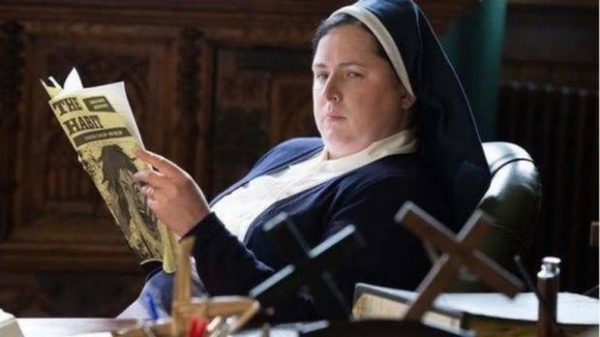
It’s ten years ago this week since I left Old School. I was at Old School for eighteen years: give me a job and I’ll stick around. So departures are on my mind at the moment, as are all the feelings around leaving and staying and moving on. It was our last day yesterday, a day of complicated emotions for various reasons, and so here I am, with a post about Thom Gunn and Sister George Michael from Derry Girls, and if Thom Gunn and Sister George Michael have ever previously featured in the same piece of writing then I’d like to know about it.

Sister George Michael, looking sceptical

A long time ago, just before we adopted The Dude, The Husband and I went to Bulgaria. We had a phase of several summers when we went to various lesser-visited parts of eastern Europe to climb hills and drink wine, and this particular part of Bulgaria was just about the most remote place we’d ever been to. I was apprehensive and excited all at the same time, and the apprehension and the excitement were heightened by the fact that a few days after our return, we’d be meeting social workers to discuss a little boy with red hair who might eventually become our son. We were staying with the friend of a friend the night before our flight, sleeping in her adult daughter’s old bedroom, still filled with books and folders and student posters. Pinned to a wall was a handwritten copy of Thom Gunn’s poem ‘On the Move’. I’d never read any Thom Gunn before, but I stood and read. The poem spoke of transition, of waiting to be started and not quite knowing what would come next. There are some times in your life when you come across the perfect poem for a particular moment, and that evening in the summer of 2006, ‘On the Move’ was absolutely it.

I quoted from ‘On the Move’ in one of the leaving cards I wrote last week. In one of my favourite parts of the poem, Gunn writes of how

Men manufacture both machine and soul,
And use what they imperfectly control
To dare a future from the taken routes.

It strikes me that daring a future from the taken routes is essentially what we all do in life. We wing it, make it up as we go along, see how it works out. Most of the time we’re oblivious to this, but when we leave a job to start a new one, or to do something else entirely, we become more acutely aware of it. We don’t know whether it’s going to be the right move, but we take a deep breath and let the future happen. We move toward, toward, trying our best with whatever we imperfectly control.

Sometimes we go, and sometimes we stay. The magnificent Sister George Michael, in Derry Girls, is the headmistress of Our Lady Immaculate College. The school is in her blood. She is sarcastic, withering and impatient, in her wimple, pleated skirt and chunky Aran sweater. (My favourite Sister George Michael bits are when school swot Jenny Joyce and her friends appear in assembly, staging well-meaning drama performances on themes such as social division or singing about the wonderful possibilities of Monday morning: her sighs and eyerolls are legendary. After one particular horror, on the Good Friday Agreement, she comments, ‘The conflict here has led to so many terrible atrocities. And now we must add your play to that list.’) But then she is told, by her bishop, that it is time for a new challenge. Familiarity distracts us from the main purpose. People get too comfortable, and when that happens, a change is the best thing all round.

I wondered, for a long time, about whether I should leave Old School. In the early years, the main reason I stayed was because my mum had died, very suddenly, at the beginning of my second year. I’d lost both of my parents in just under four years: I felt rootless and in need of somewhere to belong. There are times in your life when you need a comfort zone. Several times, over the years, I looked at other jobs. I even went for an interview, for a job that seemed perfect, and realised on the way home that I absolutely didn’t want it and didn’t want to leave. I loved being part of a community, the continuity that being a long-term member of staff gave me. This is something that’s often undervalued. The teachers who stay give students a sense of security, a feeling that they can always go back to a place where they’ll be known. Bumping into former students in town, seeing people grow up and move away and then come back: you become part of so many lives in all manner of intangible ways.

When Sister George Michael is told that it’s time for her to leave, we see a rare period of soul-searching. She sits alone in her study and ponders, the lights dimmed, watched over by statues of saints. And then she tells the parish priest that her decision has been made. She has had a whiskey, and a word with herself. She has rung the bishop and told him that she makes a difference. ‘The girls know that. The parents know that. I’m not ready to leave. Try and force me to and there’ll be an awful fuss, I said.’ There wasn’t much the Bishop could say.

It took me a long time to come to terms with leaving Old School. I’m happy where I am now, but I know that one day it’ll be time for me to pack my things into my metaphorical red-spotted handkerchief , and dare a different phase of my future from the routes I choose to take. Good luck to everyone who’s on the move this year, and best wishes to everyone who’s decided to stay.

Song 10

I was rubbish at PE at school. Something marked me out, quite early in primary school, as being very definitely substandard. I couldn’t run fast enough, couldn’t catch a ball, and as for hitting anything with a rounders bat – well, forget it. When it came to picking teams, I was either last or next to last. And even though there were some kinds of exercise that I liked – walking, and horse riding – these weren’t the kinds of things that counted at my school, where if you weren’t good at netball or hockey or athletics, you were marked out as a target for all kinds of scorn.

It took me a long time to get over my crap-at-PE funk. I started hillwalking, in my early 30s, and walked in various bits of eastern Europe: The Husband and I did the Yorkshire Three Peaks the year we turned 40, and a year later we did the Hadrian’s Wall long-distance walk with The Dude when he was nine. Then, suddenly, everyone was running. Even the unsportiest people I knew were running. They were doing Couch to 5k and loving it, and then they were doing Parkrun and loving that, too. So I bought myself a pair of running shoes, and before long, I was running, too. I signed up to Parkrun; I did the local 10k and ran all the way through lockdown. I led a Couch to 5k group for staff at school. And then it all kind of fell apart.

This is, very obviously, not me. (Photo: runninglife.com.mx)

It wasn’t anything dramatic. I got a few niggly injuries; I had a run-in with plantar fasciitis and a dodgy ITB. I joined a few Facebook groups for women runners and started measuring myself, a bit too much, against what other people were doing and judging myself, again a bit too much, for not being able to do the same. I  listened – yet again, a bit too much – to people who heaped scorn on runners who needed to take water on anything less than a 10k run, and who looked down on Parkrun because running 5k wasn’t all that much of an achievement to them. I never actually stopped running. I discovered something called jeffing, where you run and walk in measured intervals – one minute running, thirty seconds walking – and kept going, like that, for the best part of three years. I covered hundreds of kilometres, that way. But I still felt like the kid who was rubbish at PE, who couldn’t run without taking a break.

The last couple of years have been busy. I’ve written an entire actual book as well as teaching full time. There have been times when running has added to the mental load rather than offering a break from it. I’ve snoozed all the Facebook groups: when I’ve been to Parkrun, it’s been to volunteer rather than to take part. But a few weeks ago, I set myself a target. Run 5k again, without stopping, for the first time in over three years. I built up from ten minutes, to fifteen, to twenty. Yesterday, on the treadmill at the gym, I ran for thirty-one minutes. I had to cover up the display that told me how far I’d gone and how long I’d been running for, and just unhook my brain and let myself run. And then, this morning, I told myself that if I could keep running for ten songs on Spotify, that would be enough.

I can’t remember what all of the ten songs were. There was definitely some Gloria Gaynor. There was Birdhouse In Your Soul by They Might Be Giants, which I remember my friend Dermot playing over and over again to irritate people in the sixth form common room at school back in the spring of 1990, until someone took the tape out and threw it at him. My heart lifted when Amy Winehouse came on, going out by herself and looking out across the water. It would have been appropriate if there had been Belle and Sebastian’s Stars of Track and Field, but the stars of track and field weren’t showing up at my particular gym on a Bank Holiday morning, so I had to do without. I flagged a bit, and swore a lot in my head, and then I must have had some weird access of energy or something, because by the time Song 10 came on – Monkey Gone to Heaven, by the Pixies – I knew I’d be okay. By then end, I’d actually done five and a half kilometres, and to this unsporty kid it felt like a bloody triumph.

Were you, too, scarred by school PE in the 1980s? Come and join my gang.

Teacher Feature: Robyn Penrose

Sometimes, I think it was all Robyn Penrose’s fault that I became an English teacher. That’s probably a massive oversimplification, because there were all sorts of people – and events – that led to me turning up at Manchester Metropolitan University in September 1995 for the first day of the PGCE course. You could blame my mum, for instance, for teaching me to read; you could blame my own A level English teacher for helping me to see that doing English at university was a real possibility. But Robyn Penrose, one of the central characters in David Lodge’s 1988 novel Nice Work, certainly played a big part. She’s an obvious role model, forthright and determined. She opens minds and asks difficult questions. She’s the kind of teacher everyone needs at some point in their lives. Who wouldn’t want to be like her?

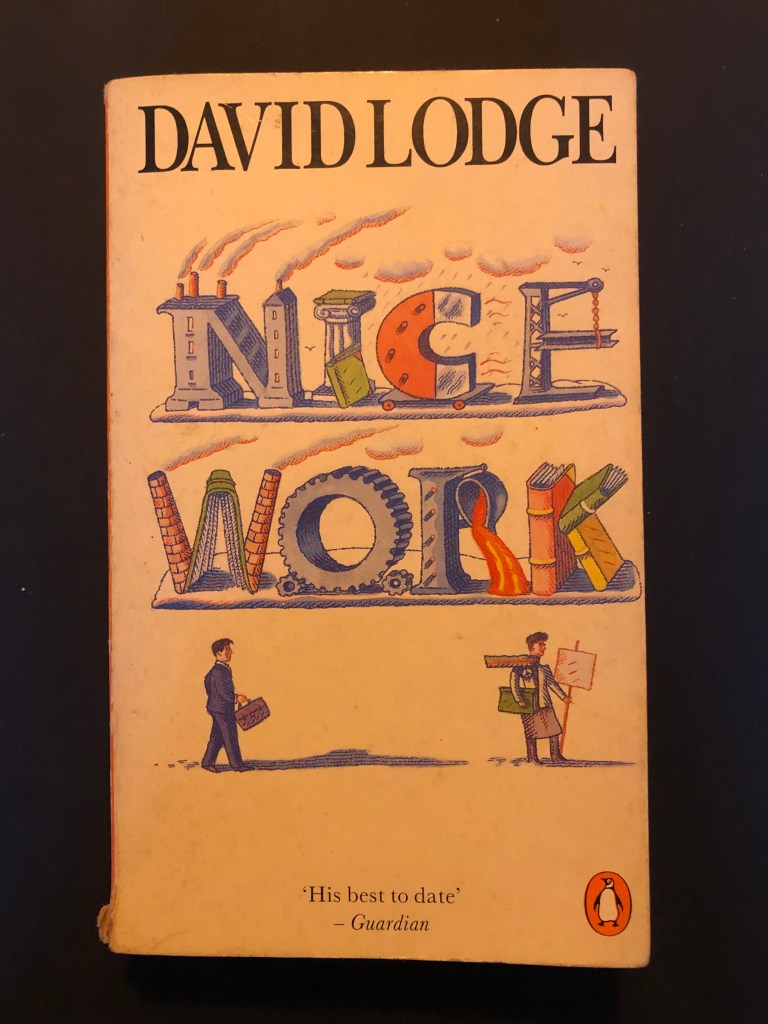
The summer of 1989 was a massive turning-point in my life. I’d just finished my GCSEs, and twelve weeks of freedom stretched in front of me before the start of A levels. I could have got a part-time job, but part-time jobs were in short supply in Merseyside in 1989, and anyway, I had other ideas. I wanted to read. We’d been told, at our A level English Literature induction session, that we should try to read as much as possible over the summer, and had been given some names of authors to try: Margaret Atwood, Ian McEwan, Julian Barnes. I couldn’t find any of them in either of the bookshops near us, but I did find a book I’d seen reviewed in the newspaper a few days earlier. It had a reassuring orange Penguin spine and its title, Nice Work, was made up of cartoonish images: factory chimneys, a cog and a crane, artfully-arranged books. There was a suited man with a briefcase and a short-haired woman carrying a placard. Hmmm. I decided to give it a go.

My original copy of Nice Work, a bit dog-eared

Nice Work is about clashing ideals, about culture and values. It’s very funny, and very clever. It’s set in 1986, and focuses on the unlikely relationship between Robyn Penrose, a young lecturer in nineteenth-century English Literature, and Victor Wilcox, the managing director of an engineering firm. Robyn has been sent to shadow Vic as part of the Government’s Industry Year. Neither is particularly happy with this arrangement. They couldn’t be more different. Robyn, in Vic’s eyes, is ‘not just a lecturer in English Literature, not just a woman lecturer in English literature, but a trendy lefty feminist lecturer in English Literature’. She’s alien to his very being. To add insult to injury, she’s also taller than he is. To Robyn, Vic is a philistine, interested only in profit and loss. Both have their own battles to fight: against cuts to university finding and threats to the arts and humanities, against industrial decline and a lack of investment. But gradually, they start to find some common ground.

When I was sixteen, I had no experience whatsoever of universities. Robyn was my introduction to what an English degree involved, to the play of ideas and the process of interpretation. I remember being intrigued by the lecture on the nineteenth-century industrial novel that she delivers early in the novel. Chartism and unrest, factories and alienation, fictional responses to real political situations: this was all both completely new to me and really, unexpectedly interesting. Up until then, I’d been toying with the idea of doing Law at university, but now I could see, utterly, why reading books and exploring them was as important as Robyn said it was. It was all about thinking, and thinking was something I enjoyed.

Robyn Penrose also introduced me to the Brontës. At one point in the novel, she accompanies Vic on a business trip to Leeds, and on the way, they pass a sign for Haworth. ‘The Brontës!’ Robyn exclaims. Vic has never heard of them, and Robyn is incredulous. There must be millions of literate, intelligent people, she reflects, who have never heard of the Brontës, who have never read Jane Eyre or Wuthering Heights. I hadn’t read Jane Eyre or Wuthering Heights. But I wanted to be literate and intelligent; and so, over the next few weeks, I read not only Jane Eyre and Wuthering Heights, but also all the dusty Brontë biographies that I unearthed from the non-fiction section of the local library. By the time school started again in September, I was halfway through Villette, all thoughts of doing a law degree very firmly in the past. It was English or nothing.

Robyn is presented, in some ways, as the woman who has it all. Lodge checks off her achievements: head girl at school, four As at A level, a First. She campaigns for social justice; she sparks off a protest at Vic’s factory and opens his eyes to inequality and to the narrowness of seeing the world in purely economic terms. She’s not perfect. She rushes in without thinking; she can be patronising, and she’s a bit of a snob. These days, we’d tell her that she needs to check her own privilege: the privilege that comes from being middle-class and free from financial pressures, with parents who value academic achievement. But she fights ferociously for her students, and for what she believes in. She changes Vic’s life, just as she changed mine. And for that, I’ll always be grateful to her and her creator.

One of the cleverest things about Nice Work – and something I didn’t appreciate on that long-ago first reading – is that it presents Robyn with the same options as the protagonists of her beloved nineteenth-century industrial novels. Existing on temporary contracts, worried about whether she’ll ever secure a permanent university post, Robyn tells her students that ‘all the Victorian novelist could offer as a solution to the problems of industrial capitalism were: a legacy, a marriage, emigration or death’. Death is never on the cards for Robyn, but a legacy, an offer of marriage and the prospect of emigration all come her way, holding out their own possible answers to the problems of being a young academic in Thatcher’s Britain. I won’t tell you what happens; you’ll have to read the novel yourself. It’s absolutely worth it.

Haydn Gwynne, who played Robyn in the BBC’s 1989 adaptation of Nice Work, died recently, and so in tribute I watched the BBC series again. It’s a lovely 1980s nostalgia trip, all Renault 5s and avocado bathroom suites and Jennifer Rush, but it’s also a reminder that there is so much that hasn’t changed. I like to think of Robyn now, campaigning against low pay and challenging prejudice, fighting for the arts and humanities and leading the battle against the dominance of STEM. She’d still be ruffling feathers. But she’d be speaking up, and acting – always – as a force for good.

Why we fight

My dad didn’t want me to do an English degree. He didn’t really want me to go to university at all, to be honest: nobody else in my family had ever been, and he didn’t see why it should start with me. He probably wouldn’t have minded if I’d wanted to do something vocational, like Law. But English: no. ‘What use is that going to be, sitting around for three years reading books when you could be out earning?’ he’d grumble. Eventually, my A level English teacher invited him into school for a meeting and explained that there were all manner of things that I’d be able to do as an English graduate, but even when I got into Oxford, there were still rumblings about finding a job in an office somewhere local. We were like Tony Harrison and his dad in the poem ‘Book Ends’: what was between us was not the thirty or so years, but books, books, books, and my desire to study them.

Follow your dreams, as long as they don’t involve an arts or humanities degree. (Photo: Rocky Chang, flickr.com)

For a huge chunk of my life I have thought that I was never more myself than when I was seventeen, reading anything and everything, walking home from school with a head full of ideas. Over the last few months, I’ve thought that I have never been more myself than I have over the past year, working away on the book that for a long time didn’t have a name but then became Reading Lessons: the books we read at school, the conversations they spark and why they matter. It’s been the distillation of twenty-eight years of teaching English, and of ten or so years before that studying it at school and at university. For most of that time, I realise, I’ve been fighting. Not just to be able to study English at degree level myself, but most importantly – and most fundamentally – against all those voices that tell us that studying English is an indulgence, a frippery, something that will never lead to a serious job of serious work. I’ve fought because it is a fight worth having.

This week, the day after Reading Lessons was introduced to the world in The Bookseller, The Times published an article that illustrates exactly why I’m writing this book. In the article, Emma Duncan describes ‘the decline of English as a subject for study at university’ as ‘a healthy development. Literature is lovely stuff but it’s not a way to earn your bread’. The drop in the number of young people applying to read arts and humanities subjects should be cheered, according to Duncan. Universities do our young people no favours if they pretend that studying English and humanities subjects will lead to a career that will make up for the ‘piles of debt’ that students will rack up during their time at university. Do a STEM subject instead, Duncan recommends – or a degree apprenticeship.

What Duncan argues is nothing new. In the late nineteenth century, one of the objections made to the infant academic discipline of English was that it was a mere indulgence, ‘chatter about Shelley’. Why did people need to study English literature at university, detractors reasoned, when they could read the books themselves at home? What were students of English actually learning, and what were they being examined upon? The subject’s supporters responded by filling the earliest English degrees full of knowledge that could be tested. ‘Mention some of the chief public events that happened during Shakespeare’s boyhood.’ ‘Make a list of Pope’s chief works in chronological order, with brief descriptions.’ ‘Write notes on the Interlude, the Heroic Play, the Opera, and the burlesque or satiric drama before 1800.’ It’s the stuff of knowledge organisers, of retrieval practice and MCQs. One question, set at Manchester in the early 1880s, invited students to give an outline of any one of the Canterbury Tales: the following year, at King’s College London, students were asked to ‘quote any passage from “Christabel”’.

You could be forgiven for thinking that some of today’s arguments about the teaching of English – about powerful knowledge and cultural capital, direct instruction or the shared construction of meanings – are really just a rehashing of these old debates about what kind of subject English actually is. But actually, articles like Emma Duncan’s should remind us that our real battle is a much bigger one. It’s to get people – our students, their parents, employers, politicians, society at large – to recognise the importance of what we do in English, and in the arts and humanities more widely. And we need to fight hard, and passionately, and with commitment.

One of the best and most persuasive books I’ve read recently on the subject of English is Bob Eaglestone’s Literature: Why It Matters (2019). Eaglestone redefines literature not as a particular body of texts – a definition that is notoriously troublesome – but as a ‘living conversation’. It argues that studying literature is about participating in a discourse that is endlessly evolving, adding one’s own voice to the thousands of others that have taken part in this conversation over time. And this is a conversation not just about books, but about ideas: about justice, society and civilisation, equality, relationships and responsibility. It’s a conversation about what it means to be a human being in a world that is currently in a pretty precarious state. As Matthew Sweet said in a tweet on Duncan’s article, ‘Literature isn’t lovely stuff. It’s unsettling, painful, shapes your morals, shows you the foul rag and bone shop of the heart’. It asks us questions whose answers aren’t immediately apparent, and confronts us with issues that we need to argue against.

None of this, of course, precludes it from leading to a career. My Twitter timeline is full of people giving examples of what their English, arts and humanities degrees have enabled them to do. In his book, Eaglestone quotes Cathy Davidson’s The New Education: How to Revolutionize the University to Prepare Students for a World in Flux. Davidson cites Project Oxygen, launched by Google in 2013, which aimed to identify ‘the qualities that lead to promotion and a successful career’. The top skills for success identified by Project Oxygen included empathy, critical thinking, communicating and listening effectively, and possessing insights into others, including their different values and points of view. Google also stated that its most effective teams were not necessarily those with the highest levels of technical skill, but those whose members displayed empathy and emotional intelligence. Another significant piece of research – the British Academy’s Qualified for the Future, published in 2020 – pointed out that eight of the ten fastest-growing sectors of the UK economy employ more graduates from arts, humanities and social science subjects than from STEM disciplines. It also underlined the crucial role played by the arts and humanities in ‘developing active citizens who can think for themselves and hold authority to account.’

In my more cynical and embittered moments, I think that maybe, just maybe, this holding-to-account is exactly what our current government wants to discourage. I had a long dark night of the soul after last year’s GCSE results when I reasoned that Michael Gove’s 2017 reforms were part of a long-term plan to destroy the subject of English altogether. Make English so dull and unrewarding that nobody wants to do it at A level, run a concerted campaign to undermine the importance of the arts and humanities at degree level, and sit back and rejoice as everyone troops off to do STEM subjects or degree apprenticeships. Schools will still need English teachers, and that problem doesn’t seem to have been addressed, but I’m sure there could be ways round it. (It was a very dark night.)

This needs not to happen. I think of my Year Eights, exploring presentations of Caliban and making connections with the history of colonialism and the dehumanisation of enslaved people; my Year Sevens, learning about displacement and human rights through their work on The Bone Sparrow. I think of the work that I did with Year Ten on toxic masculinity and Robert Browning’s ‘My Last Duchess’. I think of my A level English Language group, examining media stereotypes of regional language varieties, and of my A level English Literature students, questioning and challenging representations in texts and gaining so many insights into themselves in the process. I think of all the rich and powerful learning that goes on in English classrooms up and down the country, much of it the kind of learning that could never be measured by any formal metric, but all of it vitally important for the health of our country. I think of the young people who will be inspired to want to do English at university, just as I was, not because it will necessarily lead to a lucrative career but simply because they love it. And I think of myself, at seventeen, and of how bored I’d have been if I’d been persuaded that a degree apprenticeship was a more viable and sensible alternative to studying English, because if degree apprenticeships had existed back then, you can bet your life that I – a kid from a Merseyside comprehensive school, from a family where nobody had ever been to university – would have been steered towards one. This is why English matters, and this is why we must fight for it.

English Language: analysis, creativity and children’s books

It’s the second GCSE English Language paper tomorrow, and there’s a flurry of anticipation on Twitter as to what it will focus on and what the Question 5 task might be. There’s also, of course, the palpable dissatisfaction that English teachers feel with the current English Language GCSE and its reduction of a subject that could – should – be so broad and creative to a box-ticking, hoop-jumping exercise in exam-craft. We’re all familiar with the complaints by now: there’s no need for me to rehearse them. Nevertheless, the Literacy Trust’s recent report on its Annual Literacy Survey, showing that enjoyment of writing is at one of its lowest levels since 2010, should be a worry for everyone involved in English teaching and in the creative industries more widely. Teachers are working hard to give students the tools to write imaginatively and well, but all too often there’s a gap – as discussed in a number of threads on Twitter this week – between ‘exam-writing’ and writing that is genuinely fresh and engaged, and a lack of time in a crowded curriculum for the development of texts that are longer, require careful drafting, or diverge too sharply from the kinds of writing students might be asked to produce under timed conditions at the end of Year 11. We desperately need scope within the curriculum to re-engage young people with writing.

What should English Language be? What kinds of activities should it consist of? What skills and knowledge should it develop? I’ve been thinking, over the last few weeks, about a unit of work that I used to do with Year Nine students, years ago. It started with an investigation of a range of books aimed at very young children. Students brought in their own childhood favourites, and we had a lesson that was not only full of shared memories – a revisiting of familiar stories and characters – but also extremely rich in terms of knowledge about language: narrative structure, sentence structures and repeated sentence frames, rhyme, predictability, vocabulary choices and so on. We looked at connections between text and images, and explored issues of diversity and stereotyping. And we explored spoken language, too: the reading of stories, use of voice, and the dialogue that takes place around stories, pointing out details and asking questions.

Students then had to write and create their own book, aimed at children in Reception and Year One. Some students were able to use their artistic talents to create beautifully-illustrated books, but I emphasised that simple illustrations could be just as effective: it was the story that was important. A caterpillar can, after all, be a fabulous central character.

Creating the next generation. (“The Very Hungry Caterpillar” by against the tide is licensed under CC BY-NC-SA 2.0.)

Then – and this was brilliant – we took our stories into a local primary school to share with children in Key Stage One. I did a lot of preparation with the class beforehand to get them thinking about how to read their stories out loud, how to use their voices and how to interact with the children. They worked in small groups, taking it in turns to read their stories, and it was the kind of activity where some students really came alive, harnessing talents that they might not have been able to show elsewhere in the curriculum.

The final stage of this unit consisted of writing an evaluation of the whole process, from the initial exploration to the primary school visit. Students had to comment on how they developed their own story and show their knowledge of the importance of shared stories. There was, then, a whole cycle that began with an initial exploration, involved creative, reflective and analytical writing, and incorporated a lot of talk for learning – and had a real purpose and relevance.

Looking back, I can see that this unit, which I taught in the late 1990s, was heavily influenced by what I learned on my PGCE course about making implicit knowledge about language explicit – which, in turn, was influenced by the Cox Report’s emphasis on knowledge about language and by Ron Carter’s work on the LINC Project. It might be easy, then, to dismiss it as a relic of an educational past where teachers had more freedom and were less encumbered by the assessment frameworks with which we often find ourselves hampered. But let’s think about how a unit like this could be adapted and updated. The initial focus on narrative structures and on analysing texts; the need to craft sentences carefully and make thoughtful choices of vocabulary with a specific audience in mind; the process of reflecting analytically on one’s own writing: all of this involves rigour and is rooted in knowledge of how texts work. Moreover, it involves thinking about stories as real, living entities, written to be shared and enjoyed. It encourages students to reflect on issues of representation and diversity, and on the important role children’s books can play in making the world a fairer place. It offers the possibility of links with primary schools and other settings, as well as, potentially, with the publishing industry – therefore giving students the chance to explore different career pathways (and us the chance to contribute to the Gatsby Benchmarks). It also gives us the chance to highlight the importance of reading to young children at a time when, as so many reports tell us, many children are not read to by the significant adults in their lives. English, as a subject, needs to do so many things. One of the most vital is to highlight how important it is to share stories with the next generation.

So, as this year’s exam season draws to a close, I’m thinking of how English Language needs to be a living, breathing subject again, and of all the things it could achieve, if only we had a framework that would enable us to do so. Here’s hoping it can happen, soon.

On the margins

I’m angry at the moment. I’m having a lovely weekend, on the whole, but I’m angry. There’s a lot to be angry about in education at the moment, let’s face it, but the thing that has specifically riled me today is the article published in yesterday’s TES about the schools visited by current and former education ministers since January 2022. It chimes in with various thoughts rattling round my head at the moment about teaching in a rural area, issues of rural deprivation and lack of opportunities, and how spectacularly unbothered our current government seems to be about schools in huge swathes of the country. So let’s have a look.

Callum Mason’s article points out, amongst other things, that the politicians concerned – the four different education secretaries we’ve had since then, plus three different ministers – were more likely to have visited a school in France or Spain than they were a school in the South-West of England. It’s true: the list of schools visited includes one in Paris, one in Valencia, and none at all in the South-West. But there are other omissions too. I was curious to see whether any schools in my own county, Lincolnshire, had been visited. Absolutely none. In fact, if you drill down beyond the broad geographical regions listed by the TES, you find some pretty striking facts. There were no visits at all to schools in the rural counties of Cumbria, Norfolk, Suffolk or Shropshire. No visits to any schools at all in some of England’s biggest cities: Birmingham, Liverpool, Manchester, Leeds, Bristol, Bradford or Nottingham. No visits to Knowsley, where no A level provision has existed since 2017: if you live in Knowsley and you want to do A levels, you have to get on a bus and go elsewhere, with all the attendant worries that might bring. The only two visits that took place in the North-West were both to schools in Blackpool. In the East, two of the four schools visited were actually within the London commuter belt. Only three schools visited (the two schools in Blackpool and one school in Hastings) were in the top 20 most deprived areas in England. Most shamefully, only four of the 55 areas selected by the Government as Education Investment Areas were visited.

Big skies, narrow horizons

The issues facing young people growing up in areas of deprivation – especially rural deprivation – has been on my mind more than usual this week, as I’ve been reading Natasha Carthew’s brilliant, beautiful, angry book Undercurrent: A Cornish Memoir of Poverty, Nature and Resilience. Carthew writes powerfully of the many kinds of lack experienced by young people in rural communities, and it’s a list that all people involved in education should have at the forefront of their minds. The lack of opportunities. The lack of access to concerts, galleries, museums, theatres (which also becomes a lack of a sense of belonging in these spaces). The lack of public transport. The lack of support for marginalised groups. The lack of role models. The lack of anything to aspire to, because very few of the people you know have lives that are any different from your own. The lack of faith in any possibility of escape. It’s hard to get young people growing up in these circumstances to believe that achieving their GCSE target grades – those grades on which schools are judged, and that secondary school teachers up and down the country will be losing sleep over as we enter the last few weeks of exam preparation – has any kind of importance whatsoever.

My brain has a habit of making odd connections, and as I was reading Carthew’s memoir, I kept thinking back to the conversations I’ve been having with my Year Thirteen students about Tess of the D’Urbervilles. We’ve been looking at Tess not just as the victim of vile Alec and insufferable Angel, but also as a victim of circumstance: of having the misfortune to be born a girl, into a poor rural family, at a time when she has absolutely no means of escape. The odds are stacked against Tess from the start. And while we can think about Hardy’s concept of Fate, and of Tess’s lament about being born on a ‘blighted star’, we can also think of the many imbalances of power that make her story what it is: the story of a young woman stuck in the middle of nowhere, with limited opportunities to make decisions about her own life.

There is so much more that our government needs to offer to students in deprived areas, not the least of which is teachers who are valued, trusted, and paid appropriately. But they need to come and see us, to find out what we face.

Enough

You are enough. You see it on a thousand inspirational posters, swirly italic-effect fonts against backdrops of beaches and sunsets, spring flowers and rainbows and autumn leaves. Search on Etsy, and you can find it on mugs and sweatshirts, coasters and keyrings. It can be personalised, embroidered onto a cushion, painted onto something called a ‘positivity pebble’ that you can keep in your pocket. It’s the title of a book, with the subtitle ‘How to Love the Skin You’re In and Embrace Your Awesomeness’. There’s even a modified version, attributed to someone called Sierra Boggess: ‘You are so enough, it’s unbelievable just how enough you are’.

You are, really. (Source: Pexels)

The trouble is that it’s difficult to believe, in teaching, that we are ever enough. There’s always something else that we could do. Run that extracurricular group, read that article, try that new approach, sign up for that webinar, have that conversation with a colleague about that student who’s underperforming, contact that parent, think ahead to that trip we might run next year … We’ve heard a lot, over the last few months, about the feelings that have driven the current strikes: the real-terms pay cuts, the squeezed budgets, the crisis in recruitment and retention. And there’s the collective sense of burnout felt by a profession that is overwhelmed, accountable for far too many things with far too little support, battling poor behaviour and the after-effects of the pandemic, told constantly – by so many voices, but also by ourselves – that we are not doing enough.

I don’t want to claim special treatment for English teachers, but there’s something about English that is especially susceptible to this sense of not-enoughness. I’ve spent most of my career trying to describe what it is that makes English so complex – hell, I even did my PhD on it – and now, twenty-seven years in, I think I’ve finally pinned it down. In true English-teacher style, I’ve done it as a metaphor. English is a gas. Not in the sense of being funny, or enjoyable (although it frequently is), but because it expands to fill the space available to it. This is partly because in English we work with words, with texts, and words and texts, in all their various and wonderful forms, are what surround us. The conversations we overhear, the programmes we watch, the packaging on the products we buy, the songs we listen to, the websites we browse, the Twitter threads we read: all are grist to our English-teaching mill. And that’s before we even think about books, and everything that surrounds them.

The ever-expanding nature of English makes it particularly vulnerable to debates about powerful knowledge. It’s vulnerable anyway, because debates about powerful knowledge involve debates about issues that are central to English as a subject, not least the kinds of texts we teach and the ways in which we approach them. But if we take a text that is particularly powerful in the English curriculum – A Christmas Carol, say – it’s easy to see how the amount of knowledge available to us, as teachers, has grown massively over the last few years. Historical and biographical contexts, beautifully-produced resources, discussions of key quotations and motifs … It would be possible to spend a whole year teaching A Christmas Carol and still feel that you haven’t explored everything about it and its hinterland that is considered powerful. Except, of course, that you haven’t got a year, because there are three other texts – plus unseen poetry – to cover, as well as English Language. And so the guilt sets in. What if you miss out that key piece of information, that vital worksheet, that will unlock a particular concept for your students? What if that leads to them missing out on a vital grade? What if your department’s results plummet and Ofsted make their dreaded phone call? Your panic spirals. You stop trusting your own judgement, and before long, you’re paralysed, unable to make any decisions because it feels as though every decision is the wrong one.

English, as a subject, needs to change. It needs to change in many ways and for many reasons. Lots of these will be familiar to us: the inadequacy of GCSE English Language, the lack of diversity, the absence of any meaningful opportunities to develop vital oracy skills. But one that we must also address is the need for clearer boundaries around the knowledge we teach.

This is something I never thought I’d call for. I love exploring alternative readings and different approaches: there’s nothing I enjoy more than getting my A level students to examine varying interpretations, to play the unending game of critical debate. Yes, but … Well, okay, but couldn’t you also say …? But it feels, at the moment, as though the possibilities of what we could teach in English are growing at an exponential rate; and, as we all know, the stakes in English are so high that it’s easy to become completely overwhelmed by the scale of what we have to manage, the complexity of the landscape we have to navigate.

I’m mixing my metaphors wildly here, and that’s probably because I am swamped, at the moment, by the kinds of decisions I’m trying to describe. Everything in education, at the moment, feels like that other metaphor: a lethal mutation, spreading wildly, out of control. I think a lot of us feel as though we’re not enough. We might not have to walk through the desert on our knees repenting, but it certainly feels that way, sometimes.

The Bone Sparrow, The Arrival, and empathy

My Year Sevens are just coming to the end of their study of Zana Fraillon’s The Bone Sparrow, and it’s a long time since I’ve found a book that has gone down so well with a class. It’s a difficult business, choosing a new class reader. You find a book that you think your students will adore, spend ages developing a scheme of work and resources, and sometimes it just doesn’t play as well as you think it will. Some novels are Marmite, loved by some students but leaving others cold. Some fall a bit flat. What to do?

One of the difficult things about teaching English is that the subject blurs the boundary between academic domain and personal pleasure. Like all subjects, it demands that students spend time engaging with concepts and topics that they might not choose to engage with in their lives beyond the classroom. But there’s something about studying books that makes English different from Maths, or Geography, or the sciences. We are supposed to enjoy reading in a way that we’re not necessarily supposed to enjoy solving equations or exploring coastal landforms. It’s far easier for students to see these subjects as something that they simply have to learn. But reading has a different kind of existence, as something people do for pleasure, out of choice. What people read – indeed, if they read at all – is seen as more a matter of personal taste. And therefore students often really resent having to study a text they wouldn’t choose to read outside of school.

Sometimes, I growl that English is an academic discipline and that issues of personal preference shouldn’t matter. I talk about the reasons why we read and the fact that studying a text is about a whole range of complicated things: the ability to read closely and attentively; the critical exploration of novels and plays and poems that are culturally significant; the willingness to engage with lives and situations that are not our own. I talk about intellectual resilience and the need to push beyond the question of whether you like something or not. But, let’s face it, there is nothing quite like that feeling of teaching a group who really enjoy the text they’re studying, who are intrigued by it and relish the challenges it offers. There’s an energy to those lessons, a buzz. Eyes light up and ideas bounce around. The bell goes and someone comments ‘Is it the end of the lesson already? That went really quickly!’

The Bone Sparrow has been fabulous. We’ve explored narrative methods and analysed the creation of character; we’ve learned about the situation of the Rohingya people and researched the UN Convention on the Rights of the Child. We’ve also discussed critical literacy and the reasons why people think that particular books should be studied in schools. One of my students contacted Zana Fraillon, via her website, to ask some questions about the novel, and was beside himself with excitement when she replied, less than twelve hours later. (He declared, ‘I feel as though I’m famous!’) And we’ve also talked about being an outsider, about feeling strange and unwelcome, and how that feels.

I’ve been thinking about The Bone Sparrow a lot this week because of Rishi Sunak’s desire to make all students continue with Maths until the age of 18, and also because of two books I’ve read recently: Peter Bazalgette’s The Empathy Instinct: How to Create a More Civil Society, and Michael J. Sandel’s The Tyranny of Merit: What’s Become of the Common Good?, which was explored by Claire Stoneman in her brilliant blog post last week. One of Sandel’s key arguments is about the rhetoric of rising, the idea that if we work hard and play by the rules then there is no limit to what we can achieve. Achievement is seen as a mark of merit, of worth, rather than as the result of a constellation of lucky accidents: having a supportive family, being of good health, having the kinds of talents and abilities that are valued by society and will be rewarded with a high-paying job. As you might expect, I have lots of thoughts about the valorising of subjects that are seen to lead to higher earning power, as if earning power alone is the sole criteria that should be applied when deciding which subjects we prioritise, which departments to fund, which courses to cut. Discussions about the value of the arts and humanities often defend the study of the arts by pointing to the huge earning power of the British creative industries, which, in 2020, contributed £13 million to the UK economy every hour. And yet: should this be the only measure?

From The Arrival by Shaun Tan (2007, image licensed for non-commercial use)

We’ve followed up our study of The Bone Sparrow with some creative writing based on Shaun Tan’s book The Arrival. If you don’t know The Arrival, this is something you need to remedy right now, because it is stunning. It’s a graphic novel, but contains no words. (My students love the idea of being able to tell a story without any words: when I showed them the book last week, I had a little huddle of them round my desk at the end of the lesson, wanting to have another look and note down the title so they could track down their own copies.) It’s a story of exile, of a man who has to leave his family and travel to a different country. The illustrations, which are beautiful, are in sepia tones. Some – a tearful woman saying goodbye to her husband, a man getting onto a train, a crowd of people on a ship – carry echoes of particular historical situations, most notably the Second World War, and migration to the USA in the nineteenth and early twentieth centuries. But the country that the man finds himself in is like no other. The writing system, the buildings, the vehicles, even the animals: all are utterly estranging. And that’s the point. No matter who you are, no matter which language you speak or what kind of cultural background you’re from, this new country will be alien to you. We talked about the weirdness of an alphabet you’ve never seen before, and how significant it is that Tan does not privilege any of his readers. Nobody will find this strange world easier to navigate than anyone else. We are all equally disorientated.

Our writing, which we’ll be developing next week, focuses on one specific image, of a family walking through silent streets in a town haunted by a tentacled creature that twines itself around the rooftops and lurks menacingly round corners. We’ve discussed whether the creature is real or metaphorical, and decided on the latter. It could be war, we said, or prejudice, or some kind of idea that’s making people feel they don’t belong any more. We talked about what the characters could see, what they might smell. (That kind of rotten smell like a market at the end of a hot day when all the vegetables have been out for too long, one boy said.) We wondered whether the family would be talking to each other, or if there were thoughts running through their minds that they couldn’t put into words. Would there be people in the houses, staying away from the windows, too afraid to look out? What memories might they have of the time before the creature arrived?

In The Empathy Instinct, Peter Bazalgette writes of the capacity for empathy as being one of the foundations of a civil society. He highlights the role of fiction in building empathy, fostering our ability to imagine and to understand, to project ourselves into the lives and experiences of people who are not ourselves. Studying The Bone Sparrow, and then exploring The Arrival, has been a real journey for my Year Sevens. They’ve learned a lot academically, but they’ve also developed their understanding of a whole host of issues and situations. It would be difficult to measure this in terms of grades, or earning potential, or contributions to the economy, but that doesn’t mean it isn’t massively important to the good of our society.