Teacher Feature: Mr Smart

There’s been a lot of discussion on EduTwitter this last fortnight about performative attention. Should students receive a sanction if they look out of the window, fail to smile or sit up straight, or reply to a teacher in a manner that is less than upbeat? I was an extremely diligent student, but there were probably many lessons that I spent daydreaming or doodling in my planner. It didn’t mean that I wasn’t thinking. Beyond the obvious signs of engagement – putting your hand up to answer questions, completing everything that’s asked of you, making progress according to whatever system is being used to assess your work – there’s a whole lot we don’t know about what students are thinking about the things they do in class. Someone who seems to be completely switched off might suddenly reveal themselves to have been thinking very deeply about particular topics. There’s a whole hinterland in our students’ minds that we don’t necessarily have access to.
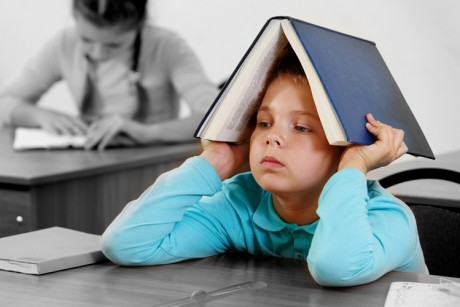
Admit it: we’ve all been there. (Source: Creative Commons)

Mr Smart, in U. A. Fanthorpe’s poem ‘Dear Mr Lee’, is one teacher who doesn’t recognise this. His student – the anonymous narrator of the poem – has been studying Laurie Lee’s Cider with Rosie and it has fired off things in her brain that Mr Smart has absolutely no idea about. She doesn’t want to write character studies or explore issues about ‘social welfare in the rural community’; she just wants to lose herself in Lee’s wonderfully rich stories of his childhood. She pours all of this out to Lee in her poem, wanting to address him by his first name, even though Mr Smart says this is rude. She wishes she could ‘see everything bright and strange, the way you do’. She’s taken As I Walked Out One Midsummer Morning out of the library, but Mr Smart is scornful about it, and says Spain isn’t like that any more. At the end of the poem, we learn that the narrator has failed her exam, but doesn’t blame Laurie Lee for it. His book isn’t a mere set text, but a book that has lived with her, ‘stained with Coke and Kitkat and when I had a cold.’

I used ‘Dear Mr Lee’ in a conference presentation I gave some years ago, to illustrate some of the tensions that exist in English teaching. What is the study of English Literature all about? Should we prioritise student enjoyment, or disciplinary knowledge? This is what my PhD focused on, and one thing I looked at was the fact that debates that were circulating at the time English literature became an academic discipline in the universities, back in the late nineteenth century, were still apparent in discussions about Curriculum 2000. They’re still going on today. There’s been a lot of discussion on Twitter this weekend about whether English should aim to promote a love of reading, and if so, how it should do this. I admit that I’m on the fence about this. Over the years I’ve heard advocates of the full gamut of approaches, from letting students read whatever they want, even if it’s Charlie and the Chocolate Factory in Year Nine, to listening to canonical texts being read out loud in tutor time. I am deeply sceptical about both of these particular approaches, but I’m not convinced I’ve found the answer, either.

Geek that I am, I’d like my students to be able to enjoy their engagement with the discipline of English, to recognise that there is something deeply pleasurable about analysing texts and writing about them. I’d also love it if my students read outside the curriculum, and as an English teacher it’s part of my job to recommend books and give students the space to share their enthusiasm for reading. There’s a problem, though, when we make English teachers responsible for something that spills over into students’ lives outside school and doesn’t necessarily correlate with their success in curricular English. Some students will love reading, but some won’t. Some will achieve stellar grades regardless of whether they read outside of lessons. Some will be avid readers but struggle to get a Grade 4. We can encourage independent reading and even give space for it in the curriculum, but reading occupies a complex area, a bit of the Venn diagram where ‘something you’re made to do in school’ overlaps with ‘something you do at home if you really want to’.

And while we should strive to create a culture where reading will flourish, we also need to recognise that some of our students might not want to share their feelings about books with us. I remember what it was like to be fourteen or fifteen and immersed in books that I wouldn’t have wanted to discuss with my English teacher in a million years. The thoughts and feelings I had about them were often so complicated and half-formed that I’d have hated to write them up as a book review or record them in a reading journal. Leave me alone, I’d have thought. It’s none of your business what I’m reading. Let’s give students the right to think their own thoughts. And let’s recognise that the daydreamers and doodlers might have a deeper relationship with the texts they read than we will ever know.

Diversifying reading

The lack of diversity in student reading has been an issue for decades. It has, however, received increased focus over the past year, and has been the subject of a major report, Lit in Colour, produced by Penguin Books UK and the think tank The Runnymede Trust. The report, published last week, found that in 2019, fewer than 1% of GCSE English Literature candidates answered a question on a novel written by a writer of colour, and fewer than 7% answered on a novel or play written by a woman. 82% of the students surveyed did not remember ever studying a text by a Black, Asian or minority ethnic writer.

I’m ashamed to say that at my school, our students’ GCSE diet is overwhelmingly white and male. Shakespeare is compulsory, and while there are three women writers on the 19th-century novel list, I have to say the idea of teaching Jane Eyre, Pride and Prejudice or Frankenstein at GCSE didn’t appeal to any of us. Studying a nineteenth-century novel at GCSE is daunting; being assessed on it through a high-stakes end-of-course assessment is even more so, and we wanted something that was both short and accessible (we’ve done Dr Jekyll and Mr Hyde for the last few years, although we’re switching to A Christmas Carol this year). Our modern text is An Inspector Calls. So we haven’t opted for any of the texts that would allow us to offer a more diverse range at GCSE. This is partly an issue of resourcing, but also of expertise. We’re teaching texts that we know, for which we have units of work that include extensive PowerPoints, worksheets, contextual information and sample responses, and for which students are able to find study guides and websites to support their learning. And I’d imagine that many schools, quizzed on their text choices for GCSE, would give a similar answer.

Lower down the school, though, it’s different. We have tried really hard over the past few years to increase the levels of challenge in student reading, and to diversify the texts we use. All our Key Stage 3 students have a reading lesson once a fortnight. This isn’t ideal – I’d rather have a little bit of reading every lesson, rather than one chunk once per cycle – but it’s a product of the way our timetable works and I can’t see it changing. These reading lessons used to take place in our lovely school library, and three years ago we put together reading lists for each year group to shadow and support the units we were working on in class. Our Year Seven reading list, for instance, included texts like I Am Malala, Wonder, The Reason I Jump and Ruby Holler; our Year Nine list contained Persepolis, Oranges Are Not the Only Fruit, Safe Area: Goražde and The Way We Live Now. But there were problems. We had copies of all of the texts, and multiple copies of some texts, but not enough. We didn’t have the funds to buy more. We started a Sponsor-a-Book scheme, to allow parents and local businesses to support us. Some came forward, but not many. And then COVID happened; and bubbles happened; and we couldn’t use the library any more.

Patchwork quilt, USA, c. 1885, displayed in the Metropolitan Museum of Art, New York. (Source: Wikimedia Commons)

This gave us the chance to go right back to basics and look at Key Stage 3 reading again. We decided pretty quickly that we wanted to replace independent reading with a series of class readers. Our stock cupboards gave us some possibilities, but we knew we’d need more books. We secured enough emergency funding to buy two new sets of class readers for each year group, and set about deciding which books we wanted to introduce.

One decision we made very early on was that we didn’t want to buy any books by white men, no matter how good they were. There are lots of excellent books for this age group written by white men, but frankly there are enough white men on the curriculum anyway and we wanted to do something different. So, all of our new books had to be by women. We’re a boys’ school, and it’s vital that our students explore and experience female perspectives. We also wanted greater cultural diversity. However, we wanted to avoid stereotypes. One of my former students commented that ‘books for boys about ethnic minorities always seem to be about gangs, as though that’s the only thing we’re interested in.’ We also felt very strongly that in thinking about diversity, we also needed to consider those of our students who come from Eastern European backgrounds. The Lit in Colour report recognises that ‘the term BIPOC does not notably include White Ethnic Minorities who are the target of racism, such as Gypsy Roma Travellers or Eastern European migrants, although it is sometimes argued to include these groups.’ A growing number of our students are of Polish and Lithuanian heritage, with others coming from Latvia, Romania, Russia and Moldova. In a constituency that registered the second highest proportion of Leave votes in the 2016 EU referendum, and bordering another constituency with the highest proportion, we are acutely aware of the hostility that many of our students and their families experience.

Some choices were easy. The Other Side of Hope by Beverley Naidoo is a cracking read with lots of pace and tension, and opens students’ eyes to the reality of lives that are torn apart by conflict. Coram Boy by Jamila Gavin has long been a favourite, with its story of the sinister Coram Man and exploration of the lives of orphans in eighteenth-century England. And Geraldine McCaughrean’s Where the World Ends, set on the remote Scottish archipelago of St Kilda, is a brilliant example of historical fiction that offered an intriguing counterpoint to life in lockdown.

Other choices required more research. We struggled to find any novels for this age group by writers of Eastern European origin that focused on the experiences of recent migrants. We did, however, choose Between Shades of Gray by the Lithuanian-American writer Ruta Sepetys. Its story of 15-year-old Lina, who is deported from Lithuania with her mother and brother in 1941 and sent to a labour camp in Siberia, asks readers to consider what keeps us alive when we are faced with the most extreme of circumstances. We also chose Sarah Crossan’s verse novel The Weight of Water, narrated by Kasienka, a Polish girl who arrives in Coventry with her mother in search of a better life. It’s a book about not fitting in and finding your own way, making tough decisions and relying on yourself, and appealed to our Year Eights even though they complained that the cover was ‘a bit girly.’

Our final choice was Hell and High Water, by the Carnegie Award-winning novelist Tanya Landman. It’s the story of Caleb, a young man whose father is transported to the Colonies for a crime he did not commit. As Caleb struggles to clear his father’s name, he becomes entangled in a web of secrets, finding out about the exploitation and injustice that exist in the world around him – and discovering more about himself in the process. It’s a pacy, intriguing novel full of courage and adversity, and a great read for our Year Nines.

We’re not there yet. All of our Key Stage 3 students have read at least one novel by a woman this year (in many cases, two or three). Most, although not all, have read a novel by a writer of colour. We’re about to introduce Iridescent Adolescent, the English and Media Centre’s fantastic anthology of short stories, and we’ve got more writers of colour and more working-class writers. We wanted to get beyond the stereotype that novels addressing themes of ethnic diversity that are suitable for teenage boys are all about gang culture and urban violence, and I think we’ve managed to do that. We’d like more sensitive male protagonists. What we’d really like would be a novel by a young writer from an Eastern European background exploring the experience of recent migrants, so agents and publishers, get cracking.

The other thing I’d say about diversifying your reading in schools: finding suitable novels, following up recommendations and discussing which texts would be most suitable for your students, takes time. Reading is an essential part of CPD for English teachers. Just because reading is something we enjoy and spend part of our spare time doing, it shouldn’t be assumed that we’re willing to do this particular CPD in our own time. Schools need to give students time to read, but they also need to invest in time for their English teachers to read as well.

Secrets, complications, and long lost families

A new series of Long Lost Family started in the UK this week. If you’ve never seen it, its format is easy to explain: members of the public contact the show asking for help in tracing estranged relatives, the show’s researchers track them down, and – if they consent to meeting up, and being filmed – there’s a reunion. It’s a hugely popular show, and I know lots of people love it, but it makes me uneasy. The situations that Long Lost Family focuses on are varied: an absent father, a brother who moved away, an aunt who emigrated and stopped getting in touch. But many of them involve adoption, and that’s where my squeamishness comes from.

There’s no doubt that Long Lost Family does an important job in helping people to search for birth relatives, and in making its audience aware of how such searches can be carried out. In doing so, it honours the importance of family connections, and helps to break down the sense of shame with which adoption was once surrounded. The adoption stories it features centre on people who were adopted during the ‘classic’ era, when adoption was widely seen as something to be kept secret. There was the stigma of illegitimacy, the stigma of being infertile, and the belief that children who were adopted as tiny babies somehow – shockingly – ‘didn’t need to know’. It wasn’t until the passing of the 1976 Adoption Act – described by a journalist in the Daily Mirror as ‘one of the most important pieces of legislation involving children since we stopped sending small boys up chimneys’ – that adopted people had the right to access their records, or even their original birth certificates. Their past, and their parentage, would no longer be a mystery to them. They would, potentially, be able to trace their birth parents, and be reunited with them.

To us nowadays, the idea of denying people information about their own lives seems so fundamentally unjust that it’s hard to believe how controversial this aspect of the 1976 Act was at the time. Yet there were many people who argued against it. Some pointed to the thousands of birth mothers who had relinquished their children in the belief that they would remain anonymous. The agony aunt Marjorie Proops wrote of the ‘terror’ and ‘torture of discovery’ experienced by women who had given up babies for adoption many years previously and gone on to create new lives for themselves – ‘women who have believed for years that their secret was safe and their past forever buried’. The desire to search was also seen by many as ‘ungrateful’ to adoptive parents. One woman interviewed by the Daily Mirror in 1975 was told by a solicitor that she should be ashamed of herself for wanting to know who her birth parents were. There must have been thousands of people who put the feelings of their adoptive families above their own desire to complete the jigsaw of their personal history.

Long Lost Family goes all out to tug at the heartstrings, with soulful piano music and cliffhanger endings to each segment that keep you watching even though you feel slightly icky for doing so. The people who appear on it will all have given their consent, and they will have access to counsellors to help them process the difficult feelings that surround searching and reunion. Many of the searches it carries out don’t actually make it to television, because they are deemed too sensitive or complex for public airing. The issue I have with the programme lies more in the image of adoption that it conveys to the viewing public. As I’ve said before on here, there’s still a widespread belief that adoption involves newborn babies relinquished by women who have no other options. There’s also a sense that reunion is a straightforward happy ending, the natural conclusion to a story of separation. Who wouldn’t want to believe that what is lost can always be found? So in turn, there’s a feeling that search is an inevitable part of being adopted, that all adopted people will one day want to trace their family of origin.

Nowadays, adoption is different. That means that reunion is different, too. For one thing, the whole idea of only finding out the truth about your past when you’re an adult – that scene in the social worker’s office, beloved of so many reunion narratives – simply shouldn’t happen. All adopted children should know, in as age-appropriate a manner as possible, what their story is and why they can no longer live with their birth parents. Many will have ongoing contact with birth relatives, whether via letter or face-to-face, and many will have conscious memories of their lives before adoption. For another, children who have been taken into care as a result of abuse or neglect might find the idea of reunion extremely traumatic. Even if birth parents’ circumstances have changed, the emotions involved will still be incredibly complex. It’s not as simple as sliding that last piece of the puzzle into place.

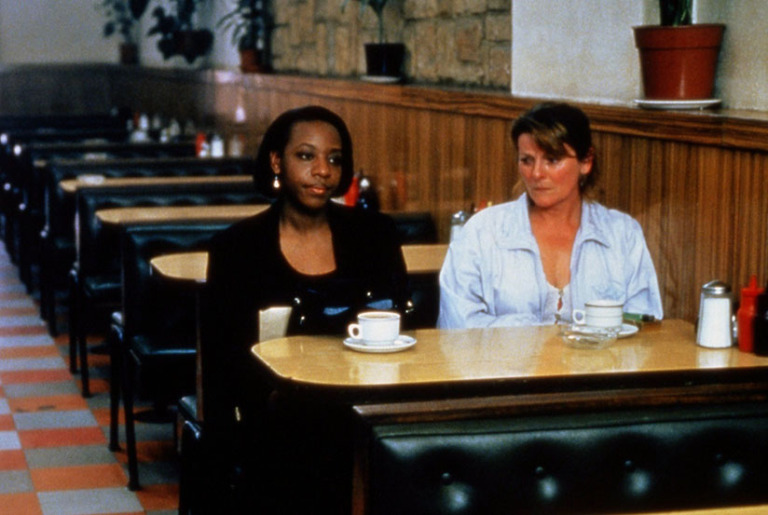
Marianne Jean-Baptiste and Brenda Blethyn in Secrets and Lies: awkward.

People who know me well will know that I can bang on for ages about the way adoption is represented in popular culture. One of the most powerful representations of search-and-reunion that I’ve seen is in Mike Leigh’s 1995 film Secrets and Lies. Itscentral character is Cynthia, played by Brenda Blethyn, ‘a sad-looking middle-aged woman’ with a low-skilled, low-paid job making cardboard boxes in a factory. She lives in a shabby rented house, drinks cheap whisky and is permanently on the verge of tears, stuck in a life that nobody would want. And then, one day, she receives a phone call from Hortense, a young woman who has found out that Cynthia is her birth mother. Hortense is an optometrist, an intelligent, middle-class professional who is happy, contented and successful. Her adoptive mother has recently died, and she has decided to seek out her birth family. It initially seems that Cynthia has forgotten all about the daughter she gave up for adoption, but then, as the reality dawns on her, she is ‘horrified and terrified’. She hangs up, and vomits in the kitchen sink. Eventually, she agrees to meet Hortense, but there is another shock in store. For Cynthia is white, and Hortense is black. When Cynthia and Hortense meet, outside a London Underground station, they walk past each other several times before Hortense finally approaches Cynthia. (Cynthia’s shock is heightened by the fact that Blethyn had not met Marianne Jean-Baptiste, who played Hortense, until this point: she did not know that her screen daughter was going to be black until this scene was filmed.) Their first conversation, in a café, is shot in a single take of over seven minutes. They sit uncomfortably, side by side, and the frequent pauses draw attention to their awkwardness. It’s a scene that gives the lie to all those narratives of happy reunions, the jigsaw finally being completed. Leigh’s message is that reunion is not a one-off event: it’s a complicated process, with steps backwards as well as forwards, that needs to be worked at.

I’m aware that it’s often difficult for adoptive parents to talk about the relationship between children and their birth parents without seeming possessive, or defensive, or reluctant to engage. It can seem as if there’s a binary choice involved, as if searching for birth parents necessarily involves a rejection of adoptive parents. I think some adopters do see reunion as something they’d rather not think about, something that’s so far in the future that it might never happen, and that’s wrong. The social worker who did our initial visit nearly seventeen years ago now – an adopted person himself – said that searching and reunion was something that adopters needed to consider right from the beginning of the adoption process. And roots are important. Look at how many people use websites like Ancestry.com to trace their family trees: online genealogy is a multi-million dollar industry. People wouldn’t do this if a sense of their past didn’t matter. I’ve known for years that one side of my family was part-Irish: what I didn’t know, until I started searching online, was that my great-great-great grandfather was one of the hundreds of Irish people who came over from County Mayo during the famine of the mid-1800s to work in the cotton mills of Lancashire. Finding this out gave me a sense of rootedness, a feeling of where I came from. These things matter. Why would we deny them to our children?

The issue of searching and reunion has been made even more complicated, in recent years, by social media and the fact that young people can now do their searching alone, in their room, without telling anyone they’re doing it and talking through the issues it might involve. Our children shouldn’t feel that they have to do this on their own. Reunion is something that adoptive parents need to be prepared for, so that their children know that wanting to search is okay and that they’ll be supported if they want to do it. And it shouldn’t be up to the child to make the first move. As adoptive parents, we need to raise that possibility ourselves.

So I’ll be viewing Long Lost Family with a wary eye, aware that reunion isn’t all hearts and flowers. It’s messy, and painful, and difficult. But I’m not sure any television programme could ever do justice to that.

Teacher Feature: Miss Stretchberry

There are all kinds of metaphors for teaching. ‘You’re not filling a bucket, you’re lighting a fire’, one earnest trainee once assured me (although students do need to Know Stuff, and fires can’t be created from nothing). You’re spinning plates and playing Whack-a-Mole. You’re conducting – possibly an orchestra, possibly a bolt of lightning – and planting acorns that you hope will one day grow into great oak trees. And sometimes, you’re opening locks.

Miss Stretchberry, the teacher in Sharon Creech’s wonderful book Love that Dog, is one of life’s unlockers. The lock that she needs to open is in the heart of Jack, a little boy in her class. Jack is reluctant, and resistant. His class is doing poetry with Miss Stretchberry, and he doesn’t want to engage. Boys don’t write poetry, he reasons. He can’t do it. His brain’s empty. He doesn’t understand the poems that Miss Stretchberry reads in class. Slowly, gradually, Jack starts to come round. He writes a poem about a blue car splattered with mud, speeding down the road, and lets Miss Stretchberry read it, as long as she doesn’t let anyone else see. A few weeks later, he allows her to put two of his poems on the board, as long as she doesn’t put his name on them. And he starts to ask questions about the poems that his class reads. Why does so much depend on the red wheelbarrow and the white chickens? What’s that business about the snowy woods and having miles to go before you sleep?

The genius thing about Love That Dog – a book about a young boy’s feelings about poetry – is that it’s told as a series of poems from Jack to Miss Stretchberry, written throughout the school year. So we see this process of unlocking through Jack’s own words. Here’s what he says about William Blake, on October 24:

I am sorry to say
I did not really understand
the tiger tiger burning bright poem
but at least it sounded good
in my ears.

And here’s what he says on November 6, once he’s allowed Miss Stretchberry to put his poems on the wall:

They look nice
typed up like that
on blue paper
on a yellow board.

(But still don’t tell anyone
who wrote them, okay?)

(And what does anonymous mean?
Is it good?)

But then the barriers come up again. Jack is asked to write about a pet, but he doesn’t have one. He used to have one, but he doesn’t want to write about it. He asks if he can write about a different pet, but to no avail. Eventually, we find out that Jack used to have a dog, a yellow dog called Sky. (If you can read the poem where Jack and his family go to choose a dog from the rescue centre without feeling a bit teary, you’re a monster.) Sky was a friendly, happy, slobbery dog, a waggy-tailed dog who joined in games of football and loved everyone. Jack starts to write abut Sky, inspired by Walter Dean Myers’ poem ‘Love That Boy’, and is so inspired by Walter Dean Myers’ poems that he writes to invite him to visit the school. A couple of weeks before the visit, Jack finally manages to write about what happened to Sky. He was killed, by a blue car splattered with mud, speeding along the road.

It takes Jack a long time to write about Sky. You sense that when he does, it’s as if a weight has been lifted. There’s the huge excitement of Walter Dean Myers’ visit, and the lovely descriptions of his voice:

low and deep and friendly and warm
like it was reaching out and
wrapping us all up
in a big squeeze

And there’s the sense that Miss Stretchberry has unlocked something for Jack: not only a way of expressing his grief and processing his feelings, but a love of poetry, of playing with language and making it his own.

We don’t find out much about Miss Stretchberry, apart from the fact that she’s good at making brownies. But we also find out a lot about her, through the poems that Jack writes to her. She’s patient enough to persist with this unhappy young boy, rather than writing him off. She’s tactful: she doesn’t nag him or hassle him, but he knows that she’s there. She respects his desire for his poems to remain anonymous. She builds his confidence, by getting him to write to Walter Dean Myers rather than doing it herself. She recognises that quiet praise goes much further than a big fanfare.

Love That Dog is dedicated to ‘all the poets and Mr.-and-Ms. Stretchberrys who inspire students every day.’ It’s a gorgeous book. If I were being political, I’d say that every Secretary of State for Education should read it, as a reminder of why poetry is important, and why education is about so much more than preparation for work. I’m sure there’s a lot more that we could put on their reading list, but it’s a start.

Barometers, microscopes and fine-toothed combs

People have lots to say about the adoption process. When we were adopting, I had an unwritten game of Adoption Bingo ticking away in the back on my mind. ‘Ooh, you’ll probably get pregnant now!’ some people would tell me excitedly. Or ‘It’s alright for you – you’re doing it the easy way.’ This latter was usually thrown in my direction when one of my then-pregnant friends or acquaintances was complaining about stretch marks or swollen ankles, and I’d smile through gritted teeth and then go away and mutter to myself in private. People would also ask questions about the process itself, especially the home study. ‘Why do they have to put you through all that?’ they’d want to know. ‘Isn’t it all a bit intrusive?’

The home study is probably the part of the adoption process that generates the most curiosity. It’s easy to see why. During the home study, you have a series of meetings with a social worker whose job is to find out about you as a person and assess your suitability to be an adoptive parent. You will explore just about everything from your own upbringing to the present day: your family relationships, your education, your friendships and your working life. You’ll consider what makes you tick; the experiences and values that are most important to you. You’ll reflect on how you weather difficulties and cope with change. If you’re adopting as a couple, you’ll also think about what binds you together and how you handle disagreements; how you make decisions and support each other; how attuned you are to each other’s emotional needs. You’ll talk about your financial circumstances: how effectively you manage your money, whether you live within your means or run up debts, what impact adoption leave will have on your household income. And you’ll talk about things that are potentially extremely painful: bereavement, loss and previous relationships. Ultimately, your social worker wants to know whether you have what the charity CoramBAAF describes as the ‘resilience, emotional maturity and capacity to parent a troubled child’. It’s tough, and wide-ranging. It feels, at times, as if you’re turning yourself inside out.

Prospective adopters, that’s you on the slide. (Source: Creative Commons)

Why does the home study have to be so intensive? In short: because adoption involves trauma, and if you want to adopt a child, you have to recognise the trauma and loss that that child will have experienced and acknowledge your role in helping them to begin the healing process. All adoption involves trauma, because being separated from your family of origin – and the sights and sounds and smells that you’re surrounded with – is traumatic, and being placed in foster care and getting used to another set of sights and sounds and smells is traumatic, and then moving to another family – your adoptive family – is traumatic again. And that’s even before we start to think about the neglect or abuse that children might have experienced, or about the fact that many children who go on to be adopted experience more than one foster placement. We are really only starting to understand the long-term effects of this trauma. And adoptive parents need to be fully aware of the responsibility they bear for supporting their children, not just in the weeks and months after placement but years into the future.

Today, the charity Adoption UK published its Adoption Barometer, an overview of the state of adoption across the UK. It has called for ring-fenced funding for adoption support, support plans for children that take account of future as well as current needs, and the extension of support for adopted people until the age of at least 26. Adoption is often viewed – by people who know little about it – as an easy solution, as if that’s needed is a loving home for everyone to live happily ever after. In reality, the loving home is only a starting point. Adoptive families need much, much more.

So, prospective adopters do get put under the microscope, and their lives are examined with a fine-toothed comb. But that’s entirely right. We don’t get the stretch marks, and the home study’s never going to leave you with your pelvic floor in tatters (at least, not unless your social worker’s doing something they really shouldn’t be). But it is hard, and we owe it to our children to make it hard.

Teacher Feature: Mr Sugden

I hated PE at school. It was the one subject at which I was truly rubbish. I probably wasn’t that rubbish – I could catch a ball, as long as I knew which direction it was coming from, and one joyful year in primary school I actually got a B+ for PE in my end of year report, to put alongside the smug row of As that I’d got for everything else. But I was bad enough for PE to be something I dreaded, week after week. I read a blog post this week about the anxiety that many students experience in Maths, and could recognise a lot of it. Fortunately, my main Maths teacher at school was the lovely Mr Wilson, who was just about the least anxiety-inducing individual on the planet and got me safely through GCSE to the point where I would never need to do Proper Maths ever again. But PE: no. It wasn’t exercise that was the problem. It was the rules; it was the picking of teams; it was being shouted at for my incompetence by people who hadn’t wanted me on their team and whose team I didn’t want to be on anyway. It was a horror.

All of this brings me to Mr Sugden, the subject of this week’s Teacher Feature. Mr Sugden is the PE teacher in Barry Hines’ 1968 novel A Kestrel for a Knave, and was immortalised by Brian Glover in the 1969 film Kes. (Fun fact: Glover was a PE teacher himself before he became an actor, and worked with Barry Hines at Longcar Central School in Barnsley). Mr Sugden is the proxy for every hated PE teacher who has ever existed. He stands in for all those petty tyrants who let the best students pick the teams while the weaklings and fat kids shivered miserably on the sidelines; all those sticklers for the rules who forced people to wear discarded kit from Lost Property; all those wannabe FA Cup-winners who thrived on taunting the kids who couldn’t move quickly enough. If Sugden was your PE teacher, your whole week would pivot around that hated lesson. You’d barely sleep the night before, and then you’d wake, gritty-eyed, and drag yourself off to school hoping against hope that something would happen to mean the lesson was cancelled, like a fire drill maybe, or a smallish meteorite landing on the school.

Brian Glover as Mr Sugden, ready for action. (Source: top10films)

Sugden’s lesson isn’t really a lesson at all, because it’s all about him. He’s there in his spotless kit, his socks held up with tape, his boots ‘polished as black and shiny as the bombs used by assassins in comic strips’, his laces tied meticulously. He captains one of the teams and gets first pick of the best players. His team is Manchester United: he is Bobby Charlton. He’s also the commentator, and the ref. He threatens and domineers and takes it all far too seriously. ‘Are you tryin’ to tell me about football?’ he challenges one pupil who dares to question him. He’s let down by his goalie – the reluctant Billy, in too-big borrowed shorts – and spitefully throws the ball at him, knocking him over into the mud. So determined is he to win that he makes the boys play on after the bell, missing their lunches, until the winning goal is scored. Except that it’s his opponents who win, the ball allowed in by Billy.

Sugden definitely gets his revenge. In the changing rooms after the game, he forces Billy into the shower, barring the exit and spraying him first with hot water, then cold. The other boys are uncomfortable. They plead with Sugden to let him go. It’s the kind of behaviour for which Sugden would nowadays, quite rightly, be sacked. Watching the film now, he’s a ridiculous figure. But he’s dangerous, too: the kind of sadist who, in real life, made the school careers of countless children an utter misery.

School PE has changed enormously since the days of Mr Sugden. It needed to. PE teachers are aware of the vital role they play in safeguarding, building confidence and tackling issues of self-image, and in emphasising the importance of exercise as well as competitive sport. Nowadays, too, there are brilliant grassroots initiatives to get people exercising. I am a massive fan of both Couch to 5k and parkrun: parkrun always has a volunteer tailwalker so that nobody ever needs to be last, and celebrates the fact that in the years since its launch, the average time that participants take to complete their 5k has actually increased. Yet on the women’s running groups I follow on Facebook, there are regular posts from people who, for years, have seen themselves as rubbish at sport, who struggle to exercise in public, and for whom putting on a pair of trainers will always bring back memories of shame and failure. The real-life Mr Sugdens – and the Mrs Sugdens, and Miss Sugdens – did a lot of damage.

Exploring Caliban: ‘You never think of Shakespeare as being about things like that.’

Year Eight are doing The Tempest at the moment, and have done some fantastic work exploring the character of Caliban. I’m writing about it here because it illustrates a number of important things: how the study of literature contributes to critical thinking; how Shakespeare can be used to illuminate contemporary issues; and how sophisticated and thoughtful students can be, if they’re given the opportunity.

The Tempest can be a difficult play to teach. Its links to colonialism and slavery can seem tricky to negotiate: the play is complex enough in itself, with its long scenes and those really boring bits with Miranda and Ferdinand. (I mean, come on.) I’d argue, though, that the play’s historical context, and its stage history, make it ripe for exploring issues of representation and the idea of the Other, and raising students’ awareness of how decisions about how to present particular characters can convey complex messages about ethnicity and power.

With Year Eight, I keep historical context relatively simple. We look at the storm in Act 1 Scene 1, and discuss how a storm at sea might have been created on stage when the play was first performed. Then we examine the backstory outlined by Prospero in Act 1 Scene 2. He and his daughter Miranda have been exiled from Milan, put on board a ship, and left to the mercy of the seas. Eventually, they find themselves on an island. The island has been given by a witch, Sycorax, to her son, Caliban. We note that Caliban’s name is a near-anagram of ‘cannibal’. I remind them of when Shakespeare was writing, and ask them what they know about overseas exploration and exploitation at this time. We note that travellers were setting out from Europe and laying claim to other parts of the world, and share what students know about colonialism. And then we turn our attention to Caliban.

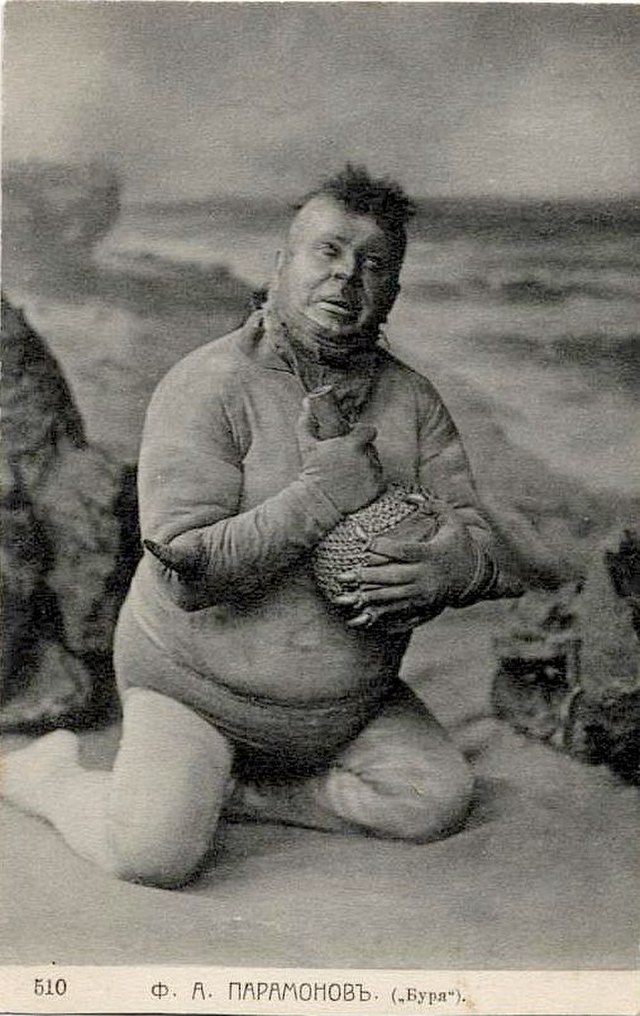
Before our first encounter with Caliban, I ask students to search for images of him in different stage and film productions. Wikipedia proclaims confidently that Caliban is ‘half man, half monster’, and Prospero describes him as a ‘mooncalf’ – a monstrous birth – and as ‘a freckled whelp hag-born, / Not honoured with a human shape.’ Many productions have taken their cue from this, and presented Caliban as a strange being who is only partly human. The students test Google Images to its limits, and find pictures of hairy wild men and strange scaly beasts. In one image he’s a weird lizard-man with green reticulated skin: in another, he’s encrusted with barnacles and seaweed. An early Caliban – Fyodor Paramonov in 1905 – seems almost human, but has enormous claws and spikes on his elbows. Hugh Griffith’s 1946 Caliban is warty and amphibious. A puppet version of Caliban, pictured on the RSC website, looks more like a giant toad.

Fyodor Paramonov as Caliban in 1905, complete with claws and spikes. (Source: Wikimedia Commons)

Many of these beast-like Calibans make the students laugh, but the more human Calibans get them thinking. We look at John Kani’s Caliban for the RSC in 2009, a dignified man who is almost a mirror image of Prospero, and Djimon Hounsou’s Caliban in Julie Taymor’s 2010 film version of the play. We examine Calibans who have scars, who look aggrieved and exhausted. Why might Caliban feel this way? What might have happened in his past?

We place these images alongside the words that Prospero and Miranda use to describe Caliban. He’s ‘a thing most brutish’, a ‘savage’, ‘filth’. He is ‘got by the Devil himself.’ He is, shockingly, addressed as ‘slave’, ‘poisonous slave’, ‘abhorred slave’, ‘most lying slave.’ Prospero calls him a ‘tortoise’, and while the students initially think this is funny, I ask them to think of it alongside the references to slavery: Prospero is insulting him for not doing his bidding quickly enough. The students discuss these descriptions of Caliban, and think about how much more appalling they are if they’re directed at a human being, rather than a giant warty mutant. Is it more effective, I ask, to present Caliban as a monster, or as a human? The penny drops. One student says, ‘If you present Caliban as a monster, you’re kind of justifying why Prospero treats him in the way he does, because Prospero wants to bring him under control. But if you present him as human, it makes Prospero seem worse. Prospero’s more of a monster than he is.’

There are a number of moments in the play that students find particularly intriguing. One is Caliban’s description of how Prospero treated him when he first came to the island:

When thou cam’st first,
Thou strok’st me and made much of me, wouldst give me
Water with berries in’t, and teach me how
To name the bigger light and how the less,
That burn by day and night. And then I loved thee,
And showed thee all the qualities o’th’isle,
The fresh springs, brine pits, barren place and fertile.
Cursed be I that did so!

The students are outraged on Caliban’s behalf. ‘It’s not fair!’ one of them exclaims. ‘He treats Caliban as if he’s really special, and then takes advantage of him. Caliban just wants to show off his island, and he ends up having it taken away from him.’ Another is Caliban’s description of the way Prospero’s demons torment him:

For every trifle are they set upon me;
Sometime like apes that mow and chatter at me
And after bite me, then like hedgehogs which
Lie tumbling in my barefoot way and mount
Their pricks at my footfall; sometime am I
All wound with adders who with cloven tongues
Do hiss me into madness.

We look at how the use of a soliloquy here enables Shakespeare to build sympathy for Caliban, allowing a direct communication with the audience. And then there’s the way Caliban reacts to Stephano, and the prospect of a new master. What does Caliban’s behaviour show us about him?

The students are full of ideas. He’s so used to being insulted that he almost throws himself at the first person who’s kind to him. He’s desperate to not be under Prospero’s power. One student points out that Caliban has been treated like rubbish for so long that he can only see himself as someone else’s servant: he doesn’t see himself as worthy of being free. I ask them to link these observations to the images we looked at, and they decide that the humanoid Calibans would just seem ridiculous at this point. One even says that the humanoid Calibans ‘seem funny, but when you think about it they’re actually really offensive.’ Their favourite Calibans, the ones they think are most powerful, are the human Calibans, those who are scarred and dignified. ‘It makes you think’, one boy says, ‘that Shakespeare was saying that colonialism was wrong, because this is what it did to people. It wasn’t just a physical thing, it was a mental thing as well. You never think of Shakespeare as being about things like that.’

The students will be writing their own Caliban monologues next week, exploring Caliban’s feelings about the island and the way Prospero has treated him. We haven’t read the whole play – we’ve missed out the Miranda and Ferdinand bits – and there hasn’t been a GCSE-style extract-based question in sight, but there has been a lot of rich discussion and close reading, and a real awareness of why representations matter.

Adoption, apologies, and various thoughts

I’m a huge fan of the Adoption and Fostering Podcast, hosted by Al Coates and Scott Casson-Rennie. One of the things I like most about it is the way it makes space for a wide range of voices and perspectives, reflecting how complex adoption is and how practically everyone involved has a different point of view. That was particularly apparent in their discussion this week of the recent call for the UK government to apologise to the many women who lost their children to adoption between the 1950s and the late 1970s. This is often referred to as the era of ‘classic’ adoption, when young unmarried women gave up their babies shortly after birth, and it shaped the lives of thousands of people: in 1968, the peak year for adoption in the UK, over 24,000 children were adopted.

I used the expression ‘gave up’ in that last sentence, and of course it’s not that simple. There are appalling accounts of women who were coerced into giving up their babies; teenage girls told that they had brought shame upon their families and women who were abused and insulted while they were in labour. ‘Giving up’ implies freedom of choice, and it’s clear that many women were given no choice whatsoever.

Al and Scott raise the point, very sensitively, of what it is that the Government would be apologising for. In Ireland, an apology was made earlier this year by the Taoiseach, Michéal Martin, and by Eamon Martin, the Catholic primate of all Ireland, expressing remorse for the role played by the church and state in running the network of mother and baby homes to which unmarried mother were consigned for most of the twentieth century. In the UK, where mother and baby homes were run by churches or charities, there was no such state-organised network. What about the role played by these churches and charities? What about the parents who were complicit in sending their daughters to these institutions? What about the extended families, the neighbours, the people behind the networks of whispers and gossip? Can a government apologise on behalf of a whole society?

Source: Wikimedia Commons

The podcast also touches on the expression ‘forced adoption’ and the way it has become a rallying-cry for opponents of adoption. Over the past few decades, these opponents have become increasingly vocal. But as Al and Scott point out, this often silences those voices that raise alternative points of view. I’ve been thinking, during these recent debates, about the women for whom giving up their babies was a free choice: the women who, in the days before free contraception and legalised abortion, welcomed adoption as the only way out of the circumstances in which they found themselves. I’ve also been thinking about the way that ‘forced adoption’ is used to describe the contemporary adoption system in the UK, where voluntary relinquishment is now extremely rare. ‘Cruel forced adoptions are still happening today,’ says a correspondent in the Guardian, and I don’t doubt that to birth families facing the removal of a child, involuntary adoption will seem appallingly cruel. Not for nothing has adoption been described as the most draconian measure a court can impose, short of the death penalty.

But. Neglect and abuse do happen. Some families do not engage with the support that’s offered, and do not make the changes that need to be made in order for their children to live with them safely. The timescales involved have to be tight. Six months might not seem long enough to recover from addiction, or break a pattern of abusive relationships, but it’s a long time in the life of a toddler, and huge amounts of developmental damage can take place during that time.

Adoption always involves loss. The birth family loses a child, or even multiple children. The children lose their ties to their biological family. Ongoing contact and life story work can help with this, but adoption still means growing up in a different family and being legally separated from the one into which you were born. In many cases, there are losses of culture and heritage. The ways in which these losses are felt will vary from one child to another, and from one stage of life to another. We can’t pretend that they don’t exist. But neither can we claim that every child can remain with his or her birth family.

It’s often difficult, as an adopter, to write about the ethics of adoption. After all, we’re the ones who get to make choices. We decide to adopt: nobody forces us to do so. We get to be parents, and that’s something that many of us might be unable to achieve otherwise. As adopters, we’re in a privileged position. Sometimes it doesn’t seem like that: when we’re struggling to access the support that our children need, or coping with disordered behaviour, or helping our children to negotiate difficult aspects of their life stories. But we do need to recognise this position, and grapple with the ethical issues it involves.

Social workers have taken a hammering too, this week, as a result of the recent review of children’s social care in England and Wales, which claimed that social services were overly focused on investigating allegations of abuse and neglect at the expense of supporting struggling families. It’s a scandal that social workers do not have the time, or the resources, to support families in need. But it’s absolutely right that allegations should be investigated, because while some allegations may be vexatious, and others unfounded, there will be children who need the state to step in. The hashtag #SocialWorkAtItsBest has been trending on Twitter today, with people sharing examples of the ways in which social workers have supported children and families, and I think it’s about time this kind of practice was shared more widely, to counter the narrative of bonus-chasing social workers snatching babies on demand.

Adoption, eh? It’s a massively complicated thing. All power to Al and Scott, who have been podcasting for over four years now, and to everyone who’s trying to raise these issues and do justice to the nuances involved.

Teacher Feature: Tom Crick

What do we do, as teachers, when we hit a crisis in our own lives? How do we manage if the world around us is falling apart?

That’s the situation that faces Tom Crick, the fiftysomething narrator of Graham Swift’s 1983 novel Waterland. His wife, Mary, is in a psychiatric unit after abducting a baby from a supermarket and pretending it is hers. Meanwhile, at the south London comprehensive school where he teaches, his subject – History – is under threat. His headmaster sees it as an irrelevance, and indulgence, in an age where budgets are being cut and future employment prospects are everything. He is also being challenged by a student called Price, a ‘teacher-baiter’ who argues that history is nothing more than a fairytale. It’s the 1980s, and the world faces the nightmare of nuclear annihilation. What’s the point of looking to the past when you might not have a future?

So Crick starts to tell his class a story. It’s the story of how he got to be in his present situation: a story of incest, murder and secrets, unfolding over the previous century and a half, and taking place against the shifting, restless backdrop of the Fens. It begins when Crick was a ten-year old schoolboy, living with his father and older brother in a lock-keeper’s cottage by the side of an East Anglian waterway, and takes in a whole sweep of Fenland history. The story loops back and forth, worrying away at the past like a persistent student and approaching it from different directions. As Crick’s lessons veer away from the French Revolution, and as he approaches his enforced early retirement, he tries to get his class to see that history not so much a collection of facts, but an attempt to understand oneself: to look at the process of cause and effect that brings you to your present state.

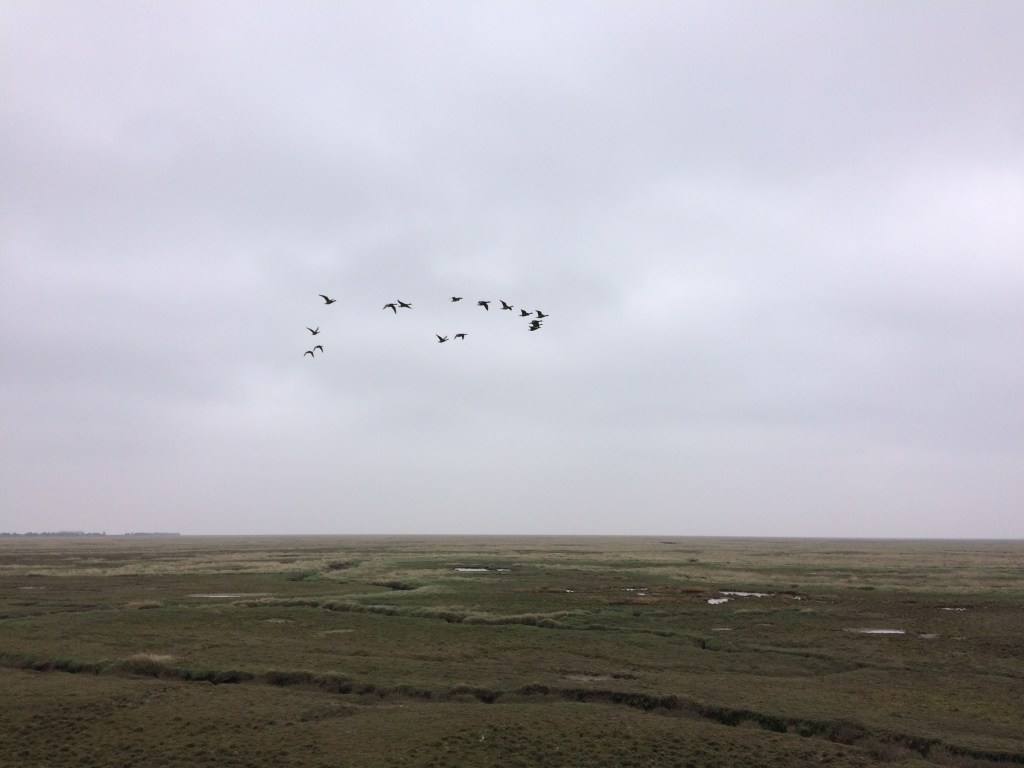
Geese over the Fens, near Boston

I first read Waterland when I was doing my A levels, and one of my A level History teachers was a Tom Crick. The other was a giant Welshman with a walrus moustache and a penchant for rugby, but our Mr Crick – who was also my form tutor – was a troubled man who was clearly undergoing a crisis of his own. He had several long spells of absence, and then a period when he only came in to teach his A level classes. He told me one day, during a tutor meeting to discuss how my A levels were going, that he’d been prescribed pills and sent to see a psychiatrist. It’s a hard thing to find out about, when you’re seventeen. When I was going through my own phase of wanting to rage at the universe, he told me I should go out into the middle of the street and scream. ‘At the top of your lungs. Better that way than on the edge of a building.’

Teaching, we’re often told, is like acting. You put on a face and perform. But if you spend more than a few years in teaching, it’s inevitable that you, or a colleague, will face something in your personal life that will shake that professional persona. Back in 2004, I was undergoing investigations for infertility. I had a series of blood tests to measure whether my ovaries were functioning properly. I got the results of the final test – which confirmed that basically it was all a bit of a disaster – one morning while I was at school. I had a choice. I could let everything fall to pieces, or square my shoulders and go off and teach my next lesson. We were in the middle of an Ofsted inspection at the time, so the former wasn’t really an option. I took a deep breath, and went off to my classroom, where there was already an inspector waiting to observe my next lesson.

I never thought, when I first read Waterland, that one day I’d end up teaching in the Fens. It’s a weird landscape, huge skies, flatness, and the constant presence of water, pumped out from the land into drains and ditches, gleaming straight lines of silver. No broad sunlit uplands; no moments of the sublime. As Tom Crick asks: ‘To live in the Fens is to receive strong doses of reality. The great, flat monotony of reality; the great empty space of reality. How do you surmount reality, children? How do you acquire, in a flat country, the tonic of elevated feelings?’ The Fens have a beauty all of their own, but it’s a strange beauty, an acquired taste.

I never found out what happened to my history teacher, and we never find out what happens to Tom Crick and his wife, either. Teaching is many things. Sometimes, it’s frustrating: sometimes, it’s a slow, laborious daily grind, and sometimes it gives you moments of joy and hope that bring home what a real privilege it is to work with young people. And sometimes, it’s a form of support, a splint: a chance to put on a mask and carry on, a sense of purpose that takes over when everything else seems meaningless.

What schools need to know about adoption

My son, the Dude, finished his school career a few weeks ago, and is enjoying a blissful summer before starting college in September. (Well, not entirely blissful, as he’s broken his hand, but he’s managing). It’s fair to say that school can be a difficult place for adopted and care-experienced children, and we’ve had our share of issues to cope with over the years. As an adoptive parent, you have to spend a huge amount of time being your child’s advocate, and this often involves having to explain things about adoption that you’d hope education professionals would be aware of already. So here’s my list of things that schools need to know about adoption, based on fourteen and a half years of adoptive parenting.

A long, long journey: the Dude, aged two, shortly after his arrival
  1. Adoption has changed since the 1960s and 70s. It’s no longer about young single mothers giving up tiny babies because there was no other option available to them. The vast majority of children adopted in the UK nowadays have been taken into care as a result of abuse or neglect. A court then has to be convinced that there is no possible chance of them returning safely to their birth parents. For this decision to be made, a huge amount of evidence has to be built up. That takes a long time – time when children might have been in harmful situations or in the uncertainty of foster care. All of this will have had an impact.
  2. Linked to this is the fact that children don’t have to have a conscious memory of the events that led to their adoption in order to be affected by them. Early trauma – neglect, abandonment, exposure to harm – disrupts the formation of secure attachments, and leaves its mark on the developing brain. Some of our children will also experience the consequences of poor antenatal care and exposure to drugs and alcohol before birth. It’s not a question of whether our children ‘remember’ any of this.
  3. Adopted children are not lucky. Even if they’ve been adopted by the most supportive and loving of parents, who can give them experiences and material advantages that their peers don’t have, this doesn’t make them lucky. In order to be adopted, they will have been through a whole raft of pretty horrible experiences. Living through circumstances that are so bad that a court has to separate you permanently from your family of origin does not make you particularly fortunate.
  4. Adoption doesn’t make everything okay. The effects of early trauma mean that some of our children will continue to need support for years into the future (and some adoptive parents will have to fight for every bit of this support, because accessing it isn’t easy). So don’t roll your eyes and claim that adoptive parents are making a meal of it when they remind you that you need to make adjustments.
  5. The classroom can be a scary place. This applies especially to children who have only just been placed with their adoptive families, who will be facing a whole bunch of new situations and people and sensations, and might well be in a different part of the country. But even children who are relatively settled in placement might still find the school environment overwhelming. Give them a safe base and clear routines that don’t involve having to make too many choices. This is particularly important in the early years, when free flow play can present children with so many different options that they end up completely bewildered: it’s like having too many puddings to choose from.
  6. Some areas of the curriculum can be extremely difficult for adopted children. Anything that involves bringing in photos of yourself as a baby, talking about your family tree, reading about children who are displaced (Goodnight Mister Tom, I’m looking at you), talks from organisations about trauma and abuse. If you’ve got adopted or care-experienced children in your school, you should do an audit of your curriculum and, if necessary, liaise with parents or foster carers. There’s a surprising number of adoption-related set texts on GCSE English Literature specifications: make sure your students aren’t blindsided by the vengeful birth mother in The Woman in Black, or the appalling worksheet on Blood Brothers that asks students to imagine only finding out that you’re adopted when you discover your original birth certificate at the age of sixteen.
  7. For many adopted children, shame can be an overwhelming emotion. Shame about what happened in their past; shame about whether it was their fault; shame about having a different kind of family. This can then bleed over into other aspects of their lives (being told off, losing a game, doing badly in a test, being teased in class). Help them to manage their reactions, but be aware that this is a difficult thing. Don’t expect them to just laugh it off, or chide them for not being able to take a joke. And don’t tell them it doesn’t matter, because it does.
  8. Social thinning is a very real thing. Many adopted children struggle to form friendships, and will need support with this. Nurture groups, friendship benches, extracurricular activities: they’ll all help. If possible, help our children to build friendships that will extend beyond school as well. Those cliques at the school gate will often exclude our children from playdates and parties, especially if their behaviour marks them out in class as being different. Anything you can do to combat this would be brilliant, and adoptive parents will be extremely grateful.
  9. Do pass on information. Make sure everyone involved in the child’s day-to-day school life knows everything they need to, including any relevant information about developmental trauma and triggers to watch out for. It sounds obvious, but it doesn’t always happen.
  10. Don’t expect adopted children to be spokespeople for adoption. They might not want to talk about being adopted. They might not want their friends to know. That’s fine, it’s up to them. It’s not a secret, but it is private. They might find anything that sparks memories of life-before-adoption really scary. They definitely shouldn’t be put in a position where they’re asked ‘What’s it like to be adopted?’ in front of a whole class of their peers. If they want to talk about it, that’s different, but make sure it’s a safe environment.
  11. Jokes about adoption really aren’t funny. The only funny adoption-based joke I know is the late Jeremy Hardy’s comment about how some parents like to cook and eat the placenta, after their child is born: adoptive parents don’t have that option, so they might want to cook and eat their social worker instead. He was allowed to say that because he was an adoptive parent. Don’t say ‘I bet your mum wishes she’d given you up for adoption’ to a random kid in your class who’s just done something mildly foolish. Really. Just don’t. Even if you don’t have any adopted or care-experienced children in your class. It’s still all shades of wrong.
  12. Adoptive parents are real parents. We went through a lot to get here. As one of my friends eloquently put it: ‘You had to go on courses and be assessed and everything; most people just have a shag.’ Our children might not be genetically related to us, but we love the very bones of them. And they’re bloody amazing, so help us to look after them.