Seamus and Year Eight and me

In Reading Lessons, I write about the shadow colleagues who share my classroom and help with my lessons: the novelists and poets and playwrights without whom I couldn’t do my job. This week, with Year Eight, it’s been Seamus Heaney. Lovely Seamus: I think he’d have been a good person to work with, slightly irreverent but also deeply wise, with a well-honed sense of the difference between the things worth cherishing and the merely faddish. He’d have a secret biscuit stash, too.
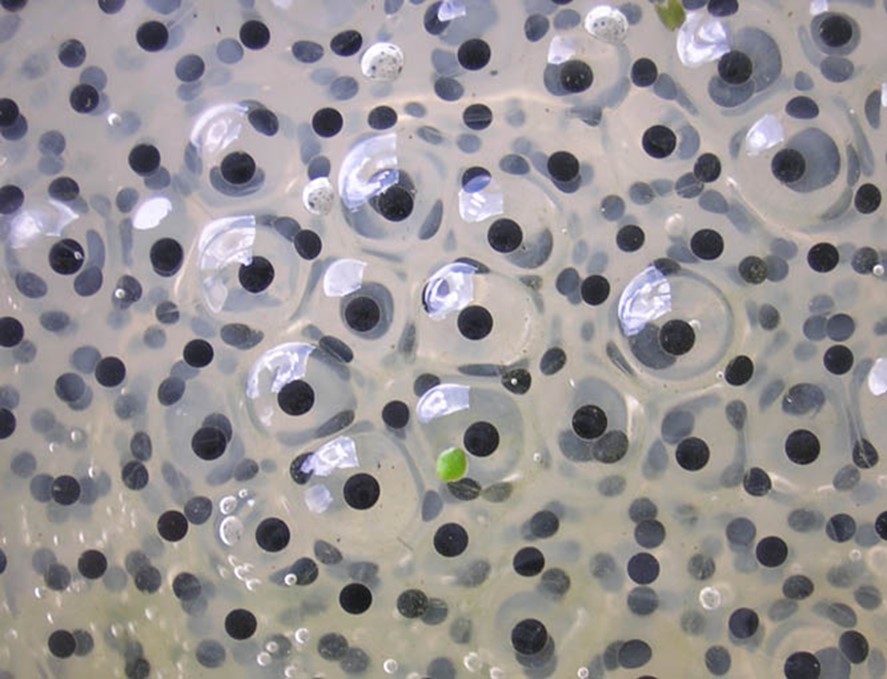
Frogspawn!

We’ve been teaching Year Eight about close reading, Seamus and me. Our Year Eight poetry unit – now in about its tenth iteration – is called ‘Mysterious Beasts’, and focuses on poems about different creatures. We explore William Blake’s ‘The Tyger’, Ted Hughes’s ‘Pike’, and U.A. Fanthorpe’s ‘Not My Best Side’, alongside a number of poems from Robert Macfarlane and Jackie Morris’s beautiful book The Lost Words. And we write our own poems, experimenting with diction and form, making careful choices of language. Before Christmas, we wrote a haiku about a pangolin, trying to find the exact way of conveying its pineconey strangeness. You can’t waste words with a haiku; they’re brilliant for developing precision.

This week, we looked at Heaney’s poem ‘Death of a Naturalist’. It’s been the first week back after Christmas, so we eased ourselves in with a wordcloud that allowed us to explore some of the key vocabulary in the poem. We noticed the rhyme of ‘clotted’ and ‘rotted’, and the onomatopoeic ‘slap’ and ‘plop’. We used dictionaries to find the precise meanings of ‘obscene’ and ‘coarse’, and talked about the fact that ‘coarse’ can be both literal – a prickly item of clothing, a hessian sack – and metaphorical. We talked, above all, about unpleasantness: about smells and textures and associations. We said words out loud. Slap. Slime. Spawn. Say them, and draw out the ‘s’ sounds: there’s something there to luxuriate in, to enjoy.

Introducing the poem: our wordcloud

This gives us a neat springboard to talk about how often, as children, we relish exploring things that would make our older selves squirm. The boys share stories of digging up worms, playing in mud, squishing up their food and making shapes with it. Before they’ve even seen the complete poem, they’ve started to inhabit the sensory world that Heaney creates in it, and from this point, it’s just a short jump to the flax-dam in the townland, sweltering in the heat of the sun.

We listen to Heaney reading the poem out loud, because it’s best in his voice. Here he is: give him a listen. We listen twice, and try to identify the story he is telling. The first part of the poem is relatively simple, the boys decide. It’s a little boy who collects frogspawn, and is fascinated by it. He fills jam-jars full of it and watches as the tadpoles hatch. But then, in the second part of the poem, something changes. There’s a threat, a fear. The boy is surrounded by frogs and feels their anger. There is something disgusting about them that wasn’t there before. They are an army, intent on revenge. We talk about what has happened. They want vengeance, one boy volunteers, because the narrator stole their children and abandoned them, and it’s a perfect summing-up of what Heaney describes.

This is one of my favourite poems to teach, and this Year Eight group is one of my favourite classes. They’re sparky, full of ideas, but biddable. We have routines. Countdowns from three and then silence. If I stand at the front of the room with my hands on my head, they have to stop what they’re doing and put their hands on their heads, too. They like the predictability of it. They like lots of positive framing – well done to all those people who’ve put the heading and date and underlined it neatly – and rewards. And they like to discuss. One of my PGCE lecturers, back in the mid-90s, talked about students as being divided into ‘oopidoops’ and ‘begetters’. The oopidoops were the lively ones, like shaken bottles of lemonade, needing to be channelled and directed. The begetters would just be getting on with what they were supposed to be doing. This class is about half and half. I have a fantastic TA who is brilliant at spotting when someone needs a fidget toy, a resistance band for some sensory input, a quiet moment outside. He’s also brilliant at suggesting alternative interpretations and offering thoughts. We bounce ideas off each other and enable the students to see that in English, there are shades of meaning waiting to be explored, ambiguities that don’t need to be resolved and closed down. It’s okay to hold multiple possibilities in your mind.

It’s a double lesson, and we need a movement break by now. An hour and forty minutes is a long time to sit, when you’re twelve. We stand up. A necessary stretch; some shoulder rolls and finger wiggles. Some jumps and hops to discharge some of that oopidoop energy. Then some smaller movements, borrowed from my Pilates instructor, to get them focused and concentrating again: sway into your toes and then into your heels, without taking your feet off the floor, and do this slowly, breathing in as you go forwards and out as you go back. Two minutes and we’re working again. We’re looking more closely at Heaney’s descriptions now, and at how he blends pleasure and disgust. We examine how he builds the setting, and relate this to the ditches and streams that the boys know, what they smell like in summer when they’re thick with vegetation. We discuss the precise meaning of ‘sweltered’, the stickiness and discomfort. We explore the contradictoriness of ‘gargled delicately’, and I introduce the term ‘oxymoron’, easing the vocabulary in where it’s needed rather than teaching it in isolation.

I ask the boys their favourite line. ‘But best of all was the warm, thick slobber of frogspawn’ is the overall winner. They love the sensoriness of it, that childlike delight – best of all – in the warmth and ooze. They love the word ‘slobber’, and say it, just like ‘spawn’ and ‘slime’. They listen to each other, and build, consciously, on each other’s contributions. When they write their ideas down, they’ve got lots to say. Sometimes, they need a bit of help shaping it. ‘I know what I want to say, but I’m not sure how to say it’, one boy tells me. I ask him what he wants to say, and it’s perfect. ‘So can I just write that down?’ he asks. I reassure him that yes, he can, and he’s off, pen whizzing across the page.

I could do all of this in a very different way. I could stand at the front and tell them, line by line, what the poem means. They could copy down my annotations and then write a perfectly-scaffolded paragraph. But the poem would stand apart from them, somehow. As it is, they’ve inhabited it. They’ve explored it, stage by stage, peeling back layers, making connections. This isn’t child-led ‘discovery learning’. It’s carefully structured and relies on a deep understanding of both the poem and the class. It’s a lot harder than lecturing from the front would be. It certainly requires more energy, more presence in the room, more of a sense of who’s thinking what: whose ideas to draw out a little bit further, who to ask next, who needs a bit of help to articulate what they’re thinking. By the end, I need to sit down somewhere quiet.

But this energy is what makes it all worthwhile. Years ago, Richard Jacobs described English teachers as like lightning conductors for the relationship between the text and the student, and that’s what teaching this particular class is like. We had a good time, Seamus and my TA and Year Eight and me, and it reminded me why I like my job so much.
On writing, aged 48

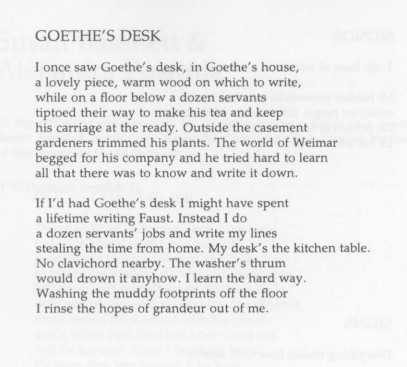
Years ago, I read a poem by Susan Bassnett, then Professor of Comparative Literature at the University of Warwick, called ‘Goethe’s Desk’. The narrator sees Goethe’s desk in Goethe’s house, and muses on what she could have done if she’d had Goethe’s desk to work at, rather than having to do ‘a dozen servants’ jobs’. Here’s the poem:

I was reminded of ‘Goethe’s Desk’ last week, when the Women’s Prize for Fiction and Good Housekeeping magazine launched a new scheme for women novelists under 35. Joanna Walsh, who runs the Twitter feed @noentry_arts, wrote an open letter asking for the age limit to be removed, citing the many inequalities experienced by women: access to education and free time, an excess of caring responsibilities, and intersectional obstacles stemming from social class, ethnicity, disability and illness. Age-based prizes, the letter argued, favoured ‘those with the cultural confidence, time and money to commit to a writing career while young’. How do you achieve this conviction that the world is waiting to read what you have to say? How do you get your words out there, without the knowledge of how publishing works, the connections and advice and help up the ladder? And how do you silence the voice in your head that tells you there’s something else you should be doing?

The @noentry_arts campaign really resonated with me, as a woman writer in my late 40s. I don’t write fiction – my genre is narrative non-fiction – but my journey to becoming a writer has been shaped by many of the factors that Walsh cites in her letter. The most obvious of these is the lack of free time, stemming from juggling writing with childcare and full-time work. Behind this, though, there’s also a raft of issues to do with social class, a lack of the kind of cultural confidence and connectedness that Walsh refers to, and a hefty dose of the kind of impostor syndrome that I should really have outgrown by now, but haven’t. So here’s me, and here’s how I came to be a writer, at 48.

It all started when I was four. That was when I first read a book – a whole book – all on my own. It was Five Run Away Together – the third in the Famous Five series – and I didn’t even know if I should be reading it, because it wasn’t my book. It was a hardback, with a faded red cover, and I’d found it in the sideboard in our house. I knew it must belong to one of my siblings, but I didn’t know which one. All I knew was that I’d found a book and it looked interesting. The writer had a funny name, written in a way that made it look like ‘Gnid Blyton’. I knew it probably wasn’t Gnid – that was a silly name – but I didn’t know what else it might be, and anyway, I wanted to get on with the story. So I squeezed myself into the little space between the sofa and the wall, the place where I used to hide if I didn’t want anyone to know where I was, and settled down to read. I had no idea what I was letting myself in for.

Enid Blyton’s got a lot to answer for. I’m not talking about the sexism, xenophobia and disdain for the working classes. They’re appalling, of course they are, but I didn’t notice them when I was four. The thing that possessed me was the idea of adventure. I wanted a boat of my own, and a torch, and a little camping stove powered by a bottle of methylated spirits. I knew I was never going to have my own island with a ruined castle and an actual dungeon, but the rest seemed reasonable. Well, perhaps not the boat. I asked for the torch and camping stove for my fifth birthday. I got the torch, but not the stove. The torch was useful, up to a point, but there wasn’t really an awful lot that I could do with it. There was an acute shortage of the key ingredients of adventure in Newton-le-Willows in 1977: no smugglers or travelling circuses with escaped jewel thieves or rogue scientists trying to steal important blueprints. So I decided that if I couldn’t actually go on any adventures, then the next best thing might be to write about them. When my sixth birthday came around, I asked for a desk so that I could be a proper writer, and that’s really when it all started.

By the time I was halfway through my second year at primary school, my Famous Five obsession was so firmly embedded that the headmistress took my mum to one side. It was getting a bit much, she suggested. Every piece of writing I did was linked to the Famous Five in some way. I’d even managed to write an imaginary interview with Julian (though, sadly, I didn’t ask him anything about his massive superiority complex). I needed something else to be interested in. So I started to go for riding lessons, and horses quickly replaced junior sleuths as my main object of interest. Inevitably, like all horse-mad little girls, I wanted my own pony. And inevitably, like most horse-mad girls, I couldn’t have one. We had nowhere to keep a pony, and anyway, ponies were expensive. If I wanted a pony, I’d have to find some way of earning some money. How could I do that? The solution, to seven-year-old me, was obvious. I’d have to write a book.

I tried to write lots of books, over the years. To begin with, most of them featured ponies. I was good at drawing and decided that if I could illustrate my own books as well, I’d earn even more money to put towards a pony. The problem was that I didn’t have a lot of staying power. I’d come up with a good idea but didn’t know how to carry it through. I tried to write a book about British native pony breeds with pictures in biro of Shetlands and Exmoors and all the different sections of Welsh (there are four; I knew my stuff) but never managed to finish it. I spent the summer between primary and secondary school writing a book called One Jump Ahead, about a girl called Rebecca who gets a pony called King and turns him into a champion showjumper, and filled an entire Woolworths notebook which I’ve still got somewhere. As a teenager, I went through a phase of wanting to write scripts for soap operas, but had no idea how you’d actually get involved in that for real, so Brookside and EastEnders had to suffer my loss. And that, actually, was the problem. I spent a lot of time in my room, writing, or walking the streets, thinking of things to write about, but I didn’t have the first clue how you went about becoming an actual writer with your work published and your name in print. Pretty much all of my writing went completely unread by anyone except me: stored away meticulously, paper-clipped and treasury-tagged, then filed away for some mysterious day when Somebody would want to read it.

Story of my life. (Card by Rosie Made A Thing)

I was the first person in my family to go to university. I went to Oxford to do English, with vague ideas of staying on to do a doctorate and become an academic, fuelled by reading too much David Lodge. On my first day there, waiting in the porter’s lodge to get the key to my room, I had my first real-life encounter with a lacrosse stick, the first time I’d seen one outside the pages of Enid Blyton. On my second day, standing in the front quad, I talked to a boy on my course about the essay on nineteenth-century literature that we’d had to do over the summer. We’d been told to write about either the presentation of women or the presentation of the working class. ‘Well, I’m not a woman and I’m not working-class,’ he explained, all bright eyes and floppy hair. ‘I wasn’t sure which one I should do.’ I remembered earnest conversations in the sixth form common room when we’d tried to decide which social class we belonged to. We were, almost universally, the children of people who’d started at the bottom and worked their way up: my own parents had both left school at 14, and my friends’ parents were nurses and schoolteachers, skilled tradespeople and the owners of small businesses. Nobody – not even Catherine, whose mum and dad read the Guardian – was confident enough to plonk themselves wholeheartedly in with the middle classes. My floppy-haired new friend at Oxford had no doubts whatsoever. His uncle was a senior QC; his family was right up there at the heart of the Establishment. He himself aspired to be a barrister. To me, this spoke of a lack of commitment to English. It seemed disloyal. All I wanted to do, by that stage, was to spend my life reading books and writing about books and eventually – I hoped – end up writing books myself. I’d stopped riding by then, and given up on the idea of a pony, but getting my name in print was still there, hovering like a distant dream.

As it was, I didn’t apply to do postgraduate work immediately after my degree. I wasn’t sure I’d get the funding. I knew that my family wouldn’t be able to pay, and they certainly wouldn’t be able to help with my living expenses. I wouldn’t have asked them to: why should they, when my siblings had all supported themselves from leaving school? I also knew that jobs in academia were few and far between, and that I’d have to be prepared to move to wherever the jobs happened to be, scraping by on temporary contracts in the hope that I’d manage to get something permanent eventually. This was so far outside my family’s experience that I didn’t have the confidence to take the risk. I could have headed into journalism, but again, it was something I knew nothing about. I’d done a tiny bit of writing for student publications, but had been put off by the number of people who seemed to know exactly what they wanted to say and were absolutely confident that people would want to hear it. My elbows didn’t feel sharp enough. Instead, I played it safe, like so many first-generation university students from non-traditional backgrounds, and did a PGCE. I got a job at a school in south Lincolnshire, a part of the country I knew nothing about but that sounded nice, and that’s where I still am, twenty-five years later.

I did do a PhD eventually, but I did it a different way, part-time, while teaching full-time. I wrote a book – the snappily-titled Defining Literary Criticism: Scholarship, Authority and the Possession of Literary Knowledge 1880-2002 – and co-wrote two others. Then I became an adoptive parent, and started to think, a lot, about the ideas people have about adoption, the way adoption is depicted in the media and in popular culture, and how far removed these images are from the reality of adoption today. I wanted to explore these perceptions, to tell this story. And so I started to write, again.

It’s not easy, combining writing with working full-time – I’m now a Head of English – and being a parent. I write in whatever gaps I can open up around the rest of my life. There are frantic bursts during school holidays and then weeks during term-time when I can barely write at all. It takes a huge amount of self-discipline, and there’s always something else demanding my attention. But I wouldn’t be me, without it.

I need to be the age I am to write what I do. I couldn’t have written about adoption without becoming an adoptive parent, without living that particular reality and having to tackle the complexities that adoption brings. It took me a long time, and hours of redrafting, to get my work to the stage where I felt ready to submit it to an agent, and I had to give myself a stern talking-to before I pressed Send.

I don’t have any hopes of grandeur, but I do want to get my writing out there. I have an agent, but no publisher. I know it takes time. So I am working on an idea for another book, and being patient and trying to build a platform. The struggle with impostor syndrome is still there: that lurking, constant feeling that at some point, someone will give me a polite nudge and tell me to get back in my box. But maybe, one day, I’ll get lucky. And now that I’ve started horse riding again, maybe one day there will be a pony, after all.