Adoption stories

Here’s a story I’ve told before, elsewhere. When the Dude was about eight, I took him round to a friend’s house to play. The friend’s little brother was there too. ‘Put your hand up if you’re adopted!’ demanded the little brother, and the Dude dutifully did. ‘You’re going to go to prison!’ the little brother announced. ‘All adopted people go to prison.’

I have no idea where exactly the little brother got that idea from. I don’t think it was his parents – at least, I hope not – but, let’s face it, it wouldn’t need to be, because there are enough stereotypes of adopted and care-experienced people around to sink any number of proverbial battleships. I’ve read so many books featuring adopted characters over the years, and watched so many films and television programmes, that I could list them in great detail, from the saintly adopted child who brightens everyone’s life to the monstrous cuckoo in the nest who destroys his or her adoptive parents with a cold, glittering joy. That character slinking around on the sidelines, unable to form relationships: my spidey senses will start to tingle, and when it’s revealed that they’re adopted, I’ll add them to my mental list, cursing the fact that the Dude and his adopted and care-experienced peers have yet another stereotype to battle against.

Not your actual adopted child. (Source: Wikimedia Commons)

A few months ago, I read the latest novel from one of my favourite novelists. It featured not one but two adopted characters, and it was disappointing, to say the least. The fact that these characters were adopted served no other purpose other than to underline the fact that they were both a bit odd. They weren’t outright villains – they weren’t criminals, and they weren’t even seething with resentment – but the reader clearly wasn’t meant to like them. They were depicted as being a little bit ridiculous, and a little bit mercenary. Their adoption wasn’t central to the plot in any way. There was no big reveal about their biological parents, and the fact that they were adopted was only mentioned a couple of times in the whole novel. It only seemed to be there to mark them out as other, and to underscore the fact that their relationship with their parents was less than perfect. Not dysfunctional, not unhappy; just a little bit distant, and unaffectionate.

It’s a pity. This particular writer is skilful enough to create a slightly odd family without needing to make it an adoptive family. It seemed to be used in this particular novel as a complacent form of shorthand, resting on a shared understanding between writer and reader. Look! This is why they’re a bit weird! And it’s an example of how such stereotypes slip through the writing and editing process unquestioned, as if adoption and care experience are somehow up for narrative grabs.

In the Epilogue to her extraordinary memoir Ootlin, Jenni Fagan writes of the stories we are told about who we are. Fagan, who grew up in the care system, points out that ‘for many of us those stories are complex and sometimes wholly against our own well-being.’ Other people were afraid of her, or refused to accept her, or didn’t bother to find out who she really was, ‘because they often could not get beyond what I represented as a child in care.’ Having an identity projected onto you, being ascribed certain characteristics purely because of the circumstances of your early life: this is something we shouldn’t accept for any of our children, and we shouldn’t allow our publishing and entertainment industries to perpetuate these stories, either.

It was excellent, then, to read the BBC’s article on stereotypes of adopted characters in films, because I have felt that for far too long, the entertainment industry has made vast amounts of money out of peddling the kinds of images that would be unthinkable if they related to any other minority group. Money that could, incidentally, be diverted towards providing support, because the other big adoption-related story in the news over the last few weeks has been the story about adopted children being returned to care because of a desperate lack of help. Young people suffering the effects of developmental trauma, and families unable to cope with the violence and aggression that can result from this: it’s an appalling read. As a society, we need to do better.

My son’s reply to his friend’s little brother was brilliant. ‘I think you’ll find’, he stated, ‘that actually, most superheroes were adopted.’ And indeed they were, but that’s another stereotype. There is danger in a single story, as Chimamanda Ngozi Adichie points out, but there is danger, too, in a bifurcated story, a binary division. It would be really good to see some adopted characters in fiction who are just going through life like their non-adopted peers, neither misfits nor superheroes, but people treated with nuance, understanding, and dignity. And it would be even better to see an increased understanding of the reality of life as an adoptive family, so that the desperate struggle for support can be alleviated.
The bookhood of books

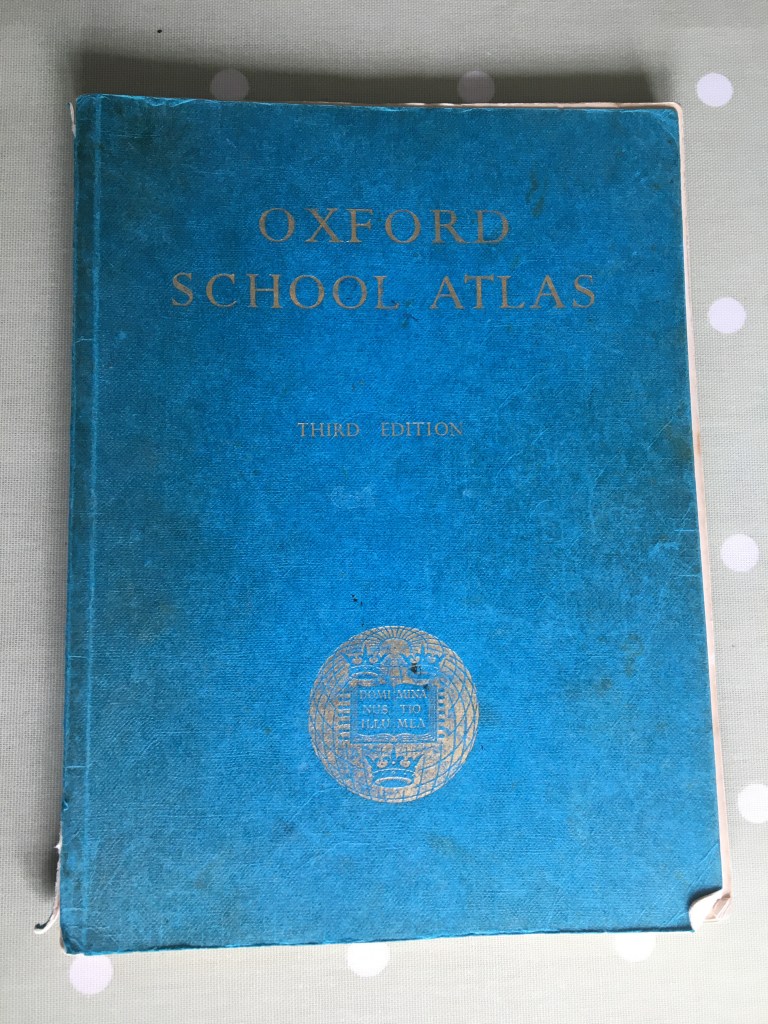
Here’s one of the most important books I own:

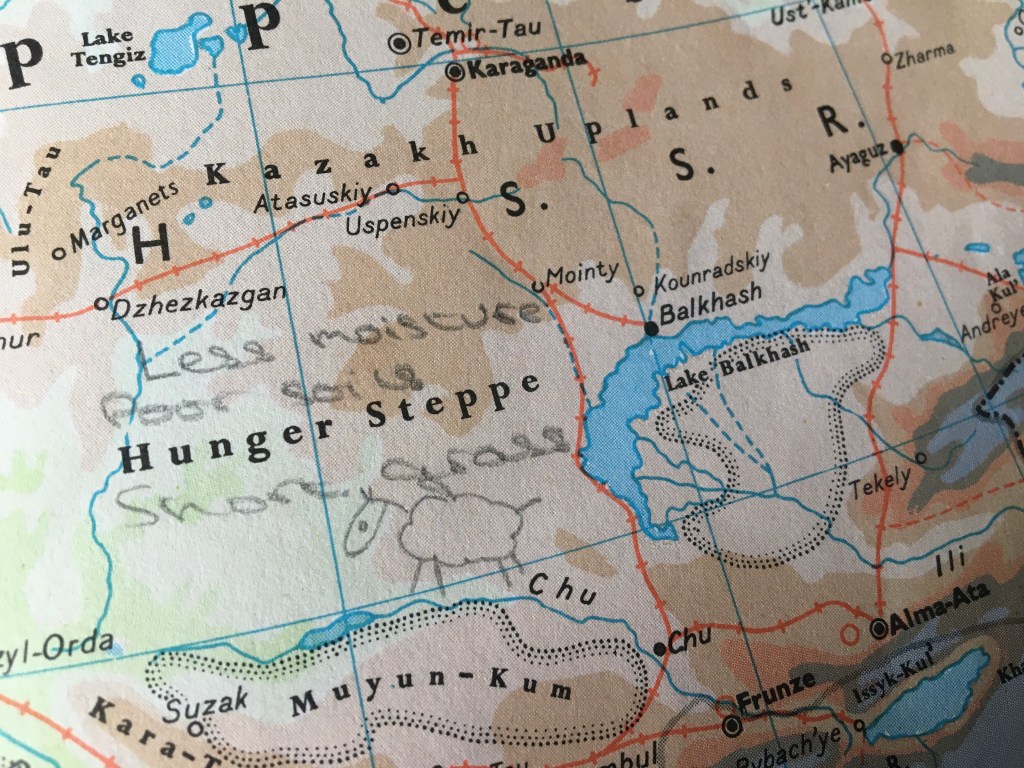
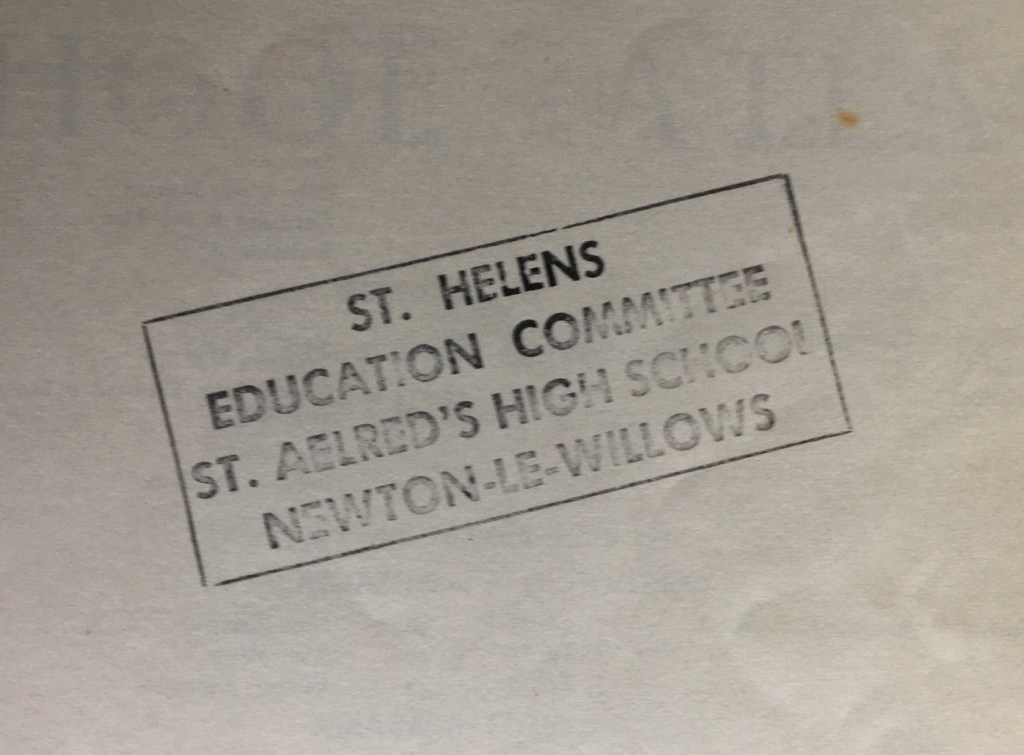
On the face of it, it’s not particularly special. It’s a 1976 copy of the third edition of the Oxford School Atlas, a paperback edition with a cover that’s faded and softened with age. Its spine is peeling and it has a couple of suspicious stains. The edges of its pages have worn soft with years of handling. It contains countries that don’t exist any more, like Yugoslavia and the USSR, and doesn’t contain countries that do exist now, like Eritrea and North Macedonia and Namibia. (Macedonia’s marked out as a vague area spanning southern Serbia and northern Greece; Eritrea appears and disappears depending which page you’re on). Germany is divided; Czechia and Slovakia are united; Zimbabwe is still Rhodesia and St Petersburg is still Leningrad. But it’s a book that’s important to me for other, more personal reasons. It was issued to my sister when she was doing A level Geography back in the late 1970s. You can’t mistake it for anything other than a school book. Inside its front and back covers, and on several other pages, it bears the stamp of its original owner:

But for some reason, lost now in the mists of time, it never made its way back to St. Aelred’s High School, and has been in the family ever since. I’m not sure exactly when it became mine, but I have always loved maps and I must have spent hours poring over it, over the years, working out where different countries are and thinking about all the places I wanted to go to. There are pencilled annotations on some pages from when I did GCSE Geography between 1987 and 1989, and various asterisks showing where we spent family holidays. At some point, it travelled down with me to south Lincolnshire, and here it’s going to stay.

Less moisture, poor soils, short grass

I spend a lot of time thinking about books, not surprisingly, but this week I’ve been thinking a lot about the physicality of books, the bookness of books, thanks to Emma Smith’s fabulous book Portable Magic. Smith focuses on what she describes as ‘bookhood’, a ‘material combination of form and content’: our physical and sensory engagement with books, their smell and feel and heft. ‘If you think about the books that have been important to you’, writes Smith, ‘it may well be that their content is inseparable from the form in which you encountered them’. And so I’ve been looking at my shelves, tracing the spines of books I haven’t read for years but nevertheless consider an important part of my life. The Penguin copy of David Lodge’s Nice Work that kicked off my reading the summer after GCSEs. Old Faber poetry books with their distinctive coloured covers. The Armada Lions copy of Joan G. Robinson’s Charley that I borrowed from my sister’s bookshelf when I was about nine and loved it so much that I couldn’t bear to put it back. (I did buy her a replacement copy several years later, honest.)

Smith’s book is intriguing, exploring the physical form of books as diverse as the Gutenberg Bible, the various editions of Rachel Carson’s Silent Spring, the Choose Your Own Adventure novels of the 1980s, and the paperbacks defaced – or upcycled – by Joe Orton and Kenneth Halliwell. In her opening chapter, Smith describes one of her school set texts:

‘The edition of Thomas Hardy’s Tess of the d’Urbervilles we had at school was most remarkable for its transparent cover film that called irresistibly to be peeled back, leaving behind a washed-out still of Natassja Kinski wearing a straw hat from Roman Polanski’s 1979 film: later, weakened by these depredations, I think my copy had to be backed in wallpaper left over from our spare bedroom.’

I’m itching to peel that cover film off right now, although I’m less keen on the wallpaper: I remember backing my Maths textbook in Anaglypta, and never being able to close it properly afterwards.

The physicality of schoolbooks, set texts, is something that’s been on my mind for other reasons this week too, because it’s the week when we’ve been doing our budget requests and thinking about that eternal question of how to balance what we’d really like with what we strictly need. We’ve spent quite a lot on books over the past couple of years, updating worn-out stock and introducing new texts. For September, we need a whole new set of novels for Year Seven (we’ve decided on The Bone Sparrow) and also another complete set of A Christmas Carol (we use the English and Media Centre edition). And it’s going to cost. There are other sets of books that we’d like to replace, but we’re not sure if we’ll be able to. How many years can you make your texts last for? How long can a set of paperbacks survive?

I remember my own English set texts. For GCSE we had a hardback Players’ Shakespeare edition of Macbeth and I can remember the different layers of annotations it contained, several years’-worth of other people’s handwriting, mostly in pencil but some in illicit biro. ‘”Aroint thee, witch”, the rump-fed ronyon cried’ was glossed, with some relish, as ‘Get lost, you fat-bottomed slut’. This was the cash-strapped late 80s, and a lot of our school books were past their best, to say the least. We had to handle them gingerly, not just because they were fragile but also because they were, sometimes, grubby and musty. The narrator of U.A. Fanthorpe’s poem ‘Dear Mr Lee’ speaks of her beloved school copy of Cider with Rosie, ‘stained with Coke and Kitkat and when I had a cold’, and anyone who’s been near a set of school books will know how unhygienic some of them can look, especially once they’ve spent a few months sharing a schoolbag with the detritus of teenage life: discarded football socks, the remnants of several packets of crisps, sedimentary layers of packed lunch.

As a teacher, I’m obviously very conscious of the content of the books I expect my students to read, but I also think the physical form of these books is important, too. I’m definitely not advocating for a full sweep of new books every year, but I want my students to spend time reading their set books, poring over them and being absorbed in them and maybe even – gosh – enjoying them, and therefore I don’t think it’s fair to give a student a book that is fusty or tattered or unpleasant to touch, a book whose pages are swollen from the time when someone’s water bottle – or worse – leaked over it, or a book that’s falling apart. I think the condition of the books we hand out gives an important message to students not only about how much we value reading in general, but also about how much we value their particular experience of reading. There are many, many secondary school students up and down the country whose homes contain very few books. The books we give to them in school need to be attractive and cared-for, ones that we’d be happy to have on our own shelves. Books matter.

Making sure books get returned at the end of the year is another perennial headache, although given the provenance of my Oxford School Atlas, you could be forgiven for calling me a hypocrite. I don’t remember St. Aelred’s ever having a book amnesty during the time I was there, between 1984 and 1991, but even if they had, I’m not sure I’d have taken the atlas back. It was too much a part of the family by then, in the way some books are. St. Aelred’s doesn’t exist any more – it was amalgamated with another local school in 2011, and has now been demolished – and I don’t think St. Helens Education Committee would want it back now, outdated as it is. In any case, I’ve spent enough of my own money on school books and supplies over the years. I think I’ve made amends.