Teacher Feature: Mr Sugden

I hated PE at school. It was the one subject at which I was truly rubbish. I probably wasn’t that rubbish – I could catch a ball, as long as I knew which direction it was coming from, and one joyful year in primary school I actually got a B+ for PE in my end of year report, to put alongside the smug row of As that I’d got for everything else. But I was bad enough for PE to be something I dreaded, week after week. I read a blog post this week about the anxiety that many students experience in Maths, and could recognise a lot of it. Fortunately, my main Maths teacher at school was the lovely Mr Wilson, who was just about the least anxiety-inducing individual on the planet and got me safely through GCSE to the point where I would never need to do Proper Maths ever again. But PE: no. It wasn’t exercise that was the problem. It was the rules; it was the picking of teams; it was being shouted at for my incompetence by people who hadn’t wanted me on their team and whose team I didn’t want to be on anyway. It was a horror.

All of this brings me to Mr Sugden, the subject of this week’s Teacher Feature. Mr Sugden is the PE teacher in Barry Hines’ 1968 novel A Kestrel for a Knave, and was immortalised by Brian Glover in the 1969 film Kes. (Fun fact: Glover was a PE teacher himself before he became an actor, and worked with Barry Hines at Longcar Central School in Barnsley). Mr Sugden is the proxy for every hated PE teacher who has ever existed. He stands in for all those petty tyrants who let the best students pick the teams while the weaklings and fat kids shivered miserably on the sidelines; all those sticklers for the rules who forced people to wear discarded kit from Lost Property; all those wannabe FA Cup-winners who thrived on taunting the kids who couldn’t move quickly enough. If Sugden was your PE teacher, your whole week would pivot around that hated lesson. You’d barely sleep the night before, and then you’d wake, gritty-eyed, and drag yourself off to school hoping against hope that something would happen to mean the lesson was cancelled, like a fire drill maybe, or a smallish meteorite landing on the school.

Brian Glover as Mr Sugden, ready for action. (Source: top10films)

Sugden’s lesson isn’t really a lesson at all, because it’s all about him. He’s there in his spotless kit, his socks held up with tape, his boots ‘polished as black and shiny as the bombs used by assassins in comic strips’, his laces tied meticulously. He captains one of the teams and gets first pick of the best players. His team is Manchester United: he is Bobby Charlton. He’s also the commentator, and the ref. He threatens and domineers and takes it all far too seriously. ‘Are you tryin’ to tell me about football?’ he challenges one pupil who dares to question him. He’s let down by his goalie – the reluctant Billy, in too-big borrowed shorts – and spitefully throws the ball at him, knocking him over into the mud. So determined is he to win that he makes the boys play on after the bell, missing their lunches, until the winning goal is scored. Except that it’s his opponents who win, the ball allowed in by Billy.

Sugden definitely gets his revenge. In the changing rooms after the game, he forces Billy into the shower, barring the exit and spraying him first with hot water, then cold. The other boys are uncomfortable. They plead with Sugden to let him go. It’s the kind of behaviour for which Sugden would nowadays, quite rightly, be sacked. Watching the film now, he’s a ridiculous figure. But he’s dangerous, too: the kind of sadist who, in real life, made the school careers of countless children an utter misery.

School PE has changed enormously since the days of Mr Sugden. It needed to. PE teachers are aware of the vital role they play in safeguarding, building confidence and tackling issues of self-image, and in emphasising the importance of exercise as well as competitive sport. Nowadays, too, there are brilliant grassroots initiatives to get people exercising. I am a massive fan of both Couch to 5k and parkrun: parkrun always has a volunteer tailwalker so that nobody ever needs to be last, and celebrates the fact that in the years since its launch, the average time that participants take to complete their 5k has actually increased. Yet on the women’s running groups I follow on Facebook, there are regular posts from people who, for years, have seen themselves as rubbish at sport, who struggle to exercise in public, and for whom putting on a pair of trainers will always bring back memories of shame and failure. The real-life Mr Sugdens – and the Mrs Sugdens, and Miss Sugdens – did a lot of damage.
Teacher Feature: Tom Crick

What do we do, as teachers, when we hit a crisis in our own lives? How do we manage if the world around us is falling apart?

That’s the situation that faces Tom Crick, the fiftysomething narrator of Graham Swift’s 1983 novel Waterland. His wife, Mary, is in a psychiatric unit after abducting a baby from a supermarket and pretending it is hers. Meanwhile, at the south London comprehensive school where he teaches, his subject – History – is under threat. His headmaster sees it as an irrelevance, and indulgence, in an age where budgets are being cut and future employment prospects are everything. He is also being challenged by a student called Price, a ‘teacher-baiter’ who argues that history is nothing more than a fairytale. It’s the 1980s, and the world faces the nightmare of nuclear annihilation. What’s the point of looking to the past when you might not have a future?

So Crick starts to tell his class a story. It’s the story of how he got to be in his present situation: a story of incest, murder and secrets, unfolding over the previous century and a half, and taking place against the shifting, restless backdrop of the Fens. It begins when Crick was a ten-year old schoolboy, living with his father and older brother in a lock-keeper’s cottage by the side of an East Anglian waterway, and takes in a whole sweep of Fenland history. The story loops back and forth, worrying away at the past like a persistent student and approaching it from different directions. As Crick’s lessons veer away from the French Revolution, and as he approaches his enforced early retirement, he tries to get his class to see that history not so much a collection of facts, but an attempt to understand oneself: to look at the process of cause and effect that brings you to your present state.

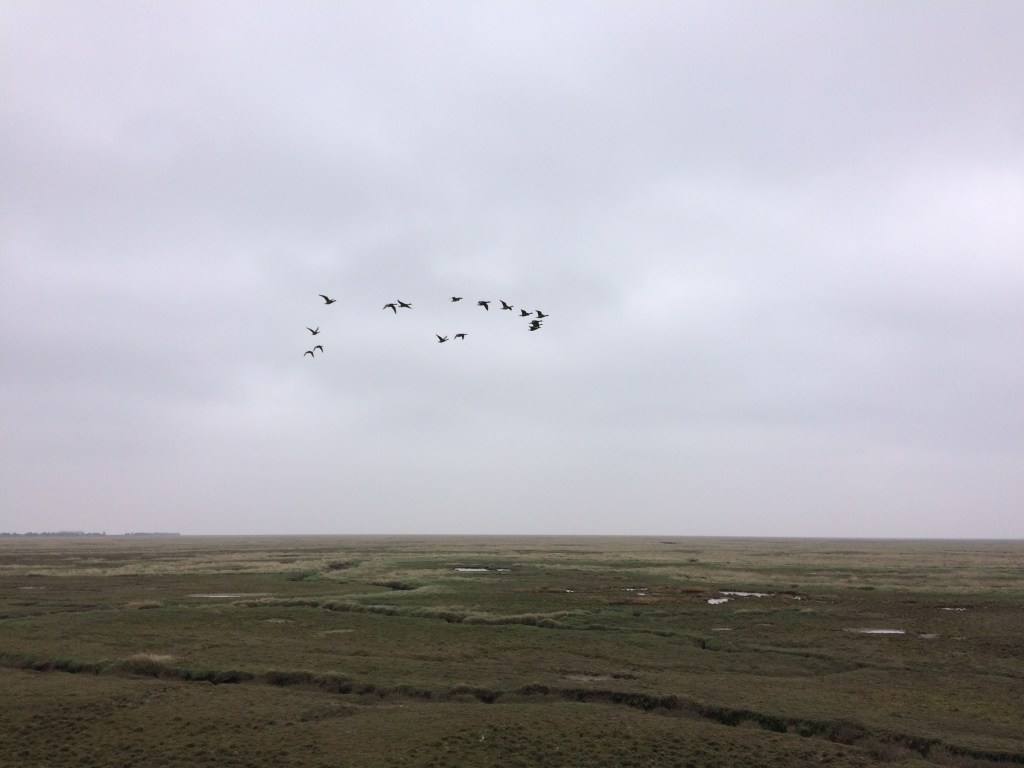
Geese over the Fens, near Boston

I first read Waterland when I was doing my A levels, and one of my A level History teachers was a Tom Crick. The other was a giant Welshman with a walrus moustache and a penchant for rugby, but our Mr Crick – who was also my form tutor – was a troubled man who was clearly undergoing a crisis of his own. He had several long spells of absence, and then a period when he only came in to teach his A level classes. He told me one day, during a tutor meeting to discuss how my A levels were going, that he’d been prescribed pills and sent to see a psychiatrist. It’s a hard thing to find out about, when you’re seventeen. When I was going through my own phase of wanting to rage at the universe, he told me I should go out into the middle of the street and scream. ‘At the top of your lungs. Better that way than on the edge of a building.’

Teaching, we’re often told, is like acting. You put on a face and perform. But if you spend more than a few years in teaching, it’s inevitable that you, or a colleague, will face something in your personal life that will shake that professional persona. Back in 2004, I was undergoing investigations for infertility. I had a series of blood tests to measure whether my ovaries were functioning properly. I got the results of the final test – which confirmed that basically it was all a bit of a disaster – one morning while I was at school. I had a choice. I could let everything fall to pieces, or square my shoulders and go off and teach my next lesson. We were in the middle of an Ofsted inspection at the time, so the former wasn’t really an option. I took a deep breath, and went off to my classroom, where there was already an inspector waiting to observe my next lesson.

I never thought, when I first read Waterland, that one day I’d end up teaching in the Fens. It’s a weird landscape, huge skies, flatness, and the constant presence of water, pumped out from the land into drains and ditches, gleaming straight lines of silver. No broad sunlit uplands; no moments of the sublime. As Tom Crick asks: ‘To live in the Fens is to receive strong doses of reality. The great, flat monotony of reality; the great empty space of reality. How do you surmount reality, children? How do you acquire, in a flat country, the tonic of elevated feelings?’ The Fens have a beauty all of their own, but it’s a strange beauty, an acquired taste.

I never found out what happened to my history teacher, and we never find out what happens to Tom Crick and his wife, either. Teaching is many things. Sometimes, it’s frustrating: sometimes, it’s a slow, laborious daily grind, and sometimes it gives you moments of joy and hope that bring home what a real privilege it is to work with young people. And sometimes, it’s a form of support, a splint: a chance to put on a mask and carry on, a sense of purpose that takes over when everything else seems meaningless.

Hey, Ofsted

Thirty-two years ago, it was the summer of 1989. I’d just finished my GCSEs. Other people kept muttering that I should find a job for the summer, but Merseyside in the 1980s wasn’t exactly overflowing with summer jobs, and in any case I had other ideas. I was alternating between going for long solo walks – pacing around the hot summer streets of Newton-le-Willows, the air thick with the scent of goldenrod and willow herb – and reading. I was due to start my A levels in September and we’d been told that we should read as much as possible over the summer. We had an induction session where we had to write down the last three books we’d read, and cross off anything that was one of our GCSE set texts. I wasn’t completely sure what I should read, but I did know that teenage fiction and pony books wouldn’t pass muster. I’d read a review of David Lodge’s novel Nice Work in the paper, and thought it sounded interesting. I bought a copy of it from WH Smith in Warrington and read it over the course of about four days, and discovered from it that there was the possibility of doing English at university, something I’d never actually thought about before but which started to take hold in my mind, that long summer, in a way that nothing else ever had.

All in all, it’s just a … (Source: Creative Commons)

One of the central characters in Nice Work was a lecturer called Robyn Penrose. At one point in the novel, she mused on what it would be like to have never read Wuthering Heights and Jane Eyre, and then reflected that there must be many thousands of reasonably well-educated people who had never read Wuthering Heights and Jane Eyre, who had never shivered at Lowood with Jane or throbbed in the arms of Heathcliff with Cathy. I’d heard of the Brontës, but what I knew of them came largely from Kate Bush singing about the wily, windy moors. There was a gap in my knowledge and it seemed to me that reading Wuthering Heights and Jane Eyre was something I needed to do. I didn’t know it yet, but I was on the edge of something big.

I bought a Penguin Classics copy of Wuthering Heights, with purple-streaked heather moors on the cover and an introduction by someone called David Daiches. I made myself read the introduction, even though it looked complicated. I found out about the Brontës, about the sisters who died so young and the ones who survived, and was intrigued by strange crabby Emily who strode across Yorkshire and didn’t give a toss about anyone. I devoured Wuthering Heights, and then I read Jane Eyre, and between them the Brontës opened up spaces in my head that I didn’t know existed before.

I raided the local library and pored over biographies, dusty-looking books from the non-fiction section that hadn’t been borrowed in years. These books made no concessions to teenage me. I needed to reach up and find my own footholds. I wasn’t sure what to do with all this stuff I was learning about. It was a huge, absorbing mass of ideas and I couldn’t quite make it fit in with the rest of my life. I had a vague sense that my friends wouldn’t know what to make of any of this, and so I didn’t tell them. It felt like dangerous knowledge, all these things I was finding out about these three strange sisters and their slightly embarrassing brother, up there in the parsonage. It was leading me into alien territory, out there on the other side of the Pennines. Empty moorland acres and twittering skylarks and trees sculpted by the wind. I squared my shoulders and trudged on into the unknown.

By the time sixth form started, I was reading Villette. It felt like the biggest book I’d ever read. Not just in itself – six hundred densely printed pages – but in its honesty, its unwillingness to make concessions. I was possessed by Lucy Snowe’s lonely journey to Brussels, her awkward existence at Madame Beck’s pensionnat and her emerging friendship with the equally spiky Paul Emanuel. I tucked my copy into my schoolbag with my French textbook and my History notes, and read it in the library when I should have been learning about the Wars of the Roses. Walking home from school, I played out conversations in my head – imaginary university interviews with lecturers who’d read more than I could ever imagine – about why the Brontës were so important and why Villette was so much better than Jane Eyre.

Learning doesn’t just take place within a classroom. That summer, the summer of 1989, changed my life, and it happened because I had the freedom to spend three months lost in books, going for walks, and thinking.

Horses, when they are young, benefit from being turned out to graze and explore. There are things that they need to learn, but they also need time to just be a horse.

There’s a lot that’s wrong with Amanda Spielman’s announcement that students in Year 11 and 13 shouldn’t be given study leave this summer, but one of the most important is that it ignores the fact that young people – especially after a deeply traumatic year – need to be given time to be themselves. They need to mooch around and pursue their own interests; they need to hang out with friends and spend time on their own. Some will be out earning money; some will have other responsibilities. Some might still need the support of school, and it’s important that this support is there, for all manner of reasons. But what none of them need is to be in a hot stuffy classroom, pursuing someone else’s idea of catch-up. Let them be, and let them breathe.

In the beginning

In sooth, I know not why I am so sad. It’s September 1987, the first week of the new school year, and we’re doing Shakespeare. We’re allowed to do Shakespeare because we’re in the top set. It gives us a sense of importance, of privilege: we square our shoulders and underline our headings and brace ourselves for the task ahead. There are two top sets, one in each half of the year, and the other one is doing Twelfth Night. We’re doing The Merchant of Venice. We’re in Mrs Ferns’ class. I’ve never had her before, but my friend Catherine has, and says you don’t want to get on the wrong side of her. Mrs Ferns has half-moon spectacles that she will lower occasionally, peering over the top of them and fixing some poor unfortunate with a beady glare. She keeps singling me out to answer questions, and for a while I think she’s picking on me, until my mum says that she’s probably just trying to test me out. Then I start putting my hand up more often, and she moves on to someone else.

It seems a bit weird, this Shakespeare business. My impression of studying Shakespeare has been formed by Adrian Mole, who writes in his diary of ‘translating Shakespeare into modern English.’ It takes us a while to get Salarino and Solanio sorted out, and we whinge about why it didn’t occur to him to choose names that were a bit easier to distinguish. We suspect that Mrs Ferns is playing mind games, sometimes, when she asks us to interpret what kind of language Shakespeare has used, why he’s used this particular word and what it might suggest. We complain that we’re reading too much into it. (Reading too much into it: that thing that every English teacher will be accused of, at some point. Surely Shakespeare didn’t mean to use all those metaphors and things?) But we’re a biddable class, and we do our homework diligently. We’re doing this new qualification, the GCSE, and know that it’s important to work hard right from the start: we’ll be doing coursework soon, and it’ll go towards our final grades. Shakespeare is all part of this. He’ll help us to do well.

In Venice, things are afoot. Antonio is borrowing money from Shylock because his friend Bassanio wants to marry a woman called Portia, who lives in Belmont. We’re not quite sure why he needs money to do this (new clothes? hiring a carriage?) or why Antonio is getting himself in debt for him. Mrs Ferns tells us that Antonio is sometimes played ‘a bit queer’, and because it’s 1987, nobody thinks to pull her up on this, although I know it’s a comment that at least one of my classmates still remembers over thirty years later, citing it as one of the things – the slow drip-drip of ingrained thoughtlessness and prejudice – that made him feel different, and isolated, without any hope of ever fitting in. Mrs Ferns also tells us about the roots of anti-Semitism, and about stereotypes of Jewishness. We think of Shylock in his gaberdine, a bogeyman, another outsider, pleading for acceptance. If you prick us, do we not bleed? In Belmont, the Prince of Morocco chooses the wrong casket, and learns that all that glisters is not gold: the Prince of Aragon, not wanting to opt for what many men desire, picks the silver, and is rewarded with the portrait of a blinking idiot. We know, from long-ago fairytales, that both of them were obviously misguided, that the third casket, the least special, is the right one to pick. But the story is trying to teach us something, as well as to entertain us, and so we let it.

There is news on the Rialto. Antonio’s ships have run aground on the Goodwin Sands: immediately after Bassanio claims Portia as his, he hears that his friend’s ventures have failed. All the riches of Tripoli, of Mexico, of Barbary and India, all lost. We picture silks and spices, rich brocades and woven cloths, all floating on the sea or sunk at the bottom of the English Channel. None of us has ever been to Venice. We know it’s in Italy, and that the streets are canals filled with gondolas, but that’s about it. We know that the Rialto is a bridge, but not what it looks like. We imagine somewhere busy and bustling, alive with colours, the scents of distant lands. Shylock is ready to exact his bond, and Portia puts on her disguise, ready to make her speech. The quality of mercy is not strained: It droppeth as the gentle rain from heaven Upon the place beneath … Mrs Ferns makes us learn it off by heart, and I can still remember it even now, reciting it as my party piece whenever my students complain about having to learn quotations.

Our GCSE coursework is to write the front page of a newspaper, reporting on the trial. I have an idea of what I want to write but can’t make it work. I don’t know how to get the sentences to sound right. I get 16 out of 20, and ‘Good’ in red biro, but I don’t know why I got 16 out of 20, or how I could have got 17 or even 18. That wasn’t how schools worked, then. Today we’d have been given assessment criteria and mark schemes; we’d have been shown examples of what a good piece of work looked like and had the chance to get feedback on a draft of our work before having a go at the finished version. But it’s 1987, so we accept what we’ve got, and move on to our piece of work, on the War Poets, where we do even more reading-things-into-things and where our answers never seem to match up to the ones in Mrs Ferns’ head.

*             *             *             *             *

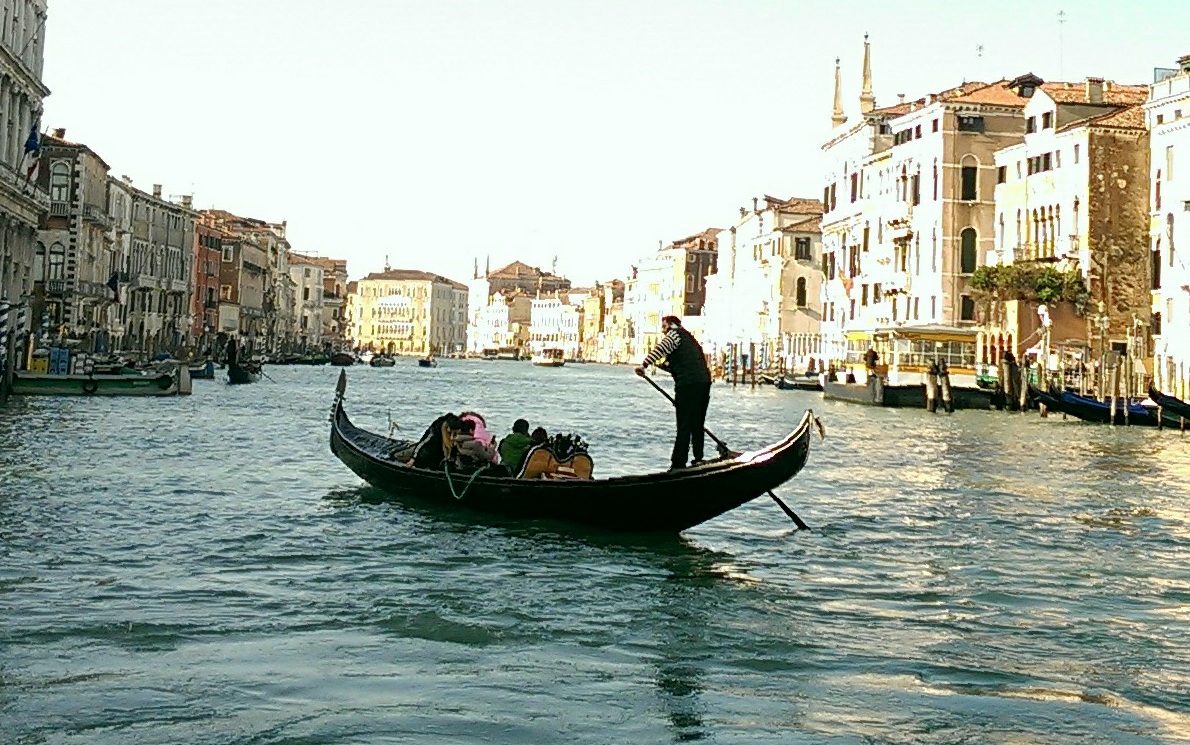
We tried to go to Venice in 2000, but there was an air traffic control strike in Italy and all the planes were grounded. Then life got in the way, as life does, and we didn’t try again until 2016. This time, we made it. It was February half-term, the week after the Carnevale, and we arrived in a misty Cannaregio towing our suitcases and hardly believing we were here. Venice! But backstreet Venice, away from the tourist hubs. Humpbacked bridges and buildings scarred with graffiti and patched with damp. Elderly men and women with wheeled shopping trollies and small dogs, going about their daily business. I remembered something I’d read in a biography of Edith Wharton, about how the interesting places were always to the side of the important monuments, hidden away.

And then we were at the Rialto. Covered in scaffolding, but still, the Rialto! Shylock wouldn’t have recognised it. The silks and brocades were cheap scarves; the spices were sachets of dried herbs for making different types of pasta sauce. There was Murano glass and fake designer handbags and bottles of olive oil. The bridge sloped under my feet and I stood and bounced, absorbing it through my soles. This was the Rialto and this was Venice and in some ways, this was where it all began. I thought of Mrs Ferns’ lessons and of everything that had happened since, and the people flowed past me on either side, oblivious.