Teacher Feature: Mrs Lintott

Hey, it’s the Teacher Feature! This is going to be a regular-ish series exploring fictional teachers from page, stage and screen, and fittingly, the opener is going to focus on a character from Alan Bennett’s The History Boys, which gives this page its name. I could have chosen Hector or Irwin, but instead I’m going to write about Mrs Lintott, played in both the original stage version and the 2006 film adaptation by Frances de la Tour.

Mrs Lintott with Hector, Irwin and the History Boys, at Fountains Abbey. (Source: Wikipedia)

Every staffroom needs a Mrs Lintott. She’d look after you in your first few weeks as a rookie teacher, making sure you knew how the coffee rota worked and whose chair you shouldn’t sit in. She’d dispense wisdom and offer suggestions on how to approach particular students. It was the Mrs Lintotts of my first school who gave me the pieces of advice that have stayed with me all my career. Don’t try to be their friend. Be kind, but make sure they know where the boundaries are. Bright students can wind you up far more effectively than less able ones. If you expect to make a meaningful connection with every student you teach, you’ll burn yourself out. Mrs Lintott has a box of tissues and a packet of digestives in her desk drawer, and knows just when you need them. She’s essential to the running of the school, although her role isn’t an official one and doesn’t come with extra pay. A school without at least one Mrs Lintott is a very poor thing.

Mrs Lintott, in Bennett’s play, acts as a kind of moral centre, standing in the middle of a triangle formed by the dilettante Hector, the smoothly ambitious Irwin, and the repulsively shallow Headmaster. The Headmaster wants the school to rise in the league tables: he is determined to get more students into Oxford and Cambridge, and recruits Irwin to tutor the school’s most able History students. Mrs Lintott has taught them in the past, but it’s clear that her approach won’t cut it, in Oxbridge terms. She offers hard graft, ‘plainly stated and properly organised facts.’ (I bet she loves a well-organised lever arch file, with dividers and plastic wallets, all the headings underlined.) Irwin offers flash. As Rudge, one of the boys, puts it: ‘You’ve force-fed us the facts; now we’re in the business of running around acquiring flavour.’ He gets his students to approach the past from unexpected angles, finding tangential ways in. With him, the boys find the moments when history ‘rattles over the points’. They develop intellectual agility. But they couldn’t have done it without Mrs Lintott laying the foundations.

Hector’s lessons, meanwhile, are all about ‘sheer calculated silliness.’ They’re the antidote to the Headmaster’s weaselling, a space to shore up fragments of Gracie Fields and George Formby and act out scenes from classic films. They are fun – witness the improvised scene in the French brothel – but eventually the boys realise that they’re not going to get them into Oxbridge. Hector is a joker, but he’s also sad, in every possible sense of the word. He offers the boys lifts home on his motorbike, and gropes them as they sit behind him, but they treat this with a weary eyeroll rather than reporting him. He recognises the loneliness in Posner, the most fragile of the boys, and speaks to him of the ‘sense of not sharing, of being out of it. Whether because of diffidence or shyness, but a holding back. Not being in the swim. Can you see that?’

Hector knows that Irwin’s lessons are about playing an intellectual game. So does Mrs Lintott. She’d have no truck with such Ofsted-isms as ‘rapid and sustained progress’, with knowledge organisers and ‘wow words’ and the need for everything to be outstanding all of the time. She’d recognise that true learning is a long slow burn, an uneven path.

In the play, Mrs Lintott has some cracking lines. There’s the obvious one about studying at Durham: ‘It’s where I had my first pizza. Other things, too, of course, but it’s the pizza that stands out.’ There’s the bit where she defines history as ‘women following behind with a bucket.’ There’s also the point where she describes the Headmaster as ‘a twat … a condescending cunt.’ (In a production at my former school, the student who played Mrs Lintott delivered this line with real relish.) But for me, the part where we really see the essence of Mrs Lintott is at the end, at Hector’s memorial service, when she tells us what has become of the boys. Their fates in the film differ from those in the original play – Posner’s ending is happier, Lockwood’s sadder – but that doesn’t really matter. What I like about this scene is the sense of Mrs Lintott’s role extending into the future, there not just for the seven years of secondary school but for many decades to come. She’d be the one who’d bump into her former students, or their parents, in the supermarket, and find out what they were up to. There’d be shared reminiscences, and maybe the odd letter. She might attend the occasional wedding, in her size seven, wide-fitting court shoes; she’d certainly be there for funerals. Teachers who matter don’t just get you through the exams. They balance and stabilise; they help to make a school a genuine community that shows young people how to be. They might not set the educational world on fire, but they do help to ground it.

Everyone should be taught by at least one Mrs Lintott, at some point in their life. Who’s yours?
Rites of passage

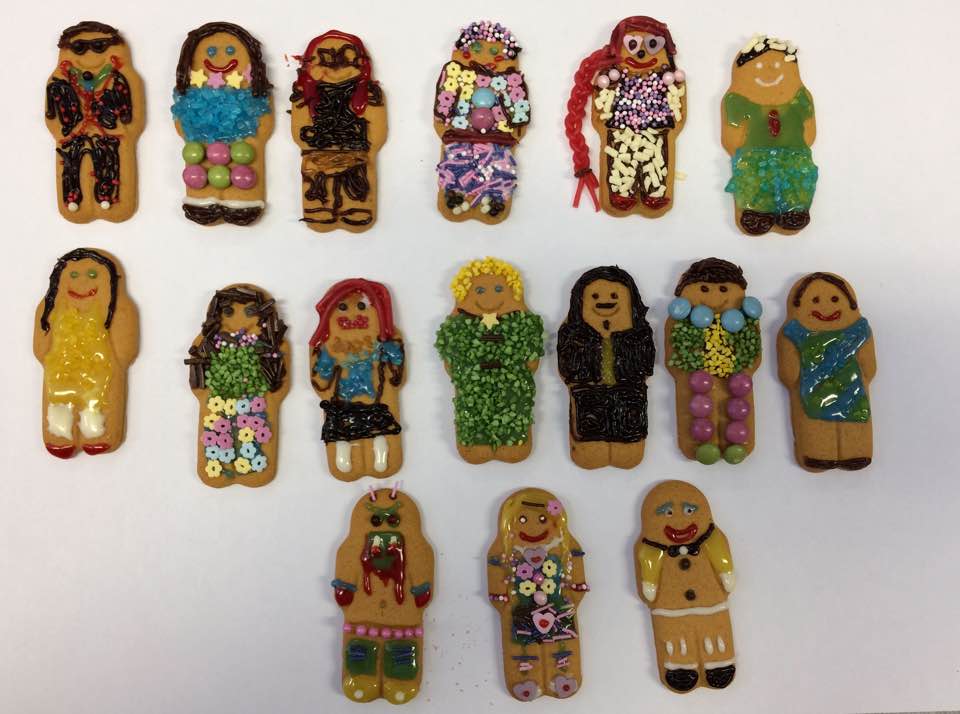
About ten years ago, I had the idea that a good way to mark the end of Sixth Form would be to get my A level students to spend their final lesson decorating gingerbread people. It turned out to be a lovely thing to do. I took in lots of squeezy icing, cake decorations, jelly strands and the gingerbread people themselves, and we had a great old time. Most years, I put everyone’s name into a hat: everyone drew out a name and had to make a gingerbread portrait of that particular person. (You haven’t lived until you’ve seen yourself represented in gingerbread, believe me.) One year, I got my English Literature group to make a character from one of the texts we’d studied. We had several Tess of the d’Urbervilles, a forlorn Willy Loman and a particularly memorable Duke of Gloucester from King Lear, who took up an awful lot of red icing.

The Class of 2017

Rites of passage are an important thing. Final assemblies, awards ceremonies, speeches from departing staff: they mark an end and help you to move on to the next phase of your life. At my previous school, there were no end-of-year celebrations and no chances to say a proper, formal goodbye. My current school is much better. There are speeches and thank-yous and a sense of tying up loose ends. It’s a ritual that matters, one that shows a proper valuing of the time you’ve spent in a particular place, the work you’ve done there and the things you’ve learned, whether it’s as a student or a member of staff.

Last year, with a global pandemic and one day’s notice that we’d be closing, we had very little time to organise anything, but we still managed to sign shirts and hold an impromptu disco. This year, conscious of the ongoing risk, we didn’t do gingerbread people, but we still pulled names out of a hat, and this time we drew each other, instead.

Carol Ann Duffy’s ‘In Mrs Tilscher’s Class’ is a fabulous, atmospheric poem about the end of primary school: I love the sense of impending change in the final stanza and the sky splitting open into a thunderstorm in the last line. And C. Day Lewis’s ‘Walking Away’ looks at departure from a different angle, that of the parent taking his child to school. I always think of the penultimate line whenever students leave school: the idea that selfhood begins with a walking away, moving on to an unknown future with all the chances and uncertainties life brings.

Running on empty

Of all the phases in the school year – back to school in stiff new uniforms in September, the exhausting long drag up to Christmas, freewheeling down to the end of term in July when all the exam groups have gone – the current one is always the toughest. In a normal year, it’s the final preparation for exams, cramming in as much practice as we can before the students go off on study leave. Teaching becomes less about genuine, mind-expanding education and more about making sure that everyone knows which boxes they’ll have to tick. Remember to quote at least three sources, cram in your buzzwords, apportion your time carefully … Nerves are frayed, minor irritations get magnified, and everyone just needs to go away and calm down.

This year, of course, it’s not a normal year at all. In the UK, grades for GCSE, A level and BTEC are being determined by teacher assessment. Last year – the first year of the pandemic – we had to forecast grades based on what we thought students would have been most likely to have achieved if the exams have gone ahead. Schools went into lockdown in March, when teaching for the exam courses was practically over: determining the grades was an administrative headache, but at least we didn’t have actual students to cope with as well. This year’s exam students have had to contend with two prolonged lockdowns plus innumerable periods of self-isolation. Individual schools and colleges have been free to determine how they’ll assess their students and what they’ll get them to cover, bearing in mind the level of disruption they’ve faced. We’ve had to put all of this in place in a relatively short space of time, and the last couple of months – in schools everywhere – have seen classrooms full of silent rows, heads down, scribbling frantically.

All this has generated a massive amount of marking, which has all had to be done by normal classroom teachers, with no extra time and for no extra pay. One English-teacher friend is a GCSE examiner: she reckons that if she’s been paid her normal examiner rates for the amount of marking she’s done over the last few weeks, she’d be pulling in at least £2500. Another friend has a colleague who is currently undergoing outpatient treatment: she’ll be spending a day marking while hooked up to a drip. A group of headteachers in England and Wales is campaigning for the exam boards to refund at least half of the £220 million charged for administering this summer’s exams, pointing out that individual schools are setting assessments, marking them, carrying out quality-assurance checks, processing results (which are being issued ten days earlier than they usually are, just to add an extra complication) and handling appeals. The exam boards promised to make assessment materials available for schools to use, but these materials were not released until just before Easter – and when they were released, they were also made available to the wider public, meaning that students could access not only question papers, but also mark schemes. It didn’t really matter, though, because none of the assessment materials were new. They were all past papers that we’d already worked with and used and discussed in class. We ended up having to produce our own.

Year Twelve, meanwhile, are currently looking at word-formation, and we’ve been talking about all the blends and compound words that can be used to describe something that’s an epic mess. Shitshow. Omnishambles. Clusterfuck. Call it what you like. What it means is that teachers everywhere are not just exhausted – sapped by that elemental tiredness that sets in at particular times of year – but battered, wanting to curl up in a corner until it all goes away.

So if you know any teachers, look after them, over the next few weeks. We’re helping students through a difficult stressy time and dealing with our own exhaustion as well. We’re good at caring – it’s why we do this job – but often we’re not good at giving ourselves a break.

I give my department chocolate every Friday, not because it changes anything but because it just gives everyone a bit of a lift. Let’s face it, who doesn’t need a Twirl at the end of the week? For the past few weeks, one of my lovely colleagues has given me chocolate in return, adorned with an appropriate sticker. One week, it was ‘Didn’t swear out loud today.’ Another, it was ‘Didn’t lose my shit.’ Because even though we’re running on empty, this is what we do: we take a deep breath, swear quietly to ourselves, and carry on.

in thunder, lightning, and in rain

I’ve just started teaching Macbeth for the sixty billionth time. Okay, the fifty billionth time. Well, actually it’s the twenty-third time, but the point is that in the course of a teaching career there are some texts that come up over and over again. People think this must get tedious. My standard reply is to remind them of all the Maths teachers, teaching Pythagoras’ Theorem and quadratic equations year in year out, or the biologists with photosynthesis, or the French department conjugating present tense verbs: now that’s what tedious is. With Macbeth, at least you’ve got some blood and guts involved.

There are some parts of Macbeth that are fantastic to teach. I’ve just got to the end of Act One Scene Three with my Year Tens, and we’ve been focusing on how Shakespeare builds up a sense of Macbeth in our minds before we even meet him. There’s that tantalising mention by the witches in Act One Scene One: what do they want with him, exactly? And then there’s the account of his prowess in battle by the wounded captain in the next scene, telling us of his sword that smokes with bloody execution and of how he killed the treacherous Macdonwald by unseaming him from the nave to the chaps. Scotland has been invaded by Norway, and a number of Scottish thanes have betrayed their king: in fighting against them, Macbeth is cast as not only brave and ruthless, but also loyal. So, we’ve got mixed messages about him. It’s not surprising, then, that he reacts to the witches in the way he does. He starts, and seems afraid. It takes him a while to find his voice. And when he finds out that he is indeed going to become Thane of Cawdor, his mind starts to work overtime. On Friday, we looked at his aside in Act One Scene Three, where Shakespeare explores the thoughts that are beginning to take shape:

[Aside] Two truths are told,
As happy prologues to the swelling act
Of the imperial theme. — I thank you, gentlemen. —
This supernatural soliciting
Cannot be ill, cannot be good. If ill,
Why hath it given me earnest of success,
Commencing in a truth? I am Thane of Cawdor.
If good, why do I yield to that suggestion
Whose horrid image doth unfix my hair
And make my seated heart knock at my ribs,
Against the use of nature? Present fears
Are less than horrible imaginings.
My thought, whose murder yet is but fantastical,
Shakes so my single state of man that function
Is smothered in surmise, and nothing is
But what is not.

Look at the quibbling in this speech. He doesn’t know whether the witches’ words are good or bad. If they’re bad, why have they brought him something good? If they’re good, why are they making him think of something so awful that he can’t even name it, so terrible that it makes his heart pound and his hair stand on end? Nothing is but what is not; fair is foul and foul is fair. This is a man whose world is about to be turned upside-down, who is contemplating something that goes against everything his identity has been built on.

Macbeth also introduces students to the idea that you need to know something about the context of a work of literature in order to inhabit its imaginative world. There are the obvious things that students can research – beliefs about witchcraft in Shakespeare’s England, the Divine Right of Kings, and the status of women – but I also like to show them images of Hell from the ‘doom paintings’ that decorated the walls of medieval churches, to show them that Hell was something that Shakespeare’s audience would have seen as very real and utterly terrifying, and therefore to underline just what Macbeth faces as a result of killing Duncan. There’s a fantastic example in the church of St Peter and St Paul at Chaldon in Surrey. It dates back to the thirteenth century, and depicts the seven deadly sins and the weighing of souls. In one image, the condemned are thrown into a boiling cauldron, with leering demons poking them with giant forks: in another, some poor unfortunate is suspended by his ears while his nether regions are roasted over an open fire. Imagine sitting in church every Sunday, looking at pictures of flame-grilled genitals and eternal torture: that’s what Macbeth has in store for him. The other thing I like to get them to do is to find out when Macbeth was first performed, and then to find out the date of the Gunpowder Plot. Why would James I have been so keen on a play that points out the evils of regicide? You can see the students putting the dates together. Oh.

Doom mural at St Peter and St Paul, Chaldon (Source: Peter Trimming at Geograph Britain and Ireland; licensed for reuse under Creative Commons)

The main problem I have with Macbeth is that it jumps the shark. There are the brilliant early scenes with Lady Macbeth, the murder of Duncan, the unravelling of Macbeth’s mind, the breakdown of his relationship with his wife (look at how he tells her, just before the murder of Banquo, to ‘be innocent of the knowledge, dearest chuck’, and contrast it with how much he needed her earlier in the play). There’s the chaos unleashed in Scotland, the banquet scene, and Macbeth’s return to the witches. And then there’s that tedious conversation between Malcolm and Macduff, and the unravelling of the second set of prophecies. And it’s all a bit rubbish. I remember sitting in a Year Eleven lesson when I was studying Macbeth for GCSE, and thinking, ‘is that it?’ Some verbal quibbling about a C-section, and a group of men cutting down branches? Compared with the end of King Lear, it seems contrived, a bit of a trick. You’d tell him to go back and have another go, if you were his beta reader.

I expect you know that Fleance, in Roman Polanski’s 1971 version of Macbeth, was played by Keith Chegwin, later of Swap Shop, Cheggers Plays Pop and, after several years in the wilderness, the Channel 5 gameshow Naked Jungle. Did you know, though, that Paul Farley wrote a poem about Chegwin’s role? It’s here, at the Poetry Society website. The most atmospheric Macbeth I’ve ever seen: the production in the crypt of the Norman church of St Peter in the East in Oxford, now the library of St Edmund Hall. It was December 1991, the end of my first term, and there were actual bats flapping around. And my favourite Macbeth-related moment: back in 2017, when we were driving up to Orkney, we passed through Birnam, and a group of forestry workers were cutting down trees.

In the beginning

In sooth, I know not why I am so sad. It’s September 1987, the first week of the new school year, and we’re doing Shakespeare. We’re allowed to do Shakespeare because we’re in the top set. It gives us a sense of importance, of privilege: we square our shoulders and underline our headings and brace ourselves for the task ahead. There are two top sets, one in each half of the year, and the other one is doing Twelfth Night. We’re doing The Merchant of Venice. We’re in Mrs Ferns’ class. I’ve never had her before, but my friend Catherine has, and says you don’t want to get on the wrong side of her. Mrs Ferns has half-moon spectacles that she will lower occasionally, peering over the top of them and fixing some poor unfortunate with a beady glare. She keeps singling me out to answer questions, and for a while I think she’s picking on me, until my mum says that she’s probably just trying to test me out. Then I start putting my hand up more often, and she moves on to someone else.

It seems a bit weird, this Shakespeare business. My impression of studying Shakespeare has been formed by Adrian Mole, who writes in his diary of ‘translating Shakespeare into modern English.’ It takes us a while to get Salarino and Solanio sorted out, and we whinge about why it didn’t occur to him to choose names that were a bit easier to distinguish. We suspect that Mrs Ferns is playing mind games, sometimes, when she asks us to interpret what kind of language Shakespeare has used, why he’s used this particular word and what it might suggest. We complain that we’re reading too much into it. (Reading too much into it: that thing that every English teacher will be accused of, at some point. Surely Shakespeare didn’t mean to use all those metaphors and things?) But we’re a biddable class, and we do our homework diligently. We’re doing this new qualification, the GCSE, and know that it’s important to work hard right from the start: we’ll be doing coursework soon, and it’ll go towards our final grades. Shakespeare is all part of this. He’ll help us to do well.

In Venice, things are afoot. Antonio is borrowing money from Shylock because his friend Bassanio wants to marry a woman called Portia, who lives in Belmont. We’re not quite sure why he needs money to do this (new clothes? hiring a carriage?) or why Antonio is getting himself in debt for him. Mrs Ferns tells us that Antonio is sometimes played ‘a bit queer’, and because it’s 1987, nobody thinks to pull her up on this, although I know it’s a comment that at least one of my classmates still remembers over thirty years later, citing it as one of the things – the slow drip-drip of ingrained thoughtlessness and prejudice – that made him feel different, and isolated, without any hope of ever fitting in. Mrs Ferns also tells us about the roots of anti-Semitism, and about stereotypes of Jewishness. We think of Shylock in his gaberdine, a bogeyman, another outsider, pleading for acceptance. If you prick us, do we not bleed? In Belmont, the Prince of Morocco chooses the wrong casket, and learns that all that glisters is not gold: the Prince of Aragon, not wanting to opt for what many men desire, picks the silver, and is rewarded with the portrait of a blinking idiot. We know, from long-ago fairytales, that both of them were obviously misguided, that the third casket, the least special, is the right one to pick. But the story is trying to teach us something, as well as to entertain us, and so we let it.

There is news on the Rialto. Antonio’s ships have run aground on the Goodwin Sands: immediately after Bassanio claims Portia as his, he hears that his friend’s ventures have failed. All the riches of Tripoli, of Mexico, of Barbary and India, all lost. We picture silks and spices, rich brocades and woven cloths, all floating on the sea or sunk at the bottom of the English Channel. None of us has ever been to Venice. We know it’s in Italy, and that the streets are canals filled with gondolas, but that’s about it. We know that the Rialto is a bridge, but not what it looks like. We imagine somewhere busy and bustling, alive with colours, the scents of distant lands. Shylock is ready to exact his bond, and Portia puts on her disguise, ready to make her speech. The quality of mercy is not strained: It droppeth as the gentle rain from heaven Upon the place beneath … Mrs Ferns makes us learn it off by heart, and I can still remember it even now, reciting it as my party piece whenever my students complain about having to learn quotations.

Our GCSE coursework is to write the front page of a newspaper, reporting on the trial. I have an idea of what I want to write but can’t make it work. I don’t know how to get the sentences to sound right. I get 16 out of 20, and ‘Good’ in red biro, but I don’t know why I got 16 out of 20, or how I could have got 17 or even 18. That wasn’t how schools worked, then. Today we’d have been given assessment criteria and mark schemes; we’d have been shown examples of what a good piece of work looked like and had the chance to get feedback on a draft of our work before having a go at the finished version. But it’s 1987, so we accept what we’ve got, and move on to our piece of work, on the War Poets, where we do even more reading-things-into-things and where our answers never seem to match up to the ones in Mrs Ferns’ head.

*             *             *             *             *

We tried to go to Venice in 2000, but there was an air traffic control strike in Italy and all the planes were grounded. Then life got in the way, as life does, and we didn’t try again until 2016. This time, we made it. It was February half-term, the week after the Carnevale, and we arrived in a misty Cannaregio towing our suitcases and hardly believing we were here. Venice! But backstreet Venice, away from the tourist hubs. Humpbacked bridges and buildings scarred with graffiti and patched with damp. Elderly men and women with wheeled shopping trollies and small dogs, going about their daily business. I remembered something I’d read in a biography of Edith Wharton, about how the interesting places were always to the side of the important monuments, hidden away.

And then we were at the Rialto. Covered in scaffolding, but still, the Rialto! Shylock wouldn’t have recognised it. The silks and brocades were cheap scarves; the spices were sachets of dried herbs for making different types of pasta sauce. There was Murano glass and fake designer handbags and bottles of olive oil. The bridge sloped under my feet and I stood and bounced, absorbing it through my soles. This was the Rialto and this was Venice and in some ways, this was where it all began. I thought of Mrs Ferns’ lessons and of everything that had happened since, and the people flowed past me on either side, oblivious.