Teacher Feature: Miss Honey

In the early weeks of my PGCE, on placement in a comprehensive school in the middle of one of the largest social housing estates in Europe, I attended a seminar on pastoral care. It was sobering, to say the least. Rows of eager trainees, all bright-eyed and bushy-tailed at the start of the day, grew increasingly silent and serious as we listened to what the teachers told us about the challenges their students faced. We heard about children who slept on bare mattresses and whose only square meal each day was their free school dinner. One teacher took several students’ uniforms home to be washed and dried, because she didn’t want them to be teased about having dirty clothes. Others spent their own money on supplies: not just pens and pencils, but sanitary towels, clean socks and snacks for breaktime. ‘These aren’t students who aren’t loved,’ one of the teachers cautioned. ‘It’s not that their parents don’t care about them. Often they’re doing all they can, but it’s just not enough.’

This was in 1995, and things haven’t got better. There are lots of children, in the UK and beyond, who are struggling, and who rely on their teachers to help them hold things together. Sometimes, as in the examples above, this is because of poverty. In 2019-20, there were 4.3 million children living in poverty in the UK, meaning that – in the words of the sociologist Peter Townsend – their families lacked the resources ‘to obtain the type of diet, participate in the activities and have the living conditions and amenities which are customary, or at least widely encouraged and approved, in the societies in which they belong.’ 4.3 million equates to 31% of all children, or, as the Child Poverty Action Group puts it, nine out of a class of 30. (Except that because that’s an average, they won’t be evenly distributed. Some classes will have fewer, others many more.) For other children, it won’t be poverty that’s the issue. It might, instead, be illness within the family, whether physical or mental, and some children will bear a great deal of responsibility for looking after those who are sick or disabled: it’s estimated that there are 700,000 young carers across the UK. There might be anxieties at home around finances or housing or any one of the many things that can crop up to throw life off balance. And for many children, these daily struggles will be the result of abuse, whether that’s physical, sexual, or emotional.

That’s where Miss Honey comes in. Miss Honey is, of course, the teacher of Matilda Wormwood, the star of Roald Dahl’s novel Matilda, and she brightens up Matilda’s sad little life in a way that is desperately needed. Matilda’s parents are truly ghastly. They do not lack material wealth – Mr Wormwood is an extremely dodgy secondhand car dealer – but they do lack warmth, and tenderness, and understanding. While Mr Wormwood is out at work, Mrs Wormwood is either glued to the television or out playing bingo. They treat Matilda as ‘nothing more than a scab.’ It is Miss Honey who recognises Matilda’s quicksilver mind and nurtures her brilliance. Lovely Miss Honey, we’re told, possesses ‘that rare gift for being adored by every small child under her care.’ She understands their fears, reassures them, and helps them to feel less bewildered. In the end, when the Wormwoods decide to do a bunk to Spain in order to avoid the law, she invites Matilda to go and live with her.
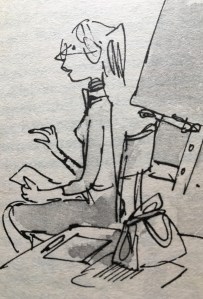
Miss Honey, from my ancient copy of Matilda

Miss Honey is a caricature, like all of Dahl’s adults, but there are real-life Miss Honeys and Mrs Honeys and Mr Honeys everywhere, and even the occasional Dr Honey, too. They help to make the lives of their charges a bit less lonely and a bit less desperate. If they’re in a primary school, they will probably be the one adult, outside a child’s immediate family, who has the most contact with them on a day-to-day basis, and who therefore has the biggest chance of making a difference. The role they play in keeping children safe is immeasurable. What they give these children is hard to describe, because it’s so multi-faceted. It could be the first smile they see in any particular day. It could be a banana and a cereal bar to make up for the breakfast they haven’t had. It could be a quiet place to sit at breaktime, when life is overwhelming. It could just be the knowledge that somebody understands, that they’re not on their own. The actual Miss Honeys are the teachers who sit and listen, keep an eye out for someone who’s having a tough time, pull strings behind the scenes to make sure that children can go on school trips that their parents might not be able to afford. They seek out helpline numbers and put families in touch with food banks. Sometimes, they change the whole direction of a life.

It’s not all sparkles and rainbows. It’s difficult, being a Miss Honey. Teacher burnout is a very real issue, especially in an educational environment where externally-imposed agendas and targets exert so much pressure and pay so little heed to the realities of students’ lives. There are days when the real-life Miss Honeys are so tired that they can barely speak. There are moments when they wonder if it’s all worth it, and think about all the easier careers they could have chosen instead.

How different would our education system be if those with the ability to make the big decisions – about policy, about funding and teacher pay, about the curriculum and how it’s assessed – had, in the past, been the pupils who’d needed the Miss Honeys themselves? It’s worth a thought. I’m not sure how it would ever happen, but I think it would be a much better place.
On nettles, war photographers, and getting things wrong

There’s an opposition that students frequently draw between English and Maths. In Maths, you’re either right or wrong. In English, it’s less clear-cut. Maths is straightforward, unambiguous. English is all airy-fairy. For many students, this means two things. The first is that if you get a disappointing mark in English, it’s because your teacher either doesn’t agree with you or doesn’t like you. This seems to persist no matter how much work you do with mark schemes and peer assessment, no matter how many worked examples you show them or how much time you put in scaffolding their responses and helping them to improve. If they don’t do as well as they thought they should, it’s not because they didn’t refer to the text or forgot to comment on the effects of the writer’s use of language, it’s because you once told them off for talking too much during a cover lesson in Year Seven and three years on, you still hold a grudge.

The second thing that students take from this opposition is that in English, there’s no such thing as a wrong answer. Of course you can get spellings wrong, and make factual errors like mixing up Duncan and Donalbain and claiming that Jane Austen was a great example of a Victorian novelist, but apart from that you can say anything you like in English. Poems can mean whatever you want them to mean, as long as you can argue your case. Simple, yes?

Well, no. The truth is, you can make mistakes. I’d be the last person to say that a poem has only one single meaning: ambiguity is one of the things that makes studying literature so intriguing, and reducing poetry to a simple act of decoding – trying to prise out a single, ‘correct’ meaning from between the lines, as if you’re trying to second-guess what the poet wanted to say – is one way of killing it stone dead. But there are ways of getting it wrong, or at least, of getting it not quite right.

There are hundreds of examples I could give of readings that are in some way flawed or mistaken. I recently came across an interpretation of Vernon Scannell’s poem ‘Nettles’ that saw the relationship between the narrator and his son as distant and hostile, claiming that the military language in the poem hinted that the two were constantly at war with each other. Absolutely not: Scannell applies this language to the nettles (a ‘fierce parade’, ‘tall recruits’) that have hurt the narrator’s son, not to the relationship between them. But the example I’m going to look at in detail is a bit more complex. It concerns Carol Ann Duffy’s poem ‘War Photographer’, originally published in 1985, and one of the big hitters in the AQA Power and Conflict anthology. It’s a fantastic poem, addressing themes of trauma and the importance of bearing witness, and many of my students say it’s one of their favourites. In the first stanza, the war photographer is at home, developing his photographs:

In his dark room he is finally alone
with spools of suffering set out in ordered rows.
The only light is red and softly glows,
as though this were a church and he
a priest preparing to intone a Mass.
Belfast. Beirut. Phnom Penh. All flesh is grass.

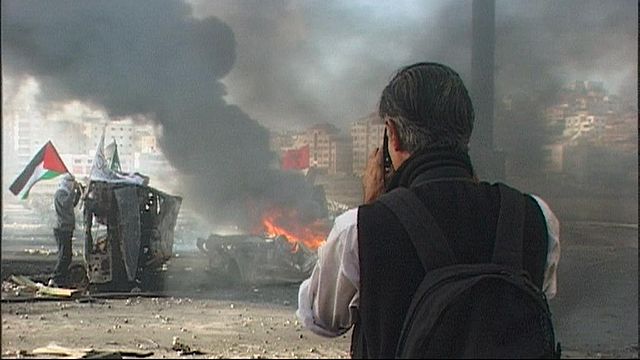
Because students nowadays are so accustomed to digital photography, I introduce the poem by showing images of a darkroom, including an enlarger, trays of developer and fixer, a series of prints hanging up to dry, and reels of film. We talk about the dark, and the sense of relief in being ‘finally alone’. The students want to know about the list of place names, and the conflicts that happened there. We find the cities on a map. We note that the names might be different if the poem had been written more recently, but that the point Duffy is making would remain the same: that conflicts happen everywhere. I show a picture of a Catholic priest consecrating the Host during Mass, and we think about the idea of transubstantiation, of capturing light and turning it into an image. Sometimes, somebody will make an observation – a bit hesitantly, just trying it out – about the photographer’s duty being just as sacred and important as the priest’s. They might even add something about the idea of ritual, drawing out the analogy by referring to a set of steps carried out in a precise order. If they do, I will nod enthusiastically, because it’ll be one of those moments that warms my English-teacher heart and makes me remember that I do actually love my job. We need those moments, every now and then.

From the 2001 Swiss documentary ‘War Photographer’, by Christian Frei and James Nachtwey. (Source: Wikimedia Commons)

So far, so good. But there’s a problem, and it’s there in the second line. It’s those pesky spools. In class, we talk about the fact that it is comforting, after experiencing something difficult, to organise and tidy, and that the ‘spools of suffering set out in ordered rows’ reflect the photographer’s need to process his experiences and impose an order on them, just as he’s processing his rolls of film. But then the students go home, and because they are mostly diligent students, they go on the Internet and see what else they can find out about the poem. And what they find, almost invariably, is one of several websites assuring them that the ‘spools of suffering set out in ordered rows’ are not reels of film in the darkroom waiting to be processed, but a reference to the white rows of war graves in military cemeteries.

Well. Rows of graves are certainly ordered, and they definitely represent suffering. But they’re not ‘spools’, and they’re not there in the darkroom with the photographer. And actually, there’s no reference in the poem to the idea of the war photographer visiting any military cemeteries. Instead, it’s quite the opposite: the people he has photographed are civilians caught up in conflict, ‘running children in a nightmare heat’ – a reference, perhaps, to Nick Ut’s famous image of nine-year old Kim Phuc – and a dying man and his wife.

These troublesome war graves represent, for me, something that students often do when faced with poetry. They think that poems must be difficult, and that meanings must be hidden. Everything a poet says must refer to something outside the poem entirely. So the ‘spools of suffering’ can’t possibly be rolls of film, because that’s too obvious, too logical and un-poetic. They have to be something else – and because the poem is about war, they must be gravestones.

Why can’t they be gravestones? This is where it gets tricky, because this is where students have to learn how to cope with tentativeness and hesitancy, qualities that aren’t necessarily prized elsewhere in the curriculum. If a student wants the spools of suffering to be gravestones, because someone on the internet has said that they are, I’ll get them to read the first few lines again, and remind themselves of what’s actually going on: the photographer is in his darkroom, preparing to develop the photographs he’s taken at scenes of conflict. I’ll then ask them why his spools of film need to be set out in ordered rows, and how that might help him. We’ll look at the neat and tidy structure of the poem, with its six-line stanzas and regular rhyming pattern. And yes, the line might well carry echoes of war graves, but they are just echoes rather than a direct reference, and the more important and subtle point to make is the one about organisation and order. I might go on to model some sentence starters for them, so they can see how it’s possible to show that you’re playing around with potential interpretations, making your thought processes explicit.

All of this requires a lot of care. Students need to read closely, and understanding this particular line takes a certain amount of empathy and imaginative projection. They need to be able to evaluate these two potential interpretations and decide which one is more convincing. With some poems, they might also need to know something about context: with others, this might not actually help. They can’t apply a formula or work through an algorithm; they need to develop a feel for poetry and how it works. What they also need to realise is that just because something is on a revision website, it’s not necessarily right. There are so many resources available these days, so many knowledge organisers and YouTube videos, that set texts can easily become reduced to a package of easily-digested ‘facts’, learned and parroted without needing to think about them.

The critic Valentine Cunningham has written about the quality of tact in reading. Cunningham has his detractors (John Kerrigan described him in the London Review of Books as ‘one of the least tactful persons on the planet’) but I think this is a really helpful concept. It conveys the need for sensitivity, for the application of judgement. Significantly, tact is also a quality that takes time to develop. Because of this, it can be allied with what Maryanne Wolf describes in her 2018 book Reader, Come Home as ‘cognitive patience’, something that is eminently neither rapid nor whizzy, but that is nevertheless hugely important. We perhaps don’t build enough time into the curriculum for this kind of skill, and this is something we need to put right.

Several years ago, one of my GCSE students stayed behind to talk to me at the end of our final lesson. He was a bright lad, and could have done English at A level if he’d wanted to, but his heart had always been set on a career in science. He still wanted to thank me, though. ‘I’ve really enjoyed doing English,’ he told me. ‘I know I won’t be doing it next year, but it’s taught me how to look at things really carefully.’ It’s one of the best things any of my students has ever said about studying English. If we can teach young people to look at things carefully, to be tactful and patient and to read with a critical eye, that’s an enormous contribution to society.

Teacher Feature: Mrs McCluskey

Tucker Jenkins. Bullet Baxter. Roland Browning. Scruffy McGuffy. Suzanne Ross. If you recognise those names, chances are you were a child or young teenager in the UK sometime during the 1980s, and a fan of the BBC children’s series Grange Hill, set in a North London comprehensive. Grange Hill started in 1978, and was extremely controversial: my friend Emma wasn’t allowed to watch it, because her mum said it encouraged hooliganism and that was obviously a Bad Thing. But it was also hugely influential. We used to act out scenes from Grange Hill in the playground at primary school, all the girls vying to be Trisha Yates with her rebellious blonde hair. At ten past five on a Tuesday and Friday young people up and down the country were glued to their screens, waiting for John Craven’s Newsround to be over and the familiar theme music to begin.

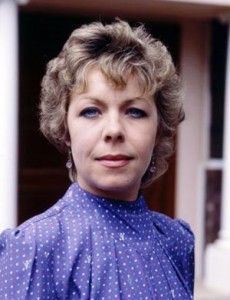
Mrs McCluskey, played by Gwyneth Powell, wasn’t the first headteacher of Grange Hill, or even the longest-serving, but she was definitely the most important. She was introduced in 1981, and immediately set about establishing herself, clashing with students over issues such as school uniform, the school magazine, vandalism and smoking. Grange Hill was an eventful place. Mrs McCluskey had to deal with bullying, truancy, racism, abuse and shoplifting. Students were suspended left, right and centre. There were deaths – Jeremy Irvine at the bottom of a swimming pool, Danny Kendall from an unidentified brain disorder – and, of course, there was Zammo McGuire’s brush with heroin. Just say no, Zammo! But Mrs McCluskey steered the school through every crisis, styling it out in an assortment of terrifying polyester blouses, surveying all with her steely blue eyes.

That blouse. (Source: Pinterest)

In her first few years, Mrs McCluskey seemed to be the kind of authority figure who existed to allow people to rebel against them. She cancelled a school trip because the students were too scruffy, and banned access to the school buildings at lunchtimes. She got into many a confrontation over infringements of uniform. Eventually, though, she came to be the epitome of firm-but-fair leadership. She listened to what people had to say and was not afraid to change her mind. She saved the life of Harriet the donkey by allowing her to become the school pet (and let’s face it, who wouldn’t want a headteacher who allowed you to have a donkey as a school pet?) She supported Miss Partridge, a single parent, when the governors wanted to have her dismissed, a storyline that’s a real sign of how times have changed. She even threatened to resign herself unless they backed down. She was indomitable, but never unapproachable, and many a storyline featured students going to see her for help when they recognised that the situations they were in were too big and serious to be kept to themselves.

This latter point was phenomenally important, because if there’s anything students need to know, it’s that teachers will not only set boundaries for them (which Mrs McCluskey does, in spades) but also have their backs if they need support. When the loner Danny Kendall was being victimised by the French teacher Mr Bronson, Mrs McCluskey made it quite clear that she wouldn’t have students at her school being treated like that. She visited Zammo at home when he was recovering from his overdose, and stayed in with him to allow his exhausted mum to have some time off. She cared about her school as a place where people grew up, made mistakes, and learned how to become a part of the world. Which is, really, what matters; and it’s important that students see teachers as people who can be trusted to guide them through difficult times.

I have no idea how Mrs McCluskey would fare in today’s world of league tables and performance targets. I’m imagining she’d roll her eyes at nitpicking over accountability measures, and perhaps have a quiet swear, back in her office, about buzzwords and hoop-jumping and quick-fix ways of gaming the system. She’d be in favour of slow learning, enrichment activities, school trips and space to grow. I suspect it’s hard to be a Mrs McCluskey, nowadays, and that’s a sad thing. But her footsteps still echo the corridors, and she still exists in the minds of millions of people as the model of what a headteacher should be.

Hey, Ofsted

Thirty-two years ago, it was the summer of 1989. I’d just finished my GCSEs. Other people kept muttering that I should find a job for the summer, but Merseyside in the 1980s wasn’t exactly overflowing with summer jobs, and in any case I had other ideas. I was alternating between going for long solo walks – pacing around the hot summer streets of Newton-le-Willows, the air thick with the scent of goldenrod and willow herb – and reading. I was due to start my A levels in September and we’d been told that we should read as much as possible over the summer. We had an induction session where we had to write down the last three books we’d read, and cross off anything that was one of our GCSE set texts. I wasn’t completely sure what I should read, but I did know that teenage fiction and pony books wouldn’t pass muster. I’d read a review of David Lodge’s novel Nice Work in the paper, and thought it sounded interesting. I bought a copy of it from WH Smith in Warrington and read it over the course of about four days, and discovered from it that there was the possibility of doing English at university, something I’d never actually thought about before but which started to take hold in my mind, that long summer, in a way that nothing else ever had.

All in all, it’s just a … (Source: Creative Commons)

One of the central characters in Nice Work was a lecturer called Robyn Penrose. At one point in the novel, she mused on what it would be like to have never read Wuthering Heights and Jane Eyre, and then reflected that there must be many thousands of reasonably well-educated people who had never read Wuthering Heights and Jane Eyre, who had never shivered at Lowood with Jane or throbbed in the arms of Heathcliff with Cathy. I’d heard of the Brontës, but what I knew of them came largely from Kate Bush singing about the wily, windy moors. There was a gap in my knowledge and it seemed to me that reading Wuthering Heights and Jane Eyre was something I needed to do. I didn’t know it yet, but I was on the edge of something big.

I bought a Penguin Classics copy of Wuthering Heights, with purple-streaked heather moors on the cover and an introduction by someone called David Daiches. I made myself read the introduction, even though it looked complicated. I found out about the Brontës, about the sisters who died so young and the ones who survived, and was intrigued by strange crabby Emily who strode across Yorkshire and didn’t give a toss about anyone. I devoured Wuthering Heights, and then I read Jane Eyre, and between them the Brontës opened up spaces in my head that I didn’t know existed before.

I raided the local library and pored over biographies, dusty-looking books from the non-fiction section that hadn’t been borrowed in years. These books made no concessions to teenage me. I needed to reach up and find my own footholds. I wasn’t sure what to do with all this stuff I was learning about. It was a huge, absorbing mass of ideas and I couldn’t quite make it fit in with the rest of my life. I had a vague sense that my friends wouldn’t know what to make of any of this, and so I didn’t tell them. It felt like dangerous knowledge, all these things I was finding out about these three strange sisters and their slightly embarrassing brother, up there in the parsonage. It was leading me into alien territory, out there on the other side of the Pennines. Empty moorland acres and twittering skylarks and trees sculpted by the wind. I squared my shoulders and trudged on into the unknown.

By the time sixth form started, I was reading Villette. It felt like the biggest book I’d ever read. Not just in itself – six hundred densely printed pages – but in its honesty, its unwillingness to make concessions. I was possessed by Lucy Snowe’s lonely journey to Brussels, her awkward existence at Madame Beck’s pensionnat and her emerging friendship with the equally spiky Paul Emanuel. I tucked my copy into my schoolbag with my French textbook and my History notes, and read it in the library when I should have been learning about the Wars of the Roses. Walking home from school, I played out conversations in my head – imaginary university interviews with lecturers who’d read more than I could ever imagine – about why the Brontës were so important and why Villette was so much better than Jane Eyre.

Learning doesn’t just take place within a classroom. That summer, the summer of 1989, changed my life, and it happened because I had the freedom to spend three months lost in books, going for walks, and thinking.

Horses, when they are young, benefit from being turned out to graze and explore. There are things that they need to learn, but they also need time to just be a horse.

There’s a lot that’s wrong with Amanda Spielman’s announcement that students in Year 11 and 13 shouldn’t be given study leave this summer, but one of the most important is that it ignores the fact that young people – especially after a deeply traumatic year – need to be given time to be themselves. They need to mooch around and pursue their own interests; they need to hang out with friends and spend time on their own. Some will be out earning money; some will have other responsibilities. Some might still need the support of school, and it’s important that this support is there, for all manner of reasons. But what none of them need is to be in a hot stuffy classroom, pursuing someone else’s idea of catch-up. Let them be, and let them breathe.

Teacher Feature: Miss Pomeroy

Oh, Miss Pomeroy. We’ve all had those days. Those days when the mindlessness of rules and bureaucracy just becomes too much; when pettifogging restrictions and other people’s small-mindedness make you want to snap. If all teachers have moments when we’re telling our students to keep their wits about them while we’re talking about scree, we all have our Miss Pomeroy moments, too: moments when we want to step out of our classrooms and scream.

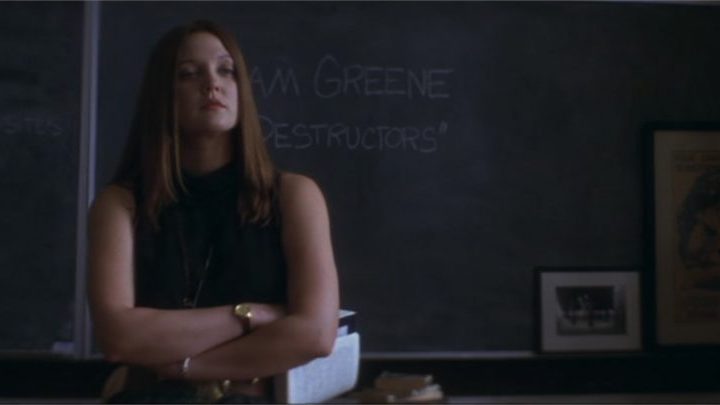
Miss Pomeroy, played by Drew Barrymore, is the English teacher in the cult film Donnie Darko, whose plot – involving time-travel, teenage rebellion and a giant demonic rabbit called Frank – has spawned endless theorizing in various corners of the internet. If you haven’t watched Donnie Darko, you really should. It has a cracking soundtrack – Tears for Fears, Echo and the Bunnymen, Joy Division – and lots of extremely quotable lines. If anyone ever tells you that sometimes they doubt your commitment to Sparkle Motion, you’ll know that they’re a Donnie Darko obsessive.

Drew Barrymore as Miss Pomeroy, looking sceptical. (Source: Creative Commons)

The film is set in the run-up to the 1988 US presidential election, and focuses on Donnie, a troubled teenager who believes that he knows when the world is going to end. The school he attends is middle-class and deeply conservative, but Miss Pomeroy is something of a rebel. She is young and cool and beautifully cutting. She is also extremely deadpan: no Dead Poet’s Society-style exhortations to seize the day, no impassioned speeches that set the world on fire. The text that she chooses for Donnie’s English class is Graham Greene’s short story ‘The Destructors’. It focuses on a group of boys – the Wormsley Common Gang – who, led by a mysterious newcomer called T., systematically destroy a beautiful old house by taking it apart from the inside out. They rip out the skirting-boards, prise up the parquet from the floors, saw through joists and scrape the mortar from between the bricks: they are organised and meticulous. Their actions could be interpreted as nihilistic, but Donnie explains that destruction can be seen as a form of creation, with its own strange beauty. ‘They just want to see what happens when they tear the world apart,’ offers Donnie. ‘They want to change things.’

So far, so straightforward. Except that Donnie’s school is suffering its own acts of destruction. An axe has been embedded in the head of a statue, daubed with the slogan ‘THEY MADE ME DO IT’. A water pipe has been vandalised, flooding the hallway. Another teacher, a fundamentalist Christian, blames Miss Pomeroy’s teaching of ‘The Destructors’ and denounces the story as ‘filth’ and ‘garbage’. The school’s principal calls Miss Pomeroy to his office to tell her that her methods are inappropriate. She argues her corner. She tells the principal that he doesn’t have a clue how to communicate with his students. Her words will ring true with just about every teacher who has ever railed against the restrictiveness of the curriculum and its failure to meet the needs of today’s teenagers: ‘We are losing them to apathy … to this prescribed nonsense. They are slipping away.’

Miss Pomeroy’s fight is all in vain. The forces of conservatism and narrow-minded orthodoxy prevail: she’s allowed to finish out the week, and that’s that. And Miss Pomeroy does what many a teacher has wanted to do. She steps outside the principal’s office, and, with all the breath in her lungs, shouts ‘FUUUUUCK!’

I’m imagining Miss Pomeroy coping with fronted adverbials, target grades and assessment objectives. I’m wondering what she’d say to Michael Gove about the utter travesty that is the current incarnation of GCSE. I’m not sure she’d have a ready supply of tissues and digestives, like Mrs Lintott, but I bet she’s got several decent bottles of gin at home, waiting for those days when she needs to rage against the machine. Because sometimes, we all want to tear the world apart and shout ‘FUUUUUCK!’ at the top of our voices at the stupidity of it all; and sometimes, we are all Miss Pomeroy.

Learning, and teaching

Horses and I go back a long way.

The Class of 77

Here’s a photo of the Class of 77 at the Civic Hall playgroup in Newton-le-Willows, Merseyside. A group of four-year olds, ready to move on and start school. See the little blonde girl on the rocking horse? That’s me. I am hanging onto that horse with silent, steely determination. If you think I’m going to let you have a turn, you can think again. Off you go to the Wendy house, and find something else to do.

I started riding real life equines, as opposed to rocking horses, when I was six, and rode intermittently for the next ten years. I started off at a proper riding school and then graduated to a local livery stable where I was allowed to ride the owner’s outgrown ponies. I was competent – I could canter and stick on over small fences – but I didn’t ride regularly enough to become good. I had a bad fall when I was thirteen, when the pony I was riding bolted and dumped me off into a barbed wire fence, and after that I was always a bit too nervous. At some point my visits to the stables grew less and less frequent, and eventually, at some point in my GCSE year, they stopped altogether.

Riding was always something that I wanted to go back to. I missed being around horses; missed the smell of hay and the clop of hooves. Living near lots of open countryside made me think of how lovely it would be to go for long hacks on summer evenings. But I could always find reasons to put off picking up the phone and booking a lesson. I didn’t have time. It was ruinously expensive (if you want a cheap hobby, don’t go anywhere near horses). I might fall off. It wasn’t until the year I turned forty that I finally got round to riding again, knowing that if I’d regret it if I didn’t.

That was nearly nine years ago, and in those nine years I’ve made a lot of progress. I have a stronger seat (which is massively important) and know how to ride more deeply and influence the way the horse moves. I have ridden some difficult horses. People whose opinion I respect have told me that I am relaxed on a horse and can ride tactfully. This is important, because horses, like your average Year Ten class, need to be approached with tact if you’re going to get the best out of them.

I will never be as good as I want to be, though. This is partly because I only ride once a week, but there are other things as well. One: I am not as brave as I need to be. I have to fight against the thought that at some point I might be ever so slightly out of control. If I fall off, I’ll go crunch, not bounce. This is an alarming prospect. Two: there are things I physically struggle to do, like the fresh hell that is trotting in a two-point position – basically, standing up in your stirrups while the horse trots along. It hurts. Want an agonizing cramp in your quads? Ten minutes of two-point trot will do it. There are ways in which I no longer bend and bits of me that just aren’t strong enough. And three: while I can recognise good riding and bad riding, someone else’s model of excellence isn’t enough on its own to help me improve. I can see what really good riders do on a horse, but I can’t imitate it. I’m not there, and I probably never will be.

Learning all of this has been really important to me, not just as a human but as a teacher. At school, learning came easily to me. Some subjects, like Maths, took a bit more effort, but I managed. I could look at a good example, work out what I needed to do, and incorporate it into my own work without too many problems. I never really had to struggle. Learning to ride has been different. There have been tears and frustrations, and times when I’ve thought about giving up. I’ve had to work my way through the low points and battle against my own pride. I’ve been taught by people whose standards have been unrealistically high and people who have pointed out what I’m doing wrong without ever telling me whether I’m getting anything right. I’ve also been lucky enough to be taught by a couple of lovely, lovely people who have been encouraging and kind, who have challenged me in just the right ways without making things feel insurmountable. As a result of this I’ve known how amazing it is when you’re told that yes, even though that thing seems really difficult, you can do it, and even if it you don’t do it perfectly, you should still give it a try. And so you do, and the sense of achievement gives you a fabulous crazy glow for the rest of the day.

As teachers, we’re used to being the people who know things, the people who can do things. Part of everyone’s CPD should involve learning something they don’t find easy, and reflecting on what it’s like to struggle and feel a bit rubbish, and on the difference that the right kind of teacher makes to all of this.

Teaching poetry: teaching from the microcosm

Poetry is scary. Lots of students find poetry hard, because it seems to demand a different kind of reading to other types of text. The very fact of being arranged differently on the page – with shorter lines, sometimes in groups, sometimes with rhyming words at the end – means that it clamours for a certain kind of attention. Consequently, poetry in the classroom is often surrounded by a haze of mysteriousness, a sense that it needs to be decoded using a certain set of operations performed in a certain order, the English equivalent of quadratic equations. Some people even advocate using acronyms to teach students how to analyse poetry, like SMILE (structure, meaning, imagery, language, effect) or FLIRT (form, language, imagery, rhyme, themes). But poetry is not mathematics, and you don’t have to apply some kind of literary BIDMAS in order to find something to say about a poem.

There are hundreds of ways of approaching poetry in the classroom, and these will vary from class to class, from teacher to teacher, and from poem to poem. English-teacher geek that I am, I enjoy the process of working out how to introduce a particular poem. Sometimes, I might use a word cloud to get students to explore patterns of vocabulary. Sometimes, I use an image or series of images (my first lesson on Carol Ann Duffy’s poem ‘War Photographer’, for instance, begins with images of photographs being developed in a darkroom, a process that students in our digital age often know very little about). Sometimes, I read the poem out loud, and then ask the students to read it out loud too, so they can focus on the sounds and their effects before they start to think about meaning. (Try this with William Blake’s ‘The Tyger’, and – if you’re feeling brave – get them to stamp out the rhythm.) And sometimes, I choose just one line, and focus on that. It’s an approach that I once heard described as ‘teaching from the microcosm’, and that seems as good a name as any.

Here’s an example. It’s the opening line of Wilfred Owen’s poem ‘Exposure’:

I put it on the board, and ask students to spend a few minutes jotting down their thoughts. Which words and phrases seem to be particularly important, and why? Do they notice anything about how the words sound? (I read the line aloud several times while they’re thinking.) Who might be speaking, and why? I’ll then ask students to share their ideas with a partner: this helps them to test out their initial thoughts and gives them some reassurance that they’re not going to say something completely off-track. Then I open the discussion to the whole class.

It’s often the kind of discussion that takes far longer than you’d expect, because there are lots of things that you can say about this line. The first thing that students often pick up on is the alliteration, all those ‘s’ sounds: two of them in ‘merciless,’ one in ‘iced’, one in ‘east’, one in ‘winds’ and one in ‘us’. Say the line out loud and it’s a bit of a tongue-twister. But it’s easy to pick out alliteration, I tell the students: you have to be able to explore the effect it creates. The clue is in the sharpness of the sibilant sounds, which mimic the relentlessness of the wind. (Some students think sibilants are always soft and gentle, but try that interpretation with this line and you’ll come unstuck.) Then there’s the personification of those winds. They’re ‘merciless’, they ‘knive us’. What kind of action does ‘knive’ suggest? The students talk about stealth and malevolence, a sense of intent. Who are they kniving? Is it one person, or a collective? It’s a collective: the pronouns are first-person plurals, ‘our’ and ‘us’. Everyone’s in the same situation. And it’s a miserable one. Look at those long vowel sounds in ‘brains’ and ‘ache’, drawn-out and weary. ‘A brain ache sounds worse than a headache’, a student commented once. ‘It’s deeper. It’s right in your core.’ And then there’s that ellipsis at the end, those three dots that trail off and leave us hanging. All that, from just twelve words.

Once you’ve discussed all this, the rest of the poem presents few challenges. It’s about the feelings of a group of men in a trench in the First World War, freezing cold, waiting for something to happen. It’s a miserable existence. It’s night-time, and the men struggle to stay awake. Bullets, when they come, are ‘less deadly than the air.’ There’s Owen’s characteristic use of half-rhyme, creating a feeling of unrest, and the lines all seem a little bit too long. Except, that is, for the refrain at the end of each stanza, and the repeated line: ‘But nothing happens.’

There are things you can say about the title, too. I get the students to find out what ‘exposure’ could potentials mean. There’s being exposed to the elements, of course, and the medical condition that can result from this. But there’s also ‘exposure’ as in revealing the truth, bringing to light something that might otherwise go unnoticed, and students might be able to make a link between this meaning of the word and Owen’s desire to challenge the view of war as noble and heroic.  

See? Lots of thoughtful, close reading; lots of scope for engagement. And not an acronym in sight.

Top reads on the teaching of poetry: Barbara Bleiman’s chapter on poetry in her brilliant book What Matters in English Teaching (English and Media Centre, 2019), Sue Dymoke’s chapter on poetry in Teaching English Texts 11-18 (Continuum, 2009) and Andrew McCallum’s Creativity and Learning in Secondary English (Routledge, 2012). If you want to get creative, Kate Clanchy’s How To Grow Your Own Poem (Picador, 2020) and, of course, England: Poems from a School (Picador, 2018) are fantastic. Sharon Creech’s Love That Dog (Bloomsbury, 2002) offers a different perspective on what poetry can do for students, and I really need to write a Teacher Feature on Miss Stretchberry at some point. You also need to read anything at all by Julie Blake, especially on the importance of reading poetry out loud and learning by heart.

Teacher Feature: Talking about Scree

There’s a lovely moment in the 2007 film Son of Rambow that will resonate with anyone who’s ever sat in a classroom, bored out of their mind. The film is set in the 1980s, and focuses on the relationship between two twelve-year old boys, one shy and well-behaved, the other the school tearaway. Early in the film, the shy boy sits in a Geography lesson at his new secondary school. For anyone who was at school at that time, it’s a beautifully evocative scene. There are dustmotes in the air, faded displays on the wall, a globe, a television set on a metal stand. There’s even one of those revolving chalkboards that you can balance a board rubber on top of and wait until it falls off onto the head of the next person to pull the board down. The children are drowsy. And the Geography teacher, shirtsleeved and bearded, remonstrates with them: ‘You’d do well to keep your wits about you when I talk about scree.’

Paul Ritter as the geography teacher in Son of Rambow, with his wits definitely about him. (Source: hotflick.net)

As teachers, we’ve all been there. Some lessons you’re on fire: others you’re trying to convey something that might well be essential but is nevertheless mind-numbingly dull. Sometimes you catch yourself saying something to your students that would have made you roll your eyes when you were a teenager, and think: hang on, when did I turn into that kind of teacher? Sometimes, you just have to cajole them through a topic that isn’t very interesting but just needs to be covered. I tell myself – and my students, when they whinge – that there is value in this. Not everything has an immediate appeal. Education isn’t about entertainment. Patient persistence is an important habit to acquire.

Ever since I saw Son of Rambow, I’ve thought of those moments as my talking-about-scree moments. And sometimes, I remind myself that even though we all want to be our own version of Michelle Pfeiffer in Dangerous Minds, or Robin Williams in Dead Poets’ Society, we all have lessons when we’re the Geography teacher in his dusty classroom, exhorting his pupils to keep their wits about them.

How many children had Lady Macbeth?

‘How many children had Lady Macbeth?’ That, of course, is the title of a lecture delivered by L.C. Knights in 1933. Knights was challenging the idea that Shakespeare’s characters can be treated as if they are real people, with lives that existed before the plays and go on afterwards. Because of this, he didn’t answer the question at all. For Knights, Shakespeare’s plays should be seen as dramatic poems: he had no time for what E.C. Pettet referred to as ‘the critical game of constructing a world outside the given material of the play’ (Shakespeare and the Romance Tradition, 1949). Nowadays, we are keen to remind students that Shakespeare’s plays were written for the stage, not the page. And thinking about the stage, of course, inevitably involves thinking about what is going on beyond the words themselves. We get students to consider set design, costume and sound effects: we show them examples of different stage and screen interpretations and make use of the insights offered by actors and directors. Often, these insights do exactly what Knights was opposed to, constructing backstories for characters and considering why they might act in the way they do. This week, Year 10 and I have been exploring different interpretations of Lady Macbeth; and I’m going to argue that rather than ‘how many children had Lady Macbeth?’, a far more interesting question is ‘how many children did Lady Macbeth lose?’

A declaration of interest, before I go any further. I write as a woman who is unable to have children, and literary and dramatic images of childlessness, child loss and alternative ways of building a family are of great interest to me. I’m writing a book that touches on the representation of adoptive families in popular culture, and I’ve got a future post brewing on the unfortunate Mrs Lyons, one of the lead female characters in Willy Russell’s curriculum stalwart Blood Brothers, who is desperate to have a child and therefore does what all infertile women do and arranges an illegal adoption. In recent lessons, my students and I have watched a number of interviews with actors who have focused on Lady Macbeth as a childless woman, and these have intrigued me. So let’s have a look.

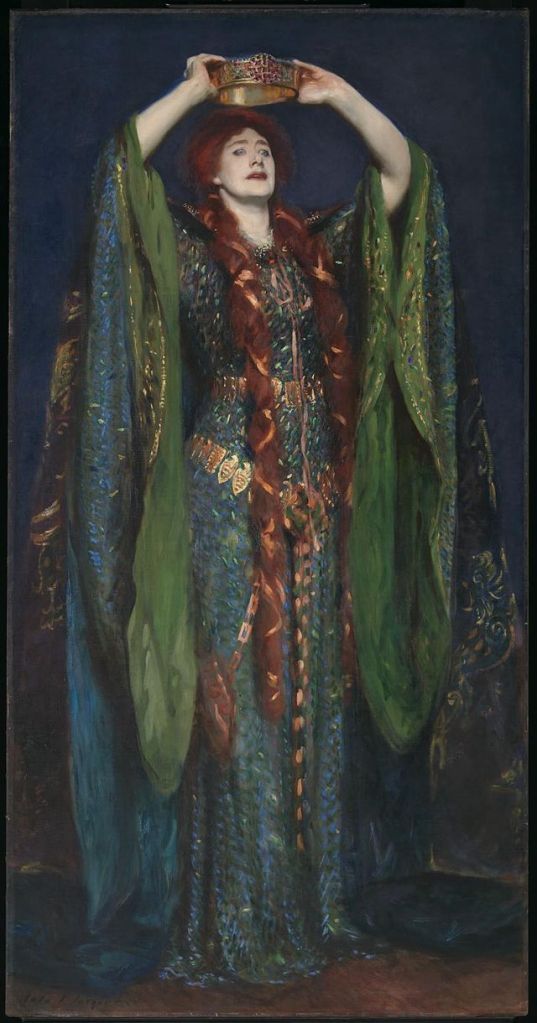
Possibly not that grief-stricken: Ellen Terry as Lady Macbeth, John Singer Sargent, 1889. (Source: Wikimedia Commons)

What do we know about Lady Macbeth and children? We know, of course, that she has ‘given suck’: she says so, in Act 1 Scene 7, where she manages to persuade Macbeth to kill Duncan. Macbeth is initially adamant that they will ‘proceed no further’ with their plan. He has weighed up the consequences for his immortal soul, and knows that he will be punished in Hell for all eternity. (Remember that doom mural I posted a couple of weeks ago? That’s what he’s scared of). Lady Macbeth throws everything she can into her attempt to change his mind. She calls him a coward. (‘She says he’s a pussy!’ said one of my Year 10s, delightedly, seizing on the reference to ‘the poor cat i’th’adage.’) She claims he doesn’t love her. She tells him he’s not a real man, even though he’s a warrior who was on the battlefield a couple of days ago, unseaming traitors with a sword that smokes ‘with bloody execution.’ And then she reminds him, horribly, of the fact that

I have given suck, and know
How tender ’tis to love the babe that milks me:
I would, while it was smiling in my face,
Have pluck’d my nipple from his boneless gums,
And dash’d the brains out, had I so sworn as you
Have done to this.

So at some point, Lady Macbeth has fed a baby. And, assuming that it’s unlikely that she would have been a wet-nurse, it seems that at some point, Lady Macbeth has had a baby. We know – because Macduff says so later, when he discovers that his wife and children have been murdered by Macbeth – that Macbeth himself has no children. So this baby is no longer alive. And even though Macbeth proclaims that his wife should ‘bring forth men-children only’, suggesting that she is still of childbearing age, there’s a hint that the Macbeths’ failure to produce a living heir is something that weighs on Macbeth’s mind. This comes in his soliloquy in Act 3 Scene 1, when he ponders the fact that it will be Banquo’s descendants who become kings, and not his own:

Upon my head they placed a fruitless crown
And put a barren sceptre in my gripe.

‘Fruitless’, ‘barren’: the implications are quite clear. And once we start to join the dots, we can invent a whole backstory for the Macbeths that rests on their absence of a family.

The actor Louise Lombard, in a series of short videos made for the BBC in 2012, critiques interpretations that depict Lady Macbeth as some kind of ‘pantomime witch’ – like the BBC’s own 1970 production for its Play of the Month series, starring Eric Porter and Janet Suzman. La series of short videos on Macbeth made for the BBC in 2012. The actor Louise Lombard talks us through interpretations that depict Lady Macbeth as some kind of ‘pantomime witch’, like the BBC’s own 1970 production for its Play of the Month series, starring Eric Porter and Janet Suzman. Lombard argues that it’s more interesting to try to understand Lady Macbeth, rather than to condemn her. In Lombard’s version, Lady Macbeth sees herself as the victim of some kind of cosmic injustice: in a society where the main role of a woman was to produce children, she has been unable to give her husband any living descendants.

It’s a fascinating idea, and one that my students enjoyed exploring. In Lombard’s version, Lady Macbeth sees herself as the victim of some kind of cosmic injustice. In a society where the main role of a woman was to produce children, she has been unable to give her husband any living descendants. (And let’s not forget that Shakespeare’s audience, in the early seventeenth century, would have been finely attuned to the issues of inheritance, of bringing forth men-children in order to secure the line of succession.) Are Lady Macbeth’s actions fuelled by a desire to right these cosmic wrongs?

Similar interpretations of the Macbeths and their marriage have cropped up in a number of productions. Julia Ford’s depiction of Lady Macbeth in the 2011 production for the Liverpool Everyman was described by Alfred Hickling in the Guardian as expressing ‘a despairing hope that an empty throne might compensate for a barren womb.’ The 2015 film version, starring Michael Fassbender and Marion Cotillard, begins with the funeral of the Macbeths’ child, and sees Lady Macbeth talking to the ghost of her dead child during the sleepwalking scene. In such interpretations, the Macbeths become less a butcher and his fiend-like queen, and more a couple whose reactions to the world have been distorted by grief.

The idea of a Lady Macbeth consumed by her childlessness puts an interesting spin on her reference to the one character in the play who is actually a mother: Lady Macduff. ‘The Thane of Fife had a wife; where is she now?’ I’m imagining a Lady Macbeth twisted by her inability to give Macbeth a living son; a totally unhistorically-accurate and un-Shakespearean Lady Macbeth who has spent a lot of time at family gatherings surrounded by women who have done what they’re supposed to and produced brood after brood of pretty chickens. She’s there, sitting on the sidelines, consumed by failure. I can sympathise with this Lady Macbeth, because I’ve been there. I’ve never asked for evil spirits to fill me with direst cruelty or urged my husband to commit regicide, but I know that sense of wanting to rage at the universe because of what you’ve been unable to do. Her sleepwalking words carry the dark spite of someone who feels vindicated: you thought you had it all, down there in Fife with your perfect family, and look where it got you.

When I teach plays, I’m always keen to get students to imagine what’s happening on stage: not just where people stand and how particular lines will be spoken, but what might be happening in the gaps and silences. This is particularly important with Shakespeare, whose stage directions are so minimal. A brilliant example of this is in King Lear: what’s going on with all those riotous knights, and why does Goneril get so angry about them? In the RSC’s 2016 production, it’s made abundantly clear. They stomp around everywhere, have food fights, overturn furniture, make rude gestures with bread rolls, and try to grope the serving-maids. I’d be a bit cross if that was going on, especially once the Fool got up on the table and started arsing around with a ukulele. So can we imagine what Lady Macbeth might be doing, how she might be spending her time while she’s waiting for Macbeth to return from battle? Is she sitting beside her dead child’s cradle, struggling with her grief? Is this a recent loss, or an old one that she is still mourning? Why is she so isolated? What might she be looking at?

None of this, of course, is necessarily what Shakespeare intended, and it certainly wouldn’t please L.C. Knights. But it’s part of the whole process of playing with ideas and pushing interpretations to see how far they’ll go, and that’s one of the things that makes teaching English so interesting.